
India’s business ecosystem has changed at a crazing pace over the last decade. This rapid growth has opened up huge opportunities for entrepreneurs, both in retail and wholesale sectors. From small family-owned kirana stores and fashion boutiques to big wholesale distribution networks and online marketplaces, businesses today have loads of options on how to set up shop, depending on their investment, target audience and growth ambitions. But one question still keeps plaguing aspiring entrepreneurs: which model makes the most money and will last the long haul?
Understanding the retail vs. wholesale business debate is key because both models operate in different ways when it comes to customer handling, pricing strategy, inventory management and scalability. While retail businesses are all about serving the end consumer straight up, wholesale businesses usually supply products in bulk to retailers or institutions. Each approach has its own profit structure, operational headaches and market opportunities.
Retail vs Wholesale Business Difference
The most important thing about understanding the retail vs wholesale business difference is figuring out the customer base and sales approach. Retail businesses operate as B2C (Business to Consumer) vs B2B (Business to Business) business structures where products are sold direct to end-users in smaller quantities. Wholesale businesses on the other hand, sell products in bulk to retailers, distributors, institutions or resellers.
In a retail setup, customer interaction plays a big part. Retailers focus a lot on building their brand, customer service, visual merchandising and product presentation. Profit margins are usually higher per product because items are sold individually at market retail prices. However, retailers often have to deal with high operating costs such as rent, staff salaries, marketing expenses and customer acquisition costs.
Wholesale businesses work differently though. Their profits depend more on volume rather than individual product margins. A wholesaler usually buys products direct from manufacturers at lower rates and then supplies them in large quantities. Because transactions are bulk-based, operational costs per unit are often lower. This creates opportunities for faster scaling if the business can develop strong distribution networks.
Understanding B2C (Business to Consumer) vs B2B (Business to Business) Business Models
The B2C (Business to Consumer) vs B2B (Business to Business) business structure makes a huge difference to profitability and business operations. Retail businesses usually operate under the B2C model, where sellers target individual consumers through physical stores, online platforms or social commerce channels.
In B2C operations, emotional buying behaviour, customer loyalty, branding and convenience become super important. Retail businesses often invest a lot in promotions, advertising campaigns, social media presence and customer retention strategies. Although customer acquisition costs are higher in retail, businesses can charge premium prices for the convenience and experience.
Profit Margin Retail vs Wholesale
One thing that entrepreneurs always look at is the profit margin when compared between retail and wholesale. Retail businesses usually get better margins on individual products because they’re selling directly to consumers at marked-up prices. For example, a clothing retailer might make a margin of 30% to 60% depending on the brand and product line.
But retail profitability can go up and down like a yo-yo depending on what the consumers are going for, how much competition there is, any discounts, and seasonal demand. And you have to pay for all those fancy marketing ads and operational costs which can really take a chunk out of your net earnings.
It all comes down to profitability, and it’s not just about the margin percentages. Turnover speed, operational efficiency and market reach all play a big role too.
Wholesale Pricing vs Retail Pricing in the Indian Market
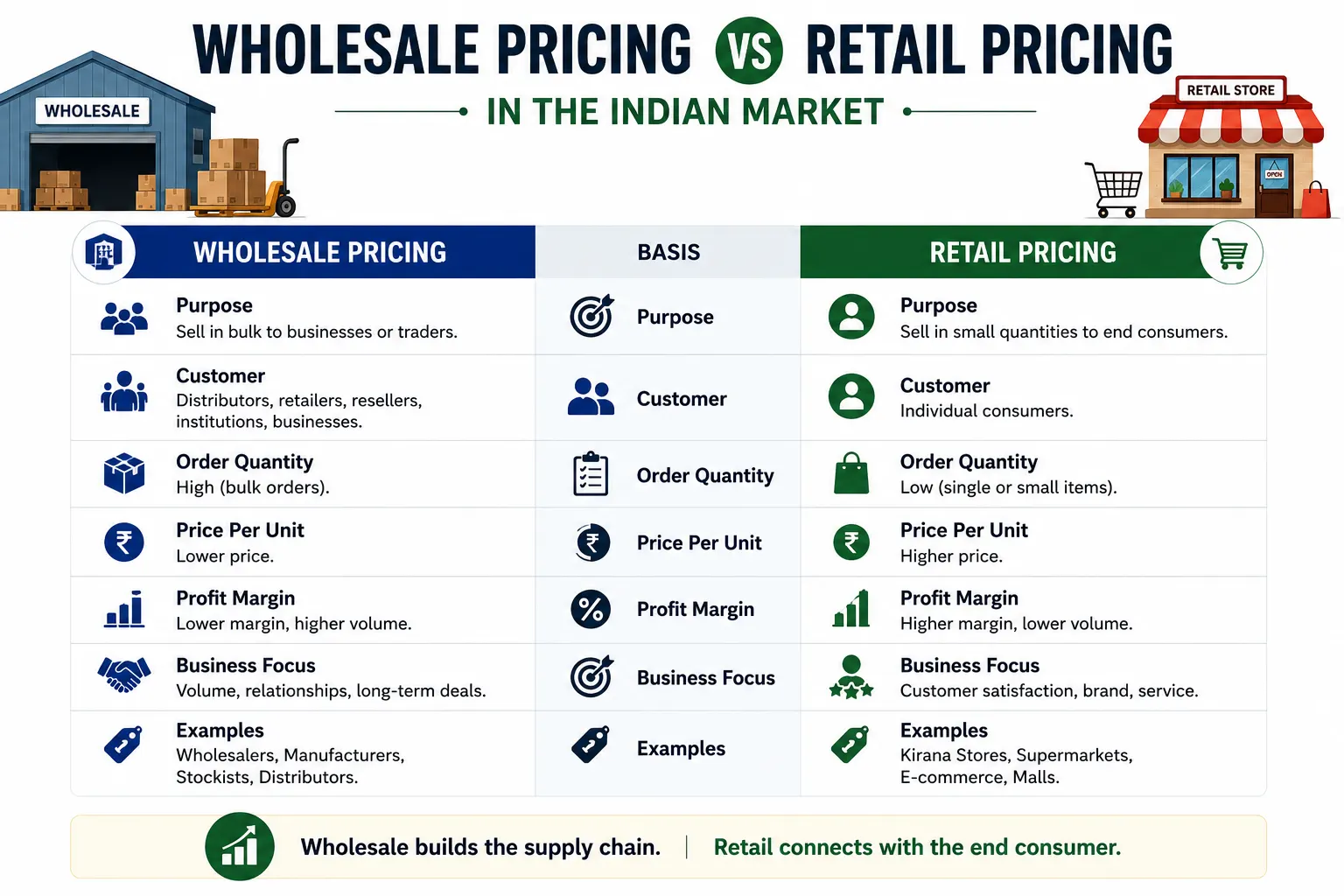
The wholesale pricing vs retail pricing mechanism is what’s going to help businesses decide where they fit in the market. Retail pricing is influenced by brand value, customer perception, packaging quality, how convenient it is and local competition. Retailers often adjust their prices based on how much demand is going up and down and how their customers are buying.
Wholesale pricing however is pretty much dependent on how much it costs to procure, transport, and negotiate suppliers and order in bulk. Since wholesalers focus on selling in big volumes, being able to keep their pricing competitive is a key to survival.
Scalability Retail vs Wholesale
When it comes to scalability, wholesale businesses have an advantage because they rely on big distribution networks and bulk orders. Once a wholesaler has built up relationships with retailers and suppliers, it gets a lot easier to expand by getting into new geographic areas and more product categories.
Retail businesses in India are able to scale but this typically means ploughing a lot of time and money into getting the branding right, creating the best customer experience, and then setting up multiple store locations. Things have helped out a bit with the rise of franchising and e-commerce – especially for fashion, food, beauty and lifestyle brands.
It’s often the logistics efficiency, warehousing capacity and good procurement management that lets wholesale businesses scale – serving multiple regions with relatively lower marketing costs as a result.
Inventory Requirements Retail vs Wholesale
When it comes to inventory retail and wholesale businesses are pretty different beasts because of the sales volume and operational structure. Retail businesses tend to have smaller quantities of a whole lot of different products – all designed to appeal to different consumer tastes. Product variety is really key in retail as customers expect to have plenty of options.
Retailers often struggle with unsold stock, changing trends and seasonal fluctuations in demand – all of which can result in dead stock and wasted profit. Poor inventory planning can literally kill a business.
Wholesale businesses, on the hand tend to stock up big time on just a few product categories – all about moving a lot of stock and keeping the supply chain ticking over. They need to have stock on hand to meet large orders, and getting it right is really important.
Customer Acquisition Retail vs Wholesale
The way we think about customer acquisition in retail vs wholesale is really different. Retail businesses often spend a lot on social media, digital marketing and off line branding – all in the hope of getting thousands of customers on board.
In retail it’s all about individual consumers and as a result competition is pretty intense. To build trust and keep customers coming back retailers need to deliver great customer service and communicate well.
Wholesale businesses on the other hand focus more on building relationships with suppliers and partners. They need to keep a handful of high value customers happy rather than trying to get thousands buying from them.
The way customer acquisition is done in India is changing for the better with the rise of digital commerce – with online marketplaces, whatsapp business catalogues, and B2B platforms making it easier than ever for businesses to get new customers.
Retailers tend to benefit from emotional branding and repeat purchases while wholesalers score from the reliability of consistent orders.
Advantages of Wholesale Business in India
There are loads of good reasons why wholesale is such a great option for entrepreneurs who want to scale and see stable cash flow. One major plus is the ability to make a lot of money from large bulk orders.
Another advantage of a wholesale business is that they’re a lot less dependent on big marketing efforts. Wholesale businesses tend to rely more on building strong relationships with suppliers and having a steady stream of business from long-term clients rather than constantly trying to get new customers through advertising.
The perks of a wholesale business also include lower customer service costs, fewer headaches with transactions, and better deals on goods straight from the manufacturer. Established wholesalers have a lot of pull because of their buying power and can get some pretty good terms from suppliers.
India’s rapidly-growing manufacturing sector and its increasing retail penetration create some really tantalising opportunities for wholesalers in a variety of industries such as FMCG, pharmaceuticals, building materials, clothes and electronics.
Also, wholesalers often find demand is way more predictable because big retailers and institutions are always in need of continuous stock replenishment.
Retail Business Challenges in India
Even though there’s lots of opportunity in the retail business, there are a few challenges India entrepreneurs should be aware of before taking the plunge. One major hurdle is the intense competition you face from big retail chains and e-commerce platforms.
Consumers have also got pretty high expectations – they want good prices, fast delivery, awesome service and a shopping experience that’s tailored to them. Meeting those expectations requires a pretty big investment in tech and staying in touch with customers.
Another major challenge India retailers face is just how expensive it is to run a store. Rent, staff, utility bills, keeping track of your stock and promotional expenses all add up and can really cut into your profit margin.
Changing consumer trends also make it hard to predict what’s going to do well – the thing that’s flying off the shelves today might be old news a few months from now. Retailers therefore need to be constantly on the lookout for what’s next and be willing to adapt.
The rise of brands that sell directly to customers over the web has also made competition even fiercer. Manufacturers are now selling online direct to the public, taking away from traditional retailers.
Business Model Comparison India: Which Is More Profitable?
Doing a business model comparison in India really means taking into account a few key things: how much money you can invest, how much risk you’re prepared to take on, what sort of industry you’re in and what you want to get out of the whole thing. Retail businesses generally offer a higher profit margin on each product sold and much better opportunities to build a strong brand. They’re ideal for entrepreneurs who are into interacting with customers, building a brand and operations focused on the end consumer.
On the other hand, wholesale businesses often provide a more stable business that can scale, less complexity day to day and a steady income from selling in bulk. Entrepreneurs with strong networking skills, a good understanding of logistics and supply chain management may find a wholesale business more profitable.
Conclusion
The retail vs wholesale business debate just can’t be answered with a one-size-fits-all solution – profitability depends on so many different factors in both your business and the market it’s in. Retail businesses offer higher margins, stronger customer relationships and brand building opportunities, but they can also be super competitive and expensive to operate.
With India’s economy getting bigger, more and more people jumping on the digital bandwagon and a consumer market that just keeps on growing – the opportunities for long term growth and profit in both retail and wholesale businesses are certainly looking very promising.
FAQs
When it comes to retail vs wholesale, the profit margins are usually way higher for retail businesses – but wholesale businesses can generate a tidy profit by selling in bulk to other retailers or business buyers. So which one is best for you – well that all depends on the type of business you’re in, how well you can run your operation, and what the market is looking like.
At the end of the day it all comes down to who you’re selling to. Retail businesses sell directly to consumers – whereas wholesale businesses sell in bulk to other businesses or big buyers.
Retail businesses usually need a bit more cash to set up a store, build a brand and get customers in the door. Wholesale businesses on the other hand need to invest in a big inventory and a warehouse.
For Indian retail businesses, some of the main challenges they’re facing are the intense competition they’re up against, rising costs of doing business, changing consumer habits and the pressure from online shopping.