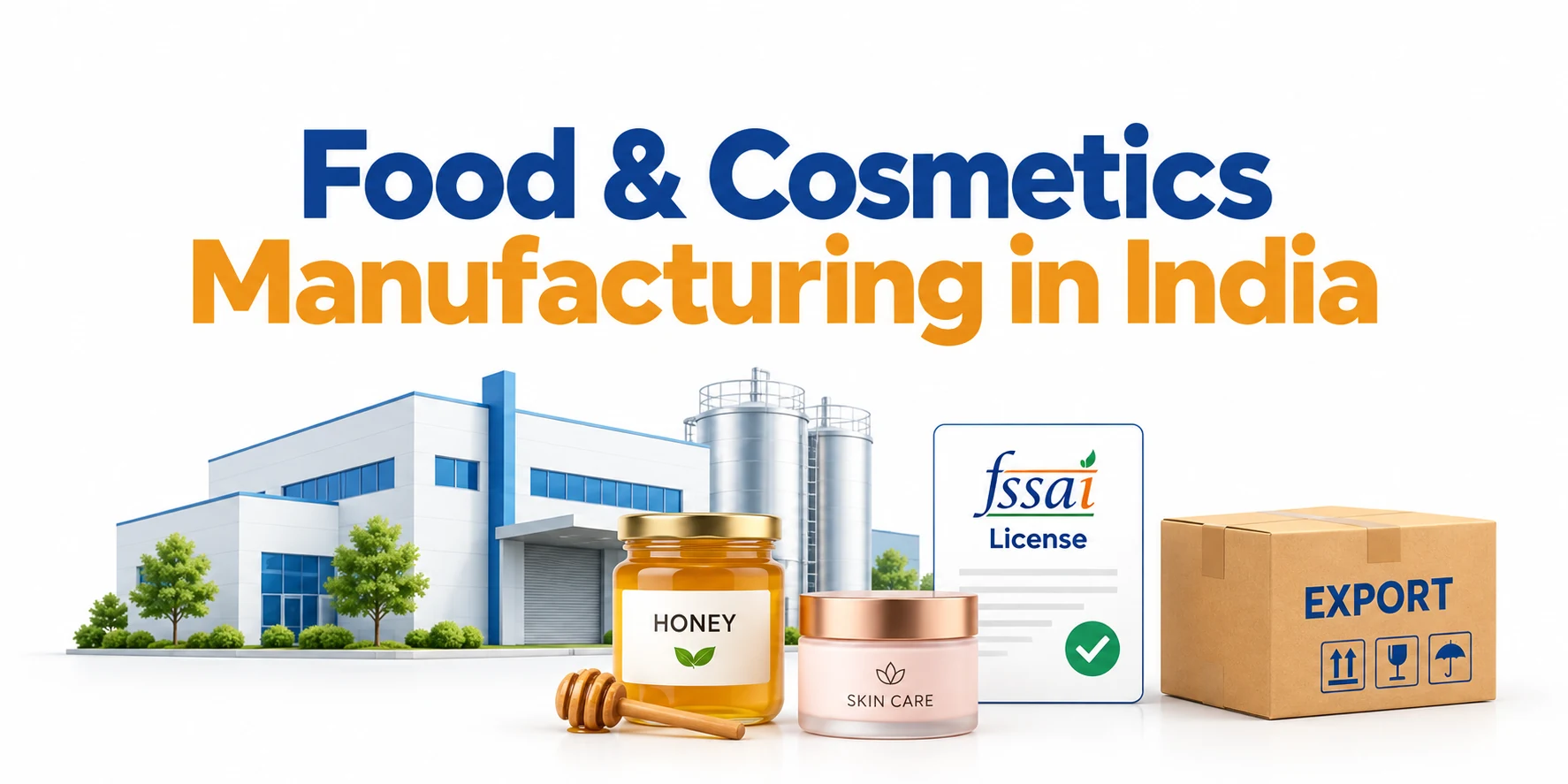

Opening a food business in India entails more than the proper selection of products, setting up a kitchen or manufacturing facility, and looking for customers. Every food business will have to be compliant with legal and safety regulations that aim to safeguard consumers. The most important legal requirement is obtaining the FSSAI license, depending on the kind of business.
In this guide, we will cover what an FSSAI license is, who should get it, the different types of licenses, how to determine your eligibility, the required documents and fees, the validity period, and, finally, how to apply online.
What Is an FSSAI License and Why Is It Required?
An FSSAI license is a government authorization under the food safety regime of India for eligible Food Business Operators in activities relating to the manufacture, processing, storage, distribution, transportation, and sale of food products.
FSSAI, or the Food Safety and Standards Authority of India, is an authority that was established under the Food Safety and Standards Act of 2006. Its functions include setting standards for food safety and regulating food businesses in India.
An FSSAI license assists in proving that a food business operates within food safety standards. An FSSAI license will also increase customer satisfaction and assist business expansion. The necessity for an FSSAI license may be required for the compliance of market places, distributors, and other commercial entities.
The requirement for an FSSAI license or registration depends on various factors, including turnover, activity, production capacity, and location.
Who Needs FSSAI Registration or a License?
Any eligible food business operator that deals with food in the food chain needs to be registered or have an FSSAI license.
Some of the common businesses which need FSSAI license or registration include:
Small food businesses can apply for basic registration whereas bigger businesses can opt for State or Central License.
Types of FSSAI License in India
Food safety registration and licensing can be broadly categorized into three types. These are Basic Registration, State License, and Central License. The category depends on the size, turnover, and nature of the business.
1. Basic FSSAI Registration
Basic registration is usually meant for small and petty food businesses having an annual turnover of up to ₹12 lakhs.
It can suit to:
2. State FSSAI License
State license is usually issued for medium-sized food businesses operating in a state and meeting the specified turnover and activity criteria.
Examples of the businesses may include:
The specific requirements for eligibility may differ depending upon the food activities and the production capacity of the business.
3. Central FSSAI License
Central license is required by larger food businesses and some other businesses irrespective of their turnover.
These typically include:
Firms need to verify their activity and eligibility instead of choosing a license based on the turnover only.
FSSAI License Types at a Glance
Eligibility Criteria for FSSAI Registration
Eligibility depends on the nature and extent of food business. Turnover is one of the important criteria but not the sole one.
One needs to consider:
For instance, a small food seller may be eligible for Basic Registration, while a big food manufacturing company will need Central license.
Documents Required for FSSAI Registration
The documents will vary depending on the kind of business and license one wishes to obtain. Provision of proper documents helps in avoiding any delays in process.
General Documents
One may have to provide some of the following documents:
Some additional documents might also be necessary depending on the purpose for which the certificate is being issued. In case of food manufacturers, some manufacturing-related documents might be necessary.
Importers and exporters will also need to have the Import Export Code and some other necessary documents.
FSSAI License Fees in India
Government fees are decided depending on the type of license and registration required. It is necessary to cross-check with the fee structure before applying.
Some brief points include:
The cost may vary depending on certain activities like manufacturing, storage, transportation and other food operations. Charges for consultancy services, if any, are different from the fees charged by the government.
What Is the Validity of an FSSAI License?
Licensing or registration can be sought by businesses for a period of one year to five years, depending on applicable rules.
Businesses need to keep track of the validity period and apply for renewal within that period. Failure to do so may lead to extra fees or other consequences.
Having a valid license is a crucial aspect of food safety compliance.
How to Apply for an FSSAI License Online?
Applications can be made using the FoSCoS portal. Applicants need to figure out what category of registration or licensing is required by their business.
Food Safety Compliance after Registration
Although obtaining registration is important, it does not fulfill the food business’ obligations regarding compliance. Food businesses need to comply with various hygiene, labelling, storage, manufacturing and food handling requirements.
Key compliance considerations are:
For food manufacturers, the need for proper manufacturing processes and documentation becomes all the more relevant, since there might be more stringent inspections and regulations.
Benefits of Food Business Registration
There are many practical benefits associated with proper food business registration, aside from the legal requirement itself.
What Happens If a Business Operates Without the Required Registration?
Consequences for operating a food business without the appropriate approval can range from regulatory measures depending on the type and level of violation, which include financial penalties, suspension or revocation of the license, operational limitations, and other measures that are in accordance with the relevant laws.
Thus, businesses should first determine the licensing requirements prior to engaging in food business activities in order to avoid regulatory action during an inspection or even complaints.
Common Mistakes to Avoid During FSSAI Registration
Some mistakes could cause unnecessary delays or complications to the entire process due to inaccurate information, including the following:
All information must be reviewed and double checked before applying for a license.
FSSAI Registration vs. FSSAI License: What’s the Difference?
The correct type of approval will depend on the type of activities conducted by the business and the eligibility criteria that apply.
How to Check FSSAI Registration or License Status?
Individuals can follow the application status via the FoSCoS portal through the use of the application or the required reference details.
The process involved includes:
After the process, individuals should keep all relevant registration and license details.
Conclusion
A license from the FSSAI is a basic requirement for eligible food businesses in India. Whether it is small-scale home food sellers, restaurants, processors, manufacturing firms, importers, or exporters, such businesses are supposed to find out the exact category depending on the nature of their activities and turnover.
Having knowledge about the various types, eligibility requirements, documentation, fees, and procedures involved in the process will facilitate food safety registration for businesses. However, getting approval is not the end but rather a beginning.
FAQs
Yes. Small food businesses, including eligible home-based food businesses, generally require a Basic Registration, provided that they fall within the relevant petty food business criteria and turnover limit.
The validity of your license depends on what you apply for, but it will generally be valid for one to five years. You need to check the validity period you choose while applying.
A manufacturer usually needs an FSSAI registration or license, depending on various aspects such as their turnover, production capacity, manufacturing activities, etc. A Central license may be required in some cases.
A Basic FSSAI Registration is mainly done by small or petty food business units. State and Central licenses are needed for those business units that exceed the basic FSSAI Registration level or fall into any particular licensing category.