
Starting up a business in India right now is a goldmine of opportunities, but for many entrepreneurs the first hurdle they have to clear is deciding between manufacturing, trading, and exporting. Each of these business models comes with its own set of demands in terms of investment, risks, profit margins and potential for growth – so before you plough in any time or money, it’s worth taking the time to understand how they all stack up against each other.
The debate about manufacturing vs trading vs exporting has been live up lately as India is experiencing rapid growth in domestic consumption, global exports and in the number of small business owners – the so called MSME sector. Some people prefer to go down the manufacturing route because it gives them more control over their products and branding, while others go for trading because it offers faster returns for lower investment. And then of course there are the export businesses which are attracting a lot of attention due to the strong demand from overseas and the prospect of earning foreign currency.
Understanding the Difference Between a Manufacturing, Trading and Exporting Business
The debate about manufacturing vs trading vs exporting all starts with getting a handle on how each of them works.
Manufacturing businesses produce goods from scratch using raw materials, machinery, people and production facilities. Think textile manufacturers, food processors, car part makers, furniture makers and electronics manufacturers – all of which are good examples of manufacturing businesses.
Trading businesses on the other hand buy finished products from other manufacturers or wholesalers and then sell them on to retailers, distributors or end customers. The main focus of a trader is on getting the product to the right customer at the right price.
Export businesses sell products or services to customers overseas. And here there are two main options – you can manufacture the products yourself or you can source them from suppliers and then sell them abroad.
Manufacturing vs Trading vs Exporting: What are the Key Differences Between these Business Models
When you compare manufacturing vs trading vs exporting the biggest difference you find is in how much value each of them creates.
Manufacturers create value by transforming raw materials into finished products – this allows them to build up a brand, improve the quality of their products and have long term relationships with customers.
Traders on the other hand mainly just focus on buying and selling – they are at the mercy of where their suppliers are buying at and the efficiency of their distribution networks.
Export businesses meanwhile leverage the demand for their products in international markets and the price advantage that comes with selling in these markets. Many Indian exporters are able to sell their products abroad at a premium because of the lower production costs they have here in India.
Manufacturing vs Trading: Which One Offers the Better Returns
The comparison of manufacturing vs trading when it comes to profit margins is one of the most important things for entrepreneurs to consider.
Manufacturing businesses tend to offer higher profit margins because the manufacturer controls what it costs to make the product, how it is branded and packaged and what it is sold for. And once a manufacturer gets to the point where they are making use of economies of scale, they can really drive up profitability.
Traders on the other hand tend to operate on slimmer margins because they are at the mercy of the price difference between what they pay to buy the product and what they can sell it for. And because so many people are involved in trading, competition between them is high which limits their ability to put up their prices.
The overall manufacturing cost vs export margin equation starts to look a lot more favourable when Indian businesses can produce goods efficiently and get in on premium global markets.
Capital Requirement Comparison of Business Models
One major factor for entrepreneurs to consider is the capital requirement comparison – which business model fits your wallet.
Manufacturing businesses need money for some serious kit, a factory to set up, labour to hire, licenses to sort out, utilities to pay for, and raw materials to buy. Depending on the industry, start-up costs can be anywhere from a few hundred thousand to several million rupees.
Trading businesses are a lot easier on the wallet – entrepreneurs only need to find some working capital to buy inventory, stash it in a warehouse, get it moved around and marketed.
Export businesses are somewhere in between – it depends whether the exporter is actually manufacturing the goods or buying them from suppliers. And on top of that, there’s the added cost of export licenses, shipping, packaging, certifications, and international marketing.
Manufacturing vs Trading vs Export: The Risks and Challenges
Every business model comes with its own risks and headaches.
Manufacturing businesses are plagued by machine breakdowns, raw material price hikes, problems with labour, production delays, and having to comply with all sorts of regulations. Operational inefficiencies can really do a number on your profits.
Trading businesses are vulnerable to relying on a single supplier, intense competition for sales, market prices going up and down like a yo-yo, and razor-thin margins. And because traders don’t control production, they can struggle with getting consistent product quality.
Export businesses have to deal with currency fluctuations, customs regulations, international competition, and general uncertainty around the world – but successful exporters often use that to their advantage by spreading their risk across multiple global markets.
The business models comparison India seems to show that manufacturing is way riskier, trading is all about survival of the fittest, and exporting is all about navigating a minefield of regulations.
Export Business Profitability in India: Why Exports Are Taking Off
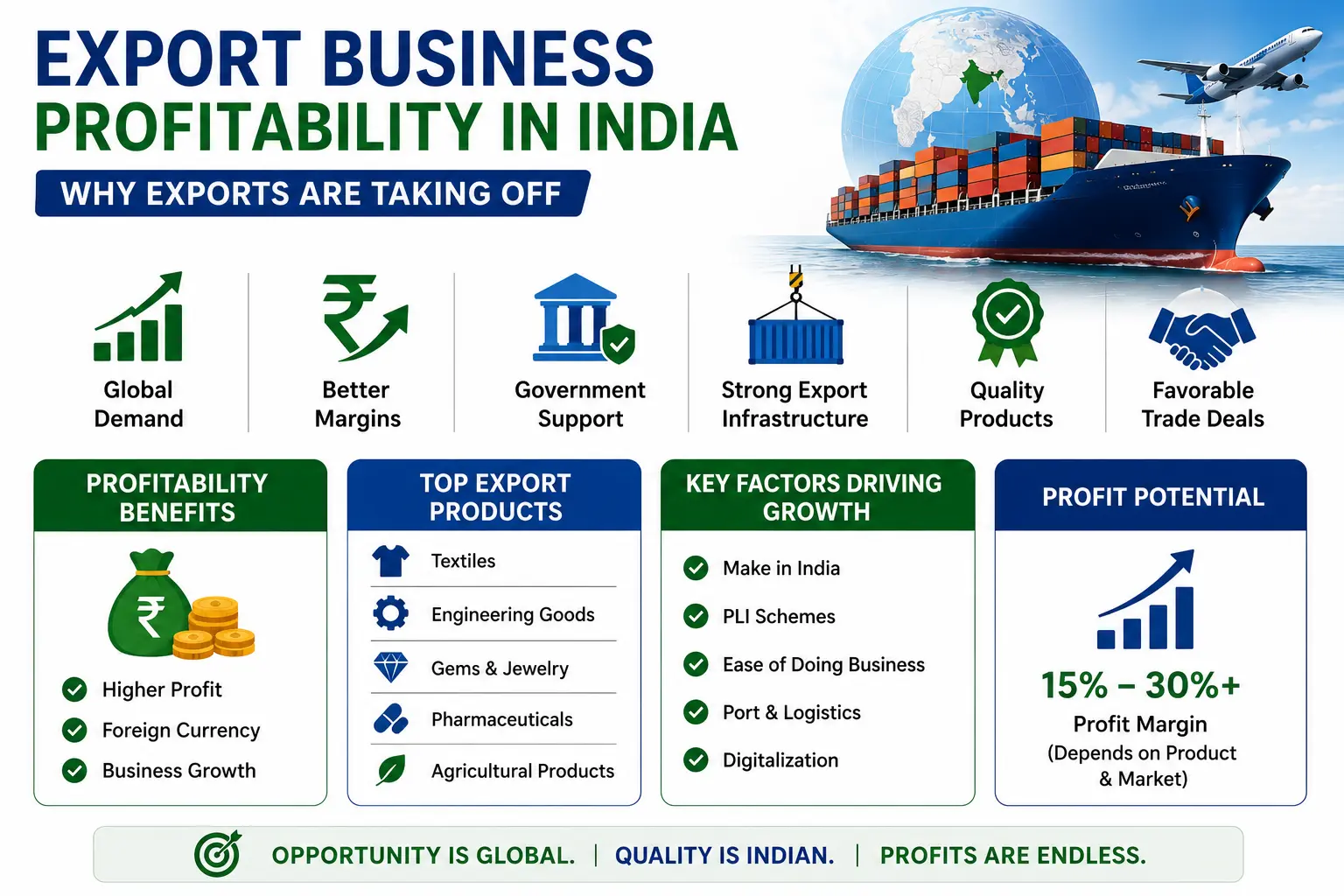
The rise in export business profitability India is being driven by government support, global demand, and the rise of digital trade.
Indian exporters are getting a lot of goodies from schemes like RoDTEP, EPCG, export incentives, and an improved logistics infrastructure. Sectors like pharmaceuticals, engineering goods, agriculture, textiles, and electronics are flying high on international demand.
The growing export vs domestic business profits debate clearly shows that export-oriented businesses can bring in some serious long-term returns if you can manage them properly.
Trading Business: The Pros and Cons
Understanding the trading business pros and cons is super important for first-time entrepreneurs.
Trading businesses are easy to get into because they require minimal infrastructure and technical know-how. You can jump into the market, test some products, and scale up your distribution network.
And they offer flexibility too – you can switch products or suppliers depending on how the market is moving.
Unfortunately, the competition is just as fierce – lots of traders are selling the same stuff, which makes it tough to make a decent profit. And another major headache is having to rely on suppliers.
ROI in Manufacturing vs Trading
When it comes to comparing ROI in manufacturing vs trading, the numbers really depend on your business scale, just how efficient you are and how far ahead you’re looking in terms of time.
Trading businesses usually provide their owners with a fast return on investment because your start-up costs are a lot lower and the inventory is moving fast – so you can get your money back a lot quicker if your sales channels are really strong.
Manufacturing businesses, on the other hand, tend to take a lot longer to get to a point where they’re profitable because of all the costs involved in setting up and running the business. However, if you can get your production up to speed and really scale your operation, manufacturers can reap way better long-term returns.
Export businesses, if done right, can also give you an excellent return on investment – provided you establish a strong network of international buyers and can maintain a high product quality standard.
Scalability of Export Business Compared to Manufacturing and Trading
For a lot of entrepreneurs, one of the biggest reasons for entering global markets is because of the scalability of export business.
Export businesses are not limited to just one city or one country – if you’re a successful exporter, you can expand into multiple international markets and really boost your revenue without relying solely on local demand.
Manufacturing businesses are also scalable – especially if you’re using a lot of automation and you’ve got your production efficiency really dialled in. Large manufacturers can expand not just domestically, but internationally through distribution partnerships.
Manufacturing Cost vs Export Margin: Which Creates Better Long-Term Wealth?
The relationship between manufacturing cost vs export margin plays a really big role in wealth creation.
Indian manufacturers, for example, often benefit from lower labour costs and raw material availability compared to businesses in Western countries. And when these products are exported internationally, businesses can earn significantly better margins.
It’s this combination of cost efficiency and international pricing power that allows a lot of exporters to build highly profitable businesses over time. However, in order to sustain long-term export profitability, businesses have to keep on top of quality standards, delivery times and international compliance.
Business Models Comparison India: Which Is Best for Beginners
When it comes to business models comparison India, the choice entrepreneurs make usually depends on their budget, experience and how much risk they’re willing to take on.
Trading is good for beginners who’ve got limited investment and are looking for a quick way into the market. It helps you understand customer behaviour, sales channels and supplier networks.
Manufacturing is more suitable for entrepreneurs who are willing to invest the long haul and build a strong brand. It offers better control and higher margins – but requires operational expertise.
Export businesses, on the other hand, are ideal for entrepreneurs who are comfortable with international communication, logistics and compliance processes. Exporting can become extremely profitable once you’ve established some stable buyer relationships.
For many Indian entrepreneurs out there, a hybrid approach is often the best way to go. They typically start by trading, then move on to manufacturing, and later start exporting products to other countries.
Manufacturing vs Trading vs Export: Which Business Is Ultimately Going to Bring in the Most Money
The bottom line to Manufacturing vs trading vs Export is going to depend on what you as an entrepreneur want to achieve, how much cash you have to put in, and what your long-term plans are.
Manufacturing is usually the way to go for long-term profits because you’re in control of production, branding, and pricing. But let’s be real, it takes a whole lot of patience, some serious operational know-how, and a huge upfront investment.
Trading, on the other hand, gets you into the game fast and with relatively low risk, but the margins are generally much thinner.
Exporting can be a real money-maker because of those international price advantages, foreign currency earnings and access to a much bigger market.
For entrepreneurs who are in it for the long haul and want to create some real wealth for themselves, combining manufacturing with exports is often the most profitable game plan. Businesses that can churn out quality products and then sell them all over the world can end up with higher margins, a strong brand, and a ton of long-term growth potential.
FAQs
Generally, yes – manufacturing is more profitable in the long term because you’re in control of production, branding and pricing. Trading businesses just don’t have the profit margins, but they also don’t need to put up as much cash to get started.
Trading – that’s the one that requires the least amount of cash upfront compared to manufacturing and exporting.
Manufacturing and exporting combined is usually the way to go if you want to scale up and create some real wealth – it gives you the best of both worlds: control of production, and access to the world market.
Absolutely, lots of traders do – they just start by buying products locally and selling them abroad.
Because of the government incentives, the demand for Indian products is high around the world, and you can make a lot more profit selling abroad.