
International courier services have enabled Indian companies to reach out to their customers, distributors, and business partners abroad easily. Nonetheless, sending a package through a courier service is not all that is involved in an export operation. There are other criteria that need to be met in order to ship your package to another country.
Incorrect description of the products, failure to provide invoices, wrong values or HS codes, among others, might lead to inquiries by the customs authority, delays in the shipping process, extra charges, or return of the shipment.
What Are Export Documents for International Courier Shipments?
Export documents for international courier shipments refer to the commercial, customs, regulatory, and transport documents used in exporting goods via a courier or express logistics company to another country.
The documents vary depending on several factors, including:
For most normal shipments from India, documentation might include an Import Export Code (IEC), commercial invoice, packing list, customs declaration, shipping bill or relevant export declaration, KYC information, and air waybill.
How International Courier Export Works
The courier export procedure may be divided into different stages.
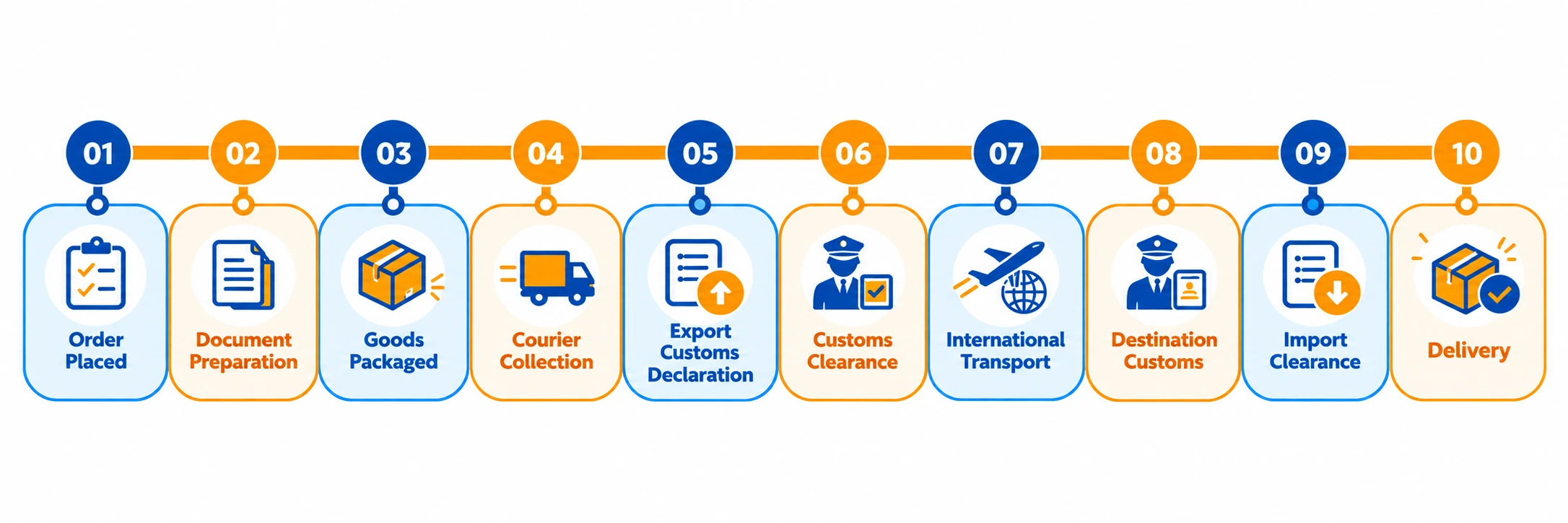
Although the courier company performs several functions, such as booking the consignment and preparing all related transport and customs documentation, the exporter bears the responsibility of providing accurate data regarding the cargo.
The courier will not be able to prepare the proper commercial value and product information without the correct data provided by the seller.
Essential Documents for International Courier Exports
The below table shows an overview of common documents.
| Document | Purpose |
|---|---|
| IEC | Identifies the exporter for international trade |
| Commercial Invoice | Records the transaction, products and value |
| Packing List | Describes package contents and weights |
| Airway Bill | Records transportation by air/courier |
| Shipping Bill | Supports customs export clearance where applicable |
| Customs Declaration | Provides information required by customs |
| Export Declaration | Declares goods being exported |
| KYC Documents | Supports identity and address verification |
| HS Code | Classifies the exported product |
| Certificate of Origin | Establishes origin when required |
| Product-specific Certificates | Demonstrate regulatory compliance where applicable |
| LUT | Relevant to eligible GST-registered exporters using the applicable zero-rated export route |
However, not all consignments require the same documentation. The need depends on the nature and value of the export consignment.

Commercial Invoice
A commercial invoice is among the most crucial documents in international courier shipments. It gives the customs authorities information about the commercial transaction and includes:
The commercial invoice must give an accurate representation of the actual commercial transaction.
For instance, an Indian firm selling five cotton shirts to its client in the United Kingdom must give an appropriate description and not something like “clothing”.
An accurate description is necessary in order to facilitate the proper assessment of the shipment.
Packing List
A packing list gives information regarding the physical characteristics of the shipment.
It may contain information such as:
The above information must match the actual package and the Commercial Invoice.
A packing list is especially helpful in case of multiple products/ packages in a shipment.
For small parcel shipments, the courier may have fewer documentation requirements, but exporters must maintain the necessary packing documents.
Airway Bill
An air waybill is a document that serves as a mode of transport used for transporting goods via air, which includes many express courier consignments.
It typically contains information on:
An air waybill facilitates identification and tracking of the shipment.
For courier exports, the air waybill will be prepared by the courier after booking the shipment.
Shipping Bill and Export Declaration
A shipping bill is an important customs document required for exporting goods from India through customs procedures.
For courier exports, customs procedures may differ from the usual procedures for cargo exports. The courier or the authorized logistics service provider may provide the required customs information via electronic means under the courier export procedure.
Export declaration conveys all information regarding the shipment to customs authorities, such as exporter details, details of goods, their value, and destination.
Exporters should not assume that having a courier involved exempts them from providing proper commercial and customs information.
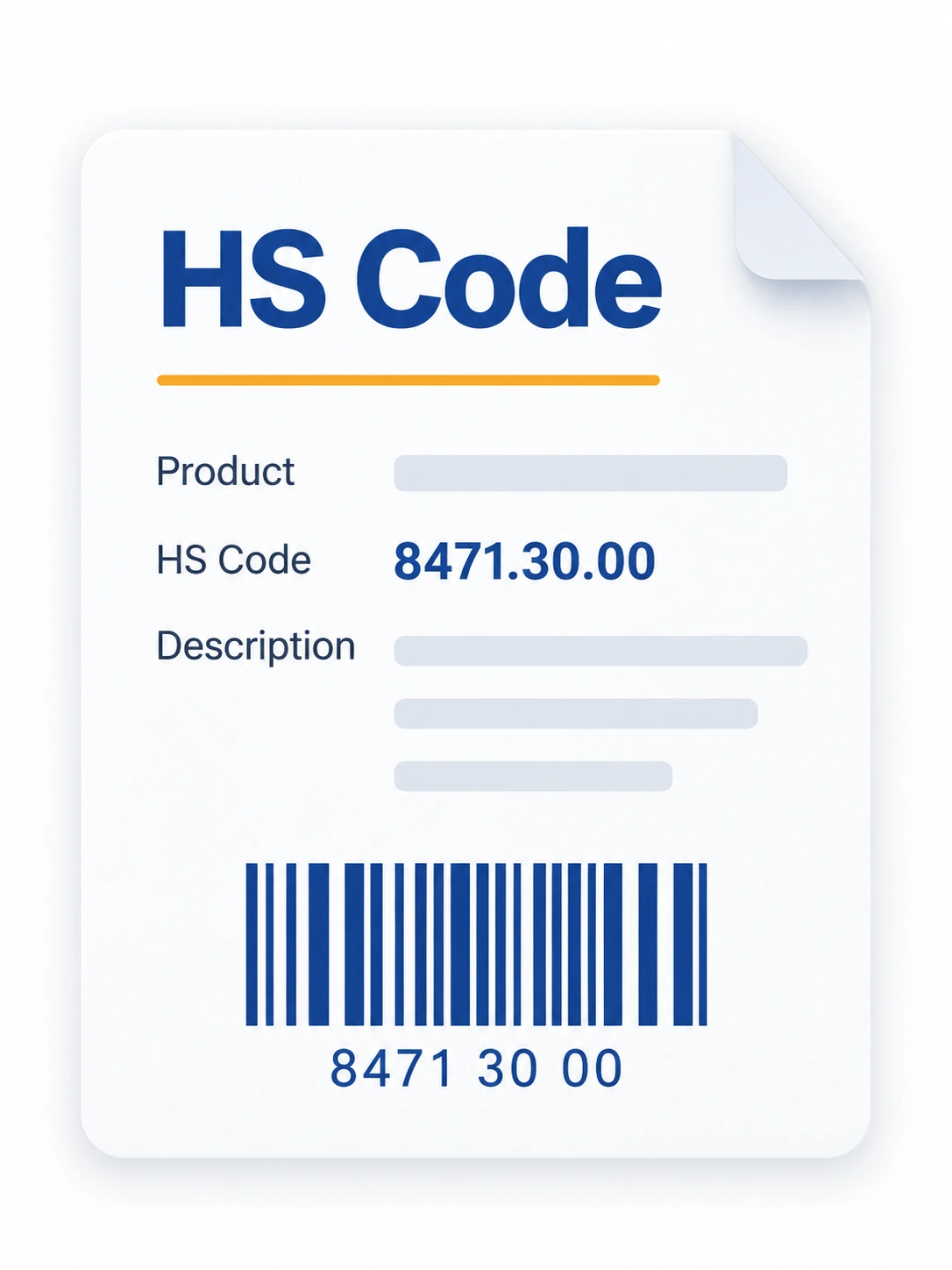
HS Code
The HS code is used to classify goods for international trading purposes.
It is important to classify correctly because the HS code influences:
It is required to classify the goods before preparation of the shipment.
Incorrect use of HS code can lead to customs questions and other problems.
For goods that have complex features and many classifications are possible, professional assistance is needed.
KYC Documents for Courier Exports
Courier company can ask for KYC documents to confirm the identity and address of the exporter/consignee.
Depending on the shipment and procedure being followed, the KYC could contain:
The above list would depend on the courier company, exporter’s type and transaction itself.
It is important for businesses to supply documents when required because KYC issues could cause the delay of shipment.
Product Description and Declared Value
There are two items that get special attention from the customs when processing shipments: these are Product description and declared value.
Product Description
Product descriptions need to be detailed and accurate.
Rather than saying:
“Items”
It would be better to say:
“Cotton men’s T-shirts, knitted, ready-made garments”
Description should allow customs to clearly identify what the package contains.
Declared Value
The declared value needs to be accurate according to the applicable customs and transaction rules.
Country of Origin
This refers to the country of manufacture of the goods based on appropriate origin rules.
As far as Indian exporters are concerned, goods manufactured in India shall, under normal circumstances, take India as their country of origin, as per the origin rules.
Information about origin could be required on commercial papers and could play a part in customs clearance in the destination country.
In certain situations, it could assume importance when the buyer wants to avail of preferential tariffs due to an existing trade agreement.
Customs Clearance for International Courier Shipments
This is the process through which goods moving into or out of a country are cleared by the authorities.
In case of an export shipment from India, customs could check:
The logistics provider could arrange for the customs clearance process but it is the customs authorities who would decide whether or not the goods could move ahead.
Once the goods reach the destination country, they may undergo the process of customs clearance again before delivery.
Restricted Items and Prohibited Items
Exporters should find out in advance if the products can be exported to the destination country.
Restricted items are only permitted to be exported/imported under certain circumstances/permissions/licensing.
This list will vary based on originating country, destination country, product type and mode of transportation.
Just because a courier service accepts an item for shipment does not mean that it is an unrestricted item in the destination country.
DDP vs DDU for International Courier Shipments
Shipments come under certain shipping terms which dictate who is responsible for various costs and responsibilities.
DDP (Delivered Duty Paid) is typically understood to mean that the seller is responsible for any duties/taxes which may apply to the transaction as part of the delivery agreement.
DDU (Delivered Duty Unpaid) is usually used to denote an arrangement where the buyer is responsible for applicable duties/taxes.
LUT and GST Considerations
GST registered exporters must know the applicable GST treatment of exports.
Under the Indian GST system, exports are usually regarded as zero-rated supplies provided the necessary conditions are met.
A valid exporter is allowed to use the LUT (Letter of Undertaking) to export without paying IGST according to the process.
Also, eligible exporters have the option to follow the alternative method where IGST is paid and a refund is sought.
International Courier Charges and Shipping Rates
International shipping costs are based not only on the actual weight of the product being shipped.
Some common criteria are:
For instance, a bulky yet light cargo could be billed using volumetric weight and not just the actual weight.
Companies need to analyze international courier charges of various carriers and calculate the total landed cost.
How to Prepare Courier Export Documents
Prior to consignment delivery to the courier, you should have a document check process in place.
Export Documentation Checklist
Conclusion
In order to prepare proper documentation for international courier exports, one needs to take care of commercial invoices, packing lists, airway bills, customs declarations, IECs, KYCs, HS codes and other documentation.
Prior to sending out any products, one should check the product description, its value, HS code, place of origin and all customs issues. One should also establish whether DDP or DDU is needed and check for restricted and prohibited items.

FAQ’s
Some of the major documents are the commercial invoice, packing list, airway bill, appropriate shipping bill/Export Declaration, IEC and KYC documents. Other certifications may also be required based on the nature of the item and destination.
An Import Export Code is generally needed by businesses for commercial exports, based on certain exceptions. This can be confirmed based on the nature of the export and its value.
Customs clearance and documentation will be taken care of by the courier company/Logistics company, based on the chosen shipping service. However, the exporter has to provide details of the product, value, classification, and transaction.
Under DDP, the importer pays the customs duty applicable to the product. On the other hand, under DDU, the buyer may have to pay the duties when the consignment reaches the destination.