
Self-Fulfillment gives Indian Walmart sellers greater operational control and lower upfront costs, making it ideal for testing products, handling bulky items, or starting international sales with limited investment.
In comparison, WFS (Walmart Fulfillment Services) is more suitable for scaling because it offers faster 2-day delivery, stronger Buy Box visibility, simplified returns management, and higher customer trust through Walmart’s fulfillment network.
So you’ve decided to sell on Walmart Marketplace. Smart move. Millions of U.S. shoppers, no monthly fees, no SKU limits, and INR payouts directly to your Indian bank account the opportunity is genuinely exciting.

But here’s the question almost every new Indian seller gets stuck on pretty quickly:
Do I ship orders myself, or do I let Walmart handle it for me?
It sounds like a small operational decision. But it actually shapes your delivery speed, your visibility on the platform, your costs, and ultimately how fast your business grows in the U.S. market. So it’s worth getting right.
Let’s break it down in plain, simple language, no jargon, no confusion.
First, What Are the Two Options?
Self-Fulfillment: FBM (Fulfilled by Merchant)
You’re in the driver’s seat. You store the products, pack the orders, ship to U.S. customers, choose your own courier, and manage returns if they come in. Everything runs through you or your logistics partner.
Self-Fulfillment
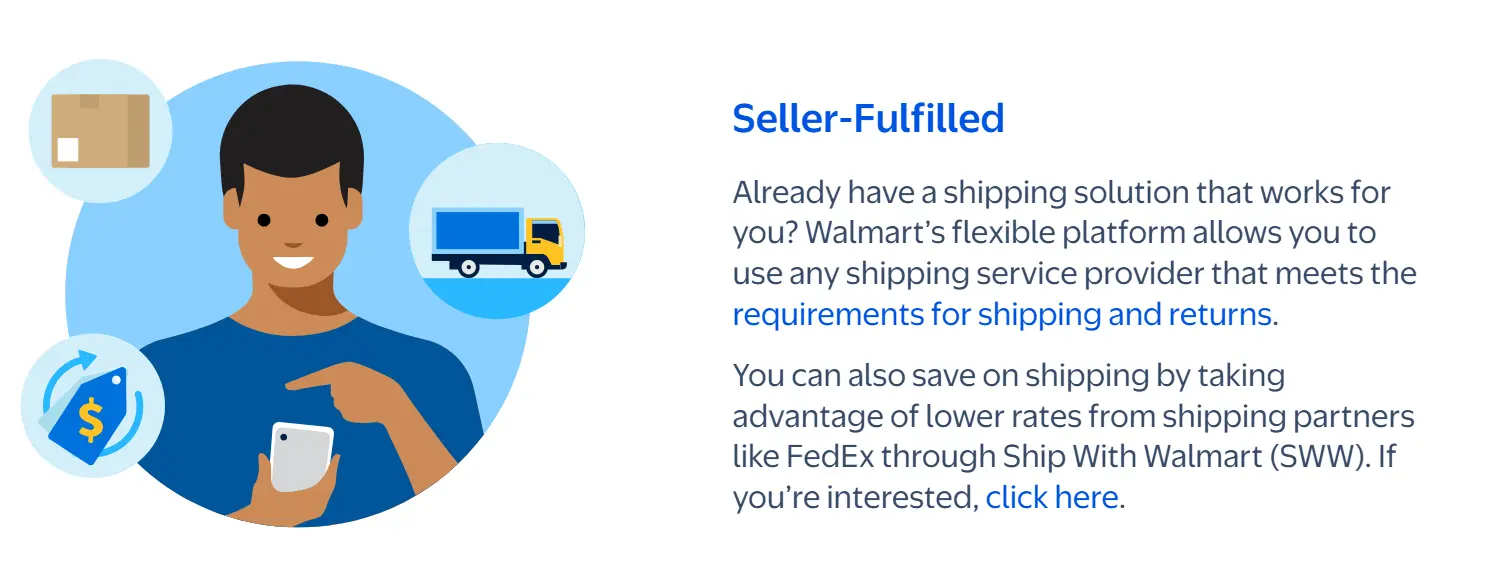
Self-fulfilment for Walmart sellers is exactly what it sounds like – you own the process end to end. For many Indian sellers, especially those just entering the U.S. market, this is where the journey begins.
What Works well with Self-Fulfilment:
- You have complete inventory control at all times – you know exactly where your stock is, how much is left, and you can make instant decisions on pricing or promotions.
- Lower upfront cost – no per-unit WFS fees, just your own packaging and courier expenses.
- Works really well for bulky, oversized, or heavy products where fulfillment fees would eat into your margins.
- Perfect for testing new products without committing large quantities to a U.S. warehouse.
- Even as an FBM seller, you can use Ship With Walmart (SWW) to access pre-negotiated discounted rates from carriers like FedEx – so you’re not navigating cross-border shipping entirely on your own.
- Full flexibility to switch carriers, renegotiate rates, or adjust your logistics setup at any time.
Where Self-Fulfilment Creates Challenges:
- Shipping from India to U.S customers typically takes 7 to 14 days – and that’s a significant problem in a market where shoppers expect fast delivery.
- The delivery time impact on sales at Walmart is very real – longer shipping times directly reduce your conversion rate because customers filter by delivery speed before they even click your listing.
- Walmart tracks your shipping performance metrics closely – on-time delivery rate, valid tracking rate, and cancellation rate – and if these numbers dip, your listings get suppressed in search results.
- You won’t carry the “Fulfilled by Walmart” badge, which customers have come to trust, and that affects click-through rates.
- Seller fulfilled shipping challenges grow louder as your volume increases – manually managing orders, tracking shipments, and handling returns from India becomes a real bottleneck.
- Scaling ecommerce fulfillment through FBM requires building your own infrastructure, which takes time, money, and attention away from growing your business.
WFS: Walmart Fulfillment Services
You send your inventory to a Walmart warehouse in the U.S. once. After that, Walmart takes over completely – picking, packing, shipping with 2-day delivery, and handling any returns. You focus entirely on selling and growing your catalogue.
Both options work. Both have real advantages. The trick is figuring out which one fits where you are right now – and where you want to go.
WFS (Walmart Fulfillment Services)
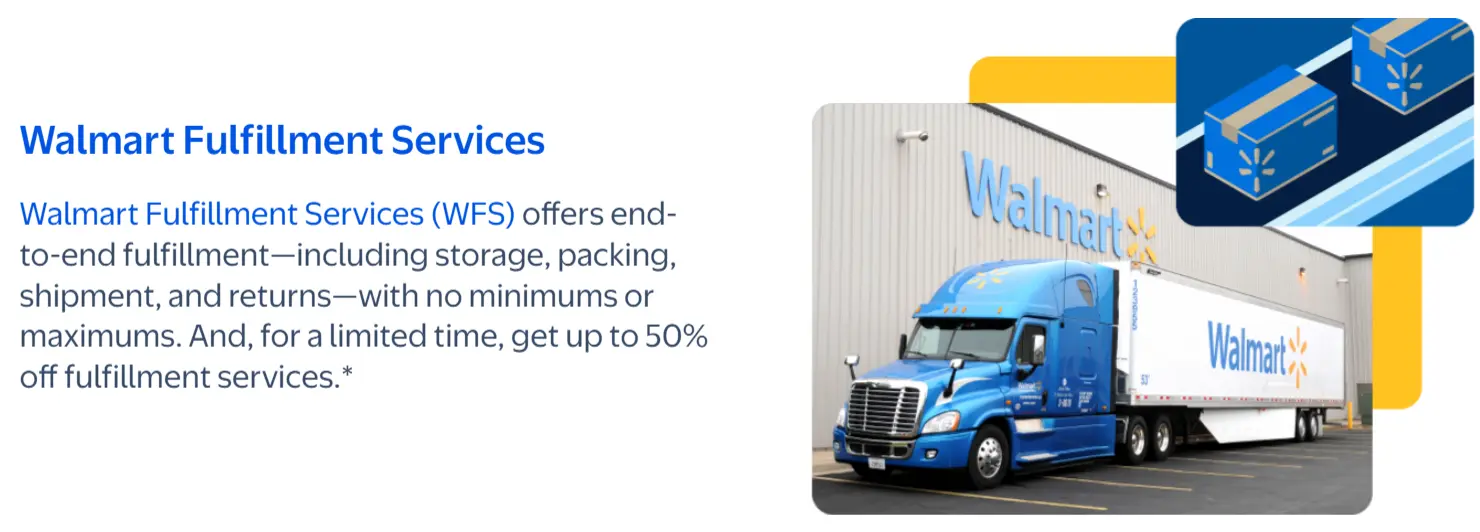
Walmart Fulfillment Services is Walmart’s end-to-end fulfillment solution, and for Indian sellers looking to grow seriously in the U.S. market, it’s a powerful tool. You ship your inventory to a U.S. Walmart warehouse once, and from there, Walmart handles everything.
What works well with WFS:
- Your orders are shipped with 2-day delivery – the standard U.S. shoppers expect and filter by. This directly improves your conversion rate.
- You automatically qualify for the “Fulfilled by Walmart” badge – a trust signal that makes customers significantly more likely to buy.
- The Walmart Buy Box and fulfillment method are directly connected – WFS listings get priority placement in Walmart’s algorithm, which means more visibility and more sales without spending extra on ads.
- Returns are handled completely by Walmart – no international coordination, no customer service headaches, no cost to you per return.
- No minimums or maximums – whether you’re shipping 10 units or 10,000, WFS scales with you.
- Simplified cross-border selling – once your inventory lands in the U.S., the entire last-mile is Walmart’s responsibility.
- For a limited time, new sellers get up to 50% off WFS fulfillment fees – making this the best time to try it.
- The order handling for Walmart sellers through WFS is completely automated – you get more time to source products, build your catalogue, and market your listings.
Where WFS has limitations:
- Your inventory is physically at Walmart’s warehouse, so inventory control vs outsourced fulfillment is a real trade-off – you can’t make instant adjustments.
- WFS has storage and per-unit fulfillment fees – for very low-priced products or slow-moving SKUs, the cost comparison WFS vs self-shipping may not always favour WFS.
- You need to forecast demand and ship inventory to the U.S. in advance, which requires planning and upfront capital in stock.
- Oversized or unusually heavy products may be cheaper to ship yourself due to dimensional weight pricing in WFS.
📦 Self-Fulfillment (FBM) vs Walmart Fulfillment Services (WFS)
Compare delivery speed, operational control, costs, and scalability before choosing your Walmart fulfillment model
Shipping Performance Metrics: Why They Matter More Than You Think
Whether you go FBM or WFS, Walmart is always watching your seller performance. The platform tracks these shipping performance metrics Walmart uses to rank, reward, or suppress listings:
- On-Time Delivery Rate – Target is 95% and above
- Valid Tracking Rate – Target is 99% and above
- Cancellation Rate – Should stay below 2%
- Return Dissatisfaction Rate – Impacts your overall seller score
If you’re on WFS, Walmart’s own logistics handles execution, so you meet most of these targets automatically. If you’re on FBM, you need to monitor your Seller Center dashboard actively and fix any gaps before they affect your visibility.
Missing these benchmarks isn’t just a score issue – it directly impacts whether your products appear in search results at all.
The Smart Move: Use Both
Here’s something most guides won’t tell you – the most successful Indian sellers on Walmart don’t choose one or the other permanently. They use a hybrid fulfillment strategy for ecommerce that evolves as their business grows.
Here’s how it typically looks:
- Start with Self-Fulfillment to test your products, understand what actually sells in the U.S., and keep your risk low
- Use Ship With Walmart (SWW) during this phase to reduce your cost comparison WFS vs self-shipping gap
- Once you identify your top 5 – 10 bestselling SKUs, move those to WFS to unlock the Buy Box advantage, 2-day delivery, and the WFS badge
- Keep FBM running for bulky products, seasonal items, or new products you’re still testing
This approach lets you control costs early, learn the market, and then scale ecommerce fulfillment strategically – without overcommitting resources before you know what’s working.
Payouts Stay the Same Either Way
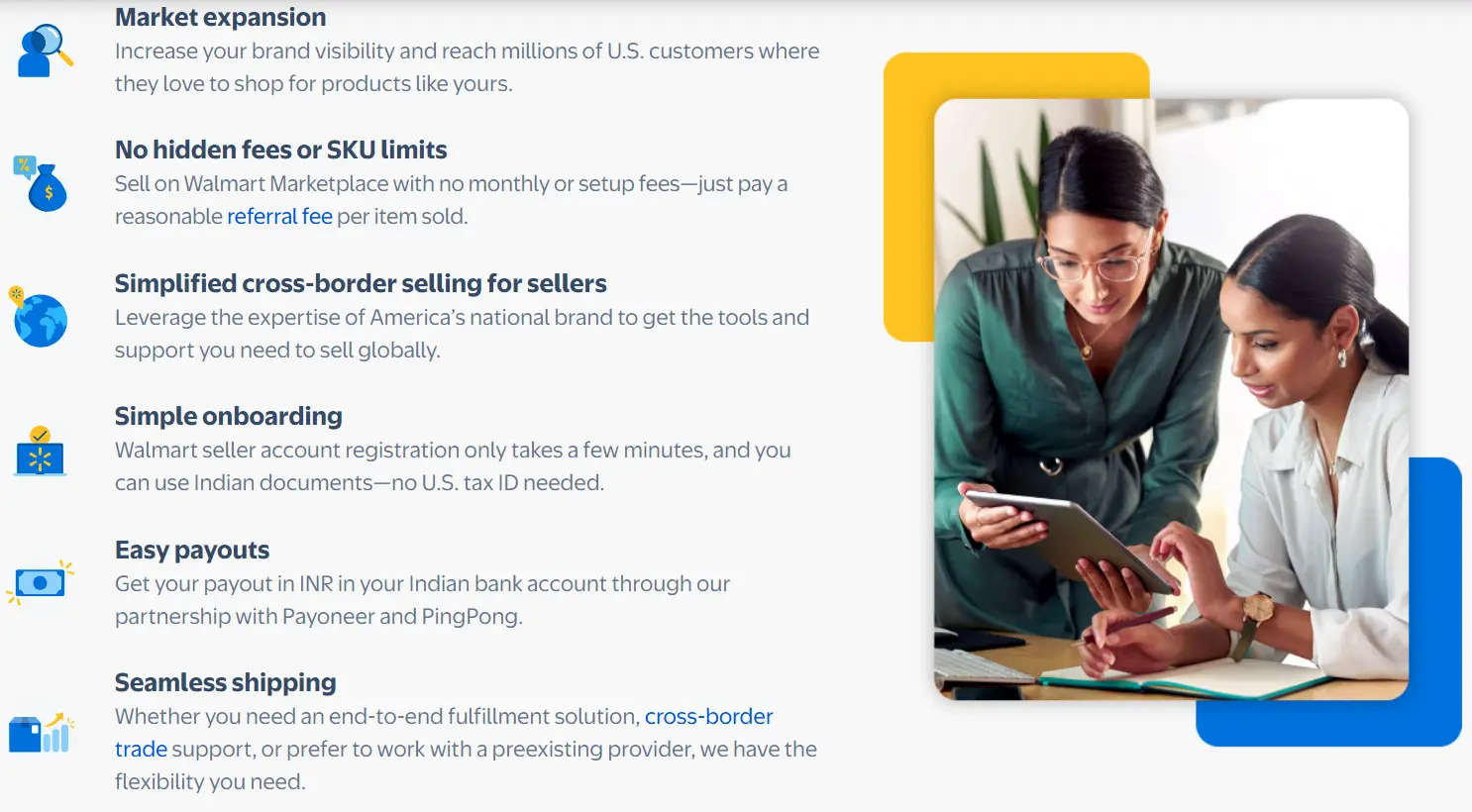
One thing that doesn’t change based on your fulfillment choice – how you get paid. Walmart has partnered with Payoneer and PingPong so Indian sellers receive payments in INR, directly to their Indian bank account. No U.S. bank account needed. No U.S. Tax ID required. Onboarding only needs Indian documents.
That’s a big deal for cross-border sellers and removes one of the most common barriers to selling internationally.
The Bottom Line
- If you’re starting out or selling bulky/niche products – begin with Self-Fulfillment
- If you have proven products and want to grow fast – WFS is the stronger logistics strategy for online sellers
- If you want the best of both – run a hybrid and shift bestsellers to WFS over time
The delivery time impact on sales on Walmart is significant. Faster Shipping = More Conversions = More Revenue. WFS is the most reliable way to get there. But you don’t have to jump in all at once. Start where you’re comfortable, learn what your U.S. customers respond to, and scale from there.
Frequently Asked Questions for Walmart Seller Central Registration
Yes, absolutely. You don’t have to commit to one model forever. Many Indian sellers start with FBM to test the market and then move their bestselling products to WFS once they know what’s working. You can run both models simultaneously on different SKUs within the same seller account.
WFS gives you a significant advantage in Buy Box eligibility because Walmart’s algorithm prioritises fast, reliable delivery – which WFS provides consistently. That said, the Buy Box also considers competitive pricing and your overall seller performance. WFS puts you in a much stronger position, but keeping your pricing competitive matters too.
You’re fully responsible for meeting Walmart’s benchmarks – 95%+ on-time delivery, 99%+ valid tracking, and below 2% cancellation rate. If these slip, your listings can get suppressed. Using Ship With Walmart (SWW) for discounted carrier rates and reliable tracking helps FBM sellers stay compliant.
No hidden fees. WFS charges are based on per-unit storage and fulfillment costs, which vary by product size and weight. There are no minimums, no setup fees, and for a limited time, new sellers can get up to 50% off fulfillment charges. You can calculate your expected costs through the Walmart Seller Center before sending inventory.
Yes. Your fulfillment method has no impact on how you receive payments. Whether you use WFS or Self-Fulfillment, Walmart pays Indian sellers in INR directly to their Indian bank account through Payoneer or PingPong. No U.S. bank account or U.S. Tax ID is required.