
India’s export and manufacturing ecosystem has undergone a fair amount of change over the past couple of decades. To give exports a boost, improve the infrastructure, attract some investment and encourage a bit of industrial specialisation the Indian government has come up with a number of different development models. Probably the most talked about are Towns of Export Excellence (TEE), Special Economic Zones (SEZs) and Industrial Clusters – although there are certainly others.
Many businesses, especially small ones & manufacturers, often get bogged down when trying to work out the differences between these models. While all three contribute to growth and the development of exports, they do have rather different objectives, benefits, operational structures and government support.
A Comparison of Export Ecosystems in India
Indian industrial and export strategy focuses on setting up specialised zones and production hubs that should improve manufacturing efficiency and boost export competitiveness. The government supports different business ecosystems depending on whether you’re in a specific type of industry, how export orientated you are and what infrastructure you need.
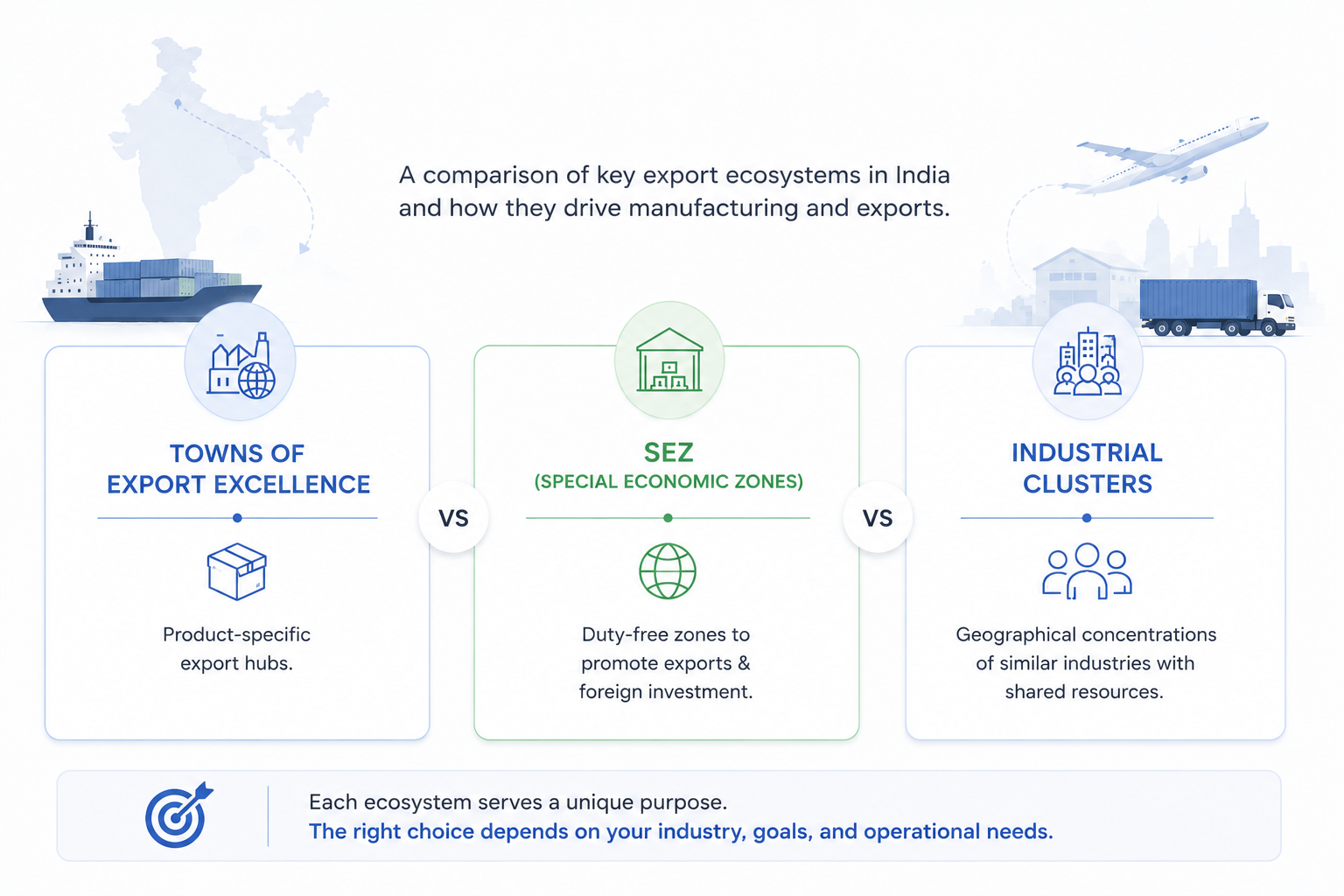
In a comparison of the export ecosystem in India, Towns of Export Excellence are product specific export hubs that are recognised for their high performance in exporting a particular product. SEZs are specially designated duty free zones that are designed to promote exports & foreign investment. Industrial clusters, on the other hand, are geographical concentrations of similar industries with businesses rubbing shoulders with shared resources, suppliers, labour, and infrastructure and so on.
What Are Towns of Export Excellence
Towns of Export Excellence are cities or towns in India that are identified for achieving high export performance in a particular product category by the Government of India. The Directorate General of Foreign Trade under the Ministry of Commerce gives TEE status to towns that demonstrate a strong potential for exporting products.
The objective behind the TEE initiative is to develop export orientated infrastructure and support product specialisation. Once a town receives TEE recognition, exporters operating there can get assistance under a variety of export promotion schemes.
🌍 TEE vs SEZ vs Industrial Clusters
A simple comparison of India’s major export and industrial ecosystems
SEZ, TEE or Clusters – What’s the Difference
You often see a debate around SEZ vs TEE vs Clusters because all three systems do support manufacturing and exports. However, their structures are entirely different.
A Special Economic Zone is a legally designated geographical area where businesses get tax incentives, duty exemptions, simplified rules and export focused operational benefits. SEZs are designed to encourage exports, attract foreign direct investment, and create first class infrastructure.
Towns of Export Excellence focus more on recognising existing export excellence rather than creating new territories to export into. They don’t function as tax free zones and they don’t provide the same level of customs or fiscal exemptions available in SEZs.
Industrial Cluster in India – What Does it Mean
To fully understand the difference between these systems, it’s especially important to understand what an industrial cluster is in India.
An industrial cluster refers to a concentration of interconnected businesses operating within the same industry or value chain in a specific geographical area. These businesses benefit from being near suppliers, skilled labour, logistics networks, service providers and technological support.
India has got a handful of really successful industrial clusters in sectors like textiles, autos, pharmaceuticals, leather, ceramics, engineering, and IT services. Take Tiruppur for knitwear, Surat for diamonds and textiles, Morbi for ceramics, and Pune for autos – these are all good examples
The Cluster Development Programme that the Indian government has put in place aims to make these ecosystems stronger, with better infrastructure, more innovative thinking, common tech support, and better training for workers.
🌍 TEE vs SEZ vs Industrial Clusters
A simple comparison of India’s major export and industrial ecosystems
Towns of Export Excellence vs SEZ vs Industrial Clusters – What’s the Main Goal of Each
Trying to understand the difference between Towns of Export Excellence, SEZ, and Industrial Clusters is really easy once you look at what each one is actually trying to achieve.
The main aim of Towns of Export Excellence is to promote exports by offering recognition and some basic infrastructure support to exporters already doing well in a particular field.
SEZs are designed to create zones that can compete globally – this is done by relaxing certain rules and offering policy incentives. Their main focus is on attracting investments and getting manufacturers to shift towards exporting more.
Industrial clusters exist to improve production efficiency, make it easier for businesses to work together, to innovate, and to stay competitive in the same sector.
What’s the Real Difference Between SEZ and Export Clusters
When you look at how they’re governed, regulated, and the incentives that come with them, the difference between SEZ and export clusters starts to make sense.
SEZs have their own special set of rules and are governed by the SEZ Act – businesses operating within them get things like customs duty exemptions, easier compliance, quicker clearances, & export incentives.
An export cluster might or might not get these benefits – they’re usually industry-driven, and businesses get together because it makes sense to collaborate and be more efficient rather than getting direct financial incentives
SEZs are like specially designated areas with strict rules – what goes on, where you come from, how you operate & what you pay taxes on are all controlled within the zone.
Industrial clusters on the other hand are more open-ended and spread out over a city or region – businesses in them might not get any special tax breaks just because they’re part of the cluster.
If you look at the difference between SEZ and export clusters from a specific point of view, SEZs are zones created by the government, whereas clusters just happen because people & businesses naturally come together in a region & focus on the same industry.
🌍 SEZ vs Export Clusters — What’s the Real Difference?
SEZs are government-created export zones with policy benefits, while industrial clusters grow naturally through industry concentration and collaboration.
Operate under the SEZ Act with special regulations and compliance systems.
Duty exemptions, GST benefits, faster customs clearances, and export incentives.
Designed to attract FDI (Foreign Direct Investment) and export-oriented manufacturing.
Businesses naturally grow together in the same sector and region.
Shared suppliers, labour, logistics, technology, and service networks.
Usually no automatic tax exemptions like SEZs.
How Do SEZs Benefit India Exporters
An SEZ can really help Indian exporters by creating a level of competitiveness for manufacturing & trade that is on par with the rest of the world.
Businesses operating within SEZs get some amazing advantages like being able to import raw materials without paying customs duty, being exempt from certain taxes, having their customs processing sped up, and having top-notch infrastructure.
These benefits make it a lot easier for businesses to keep costs down & compete in the global market.
Another big advantage is that compliance becomes a heck of a lot easier – approvals are faster, there are fewer bureaucratic hurdles to deal with & it’s just a more streamlined process overall.
Foreign investors also really like SEZs because the rules are clear, the infrastructure is ready to go, and the regulations are all export-focused.
Tax Benefits in SEZ India
One of the major draws of Special Economic Zones is the array of fiscal incentives & tax breaks on offer.
The tax benefits that businesses in SEZ India get access to might include customs duty exemptions, GST perks, and exemptions on certain imports that they use in producing exports.
While tax structures have evolved over the years and some of the direct tax incentives have gotten tweaked, SEZs still offer a lot of scope for cost savings for export-orientated companies.
SEZ India in particular seems to have a tax framework that is geared towards supporting sectors such as electronics, pharmaceuticals, engineering goods, textiles, and IT services – sectors where export competitiveness is heavily tied up with cost efficiency.
That being said, Towns of Export Excellence and industrial clusters don’t automatically get the same level of tax exemptions that SEZs get.
Cluster Development Program in India
The cluster development program India has been implementing focuses on bolstering MSMEs & manufacturing ecosystems.
In this approach the government is supporting infrastructure development, tech centres, testing facilities, skill development & shared services platforms for businesses in industrial clusters.
The aim is to boost productivity, cut operational costs, encourage innovation & get businesses better access to the market.
This cluster development program India strategy is particularly useful for small manufacturers that may not be able to afford to invest in the latest technology or infrastructure for themselves.
Unlike SEZs, cluster development initiatives are generally less about providing fiscal incentives and more about strengthening ecosystems.
Manufacturing Hubs vs Export Zones – What’s the Difference
The whole concept of manufacturing hubs vs export zones is another important point of distinction in India’s industrial strategy.
Manufacturing hubs are basically areas where production activities are concentrated because they’ve got access to the right kind of workforce, raw materials, infrastructure or just historical specialisation. Industrial clusters often become manufacturing hubs because businesses naturally start to cluster around a successful sector.
Export zones, on the other hand, like SEZs are specifically set up to encourage exports through policy incentives & by making international trade easier.
Manufacturing hubs can supply both the domestic & international markets, whereas export zones are primarily designed for export-orientated production.
Understanding the difference between manufacturing hubs & export zones is going to help businesses figure out whether they need to focus on operational efficiency or on getting export-specific incentives.
Government Export Schemes Compared
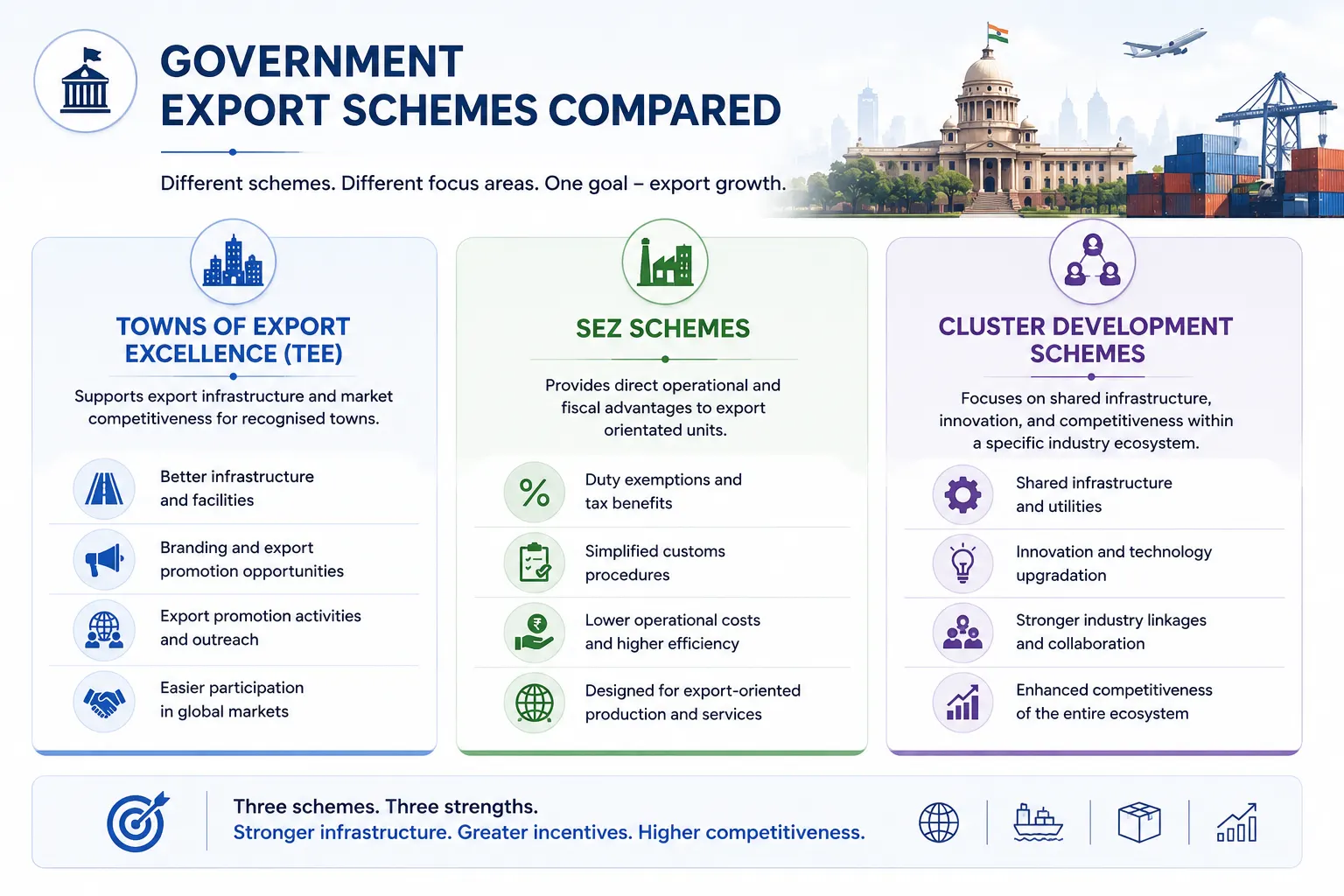
Looking at a government export schemes comparison shows that different schemes are geared towards different business objectives.
The TEE initiative mainly supports export infrastructure & market competitiveness for recognised towns – indirectly benefiting businesses through things like better facilities, branding opportunities, export promotion activities & just generally making it easier for them to get involved in exports.
SEZ schemes on the other hand provide direct operational & fiscal advantages to export orientated units.
Cluster development schemes focus on shared infrastructure, innovation, and competitiveness within a specific industry ecosystem.
What Model is Best for MSMEs
The answer is going to depend entirely on the specific nature of the business in question.
MSMEs engaged in making specialised products may get a real benefit from setting up in Towns of Export Excellence because these towns often get some serious infrastructure upgrades and export promotion support.
Businesses that are looking for cost-efficient manufacturing & industry collaboration may find that industrial clusters are more up their street.
On the other hand, companies with big export volumes, international supply chains or with production processes that are heavily reliant on imports may find that SEZs turn out to be more advantageous because of the customs benefits on offer.
The Future of India’s Export Infrastructure
India is more and more focused on developing its industrial base, where export towns, clusters, logistics hubs and SEZs all work together as part of a bigger picture.
The fact that the government is putting a lot of emphasis on manufacturing competitiveness, supply chain strength and export growth is going to make it easier to create stronger connections between these different systems.
As global trade patterns keep evolving, businesses that understand the important role that TEEs, SEZs and industrial clusters play will be in a better position to scale internationally.
The future of exports will depend on more than just tax breaks – infrastructure quality, logistics efficiency, technology adoption, and working well together within an ecosystem are going to be just as important.
Conclusion
Understanding the difference between Towns of Export Excellence, SEZs and industrial clusters is essential knowledge if you’re an exporter, a manufacturer, an investor or an MSME looking to grow in India’s changing industrial landscape.
Towns of Export Excellence are about identifying and supporting regions that have a strong track record of exporting. SEZs create dedicated business environments focused on exports with special tax and regulatory breaks. Industrial clusters help manufacturers by bringing together a group of specialists and encouraging collaboration.
Frequently Asked Questions for Towns of Export Excellence vs SEZ vs Industrial Clusters
No way, industrial clusters aren’t just for businesses that export. They are industry-specific ecosystems where businesses can take advantage of shared infrastructure, suppliers, labour and services. Some clusters are mainly for the domestic market while others are focused on exports.
Businesses in Towns of Export Excellence don’t get direct tax breaks as SEZ units do. Their benefits are more about improving infrastructure, making it easier to export and boosting competitiveness.
SEZs are important for exporters because they can help reduce the costs of doing business by offering customs duty exemptions, better infrastructure, simplified regulations and faster trade procedures, which all add up to making them more competitive in global markets.
The Cluster Development Program India initiative helps support industrial ecosystems by making common infrastructure better, giving businesses in the cluster access to technology, helping with skill development and making operations more efficient.