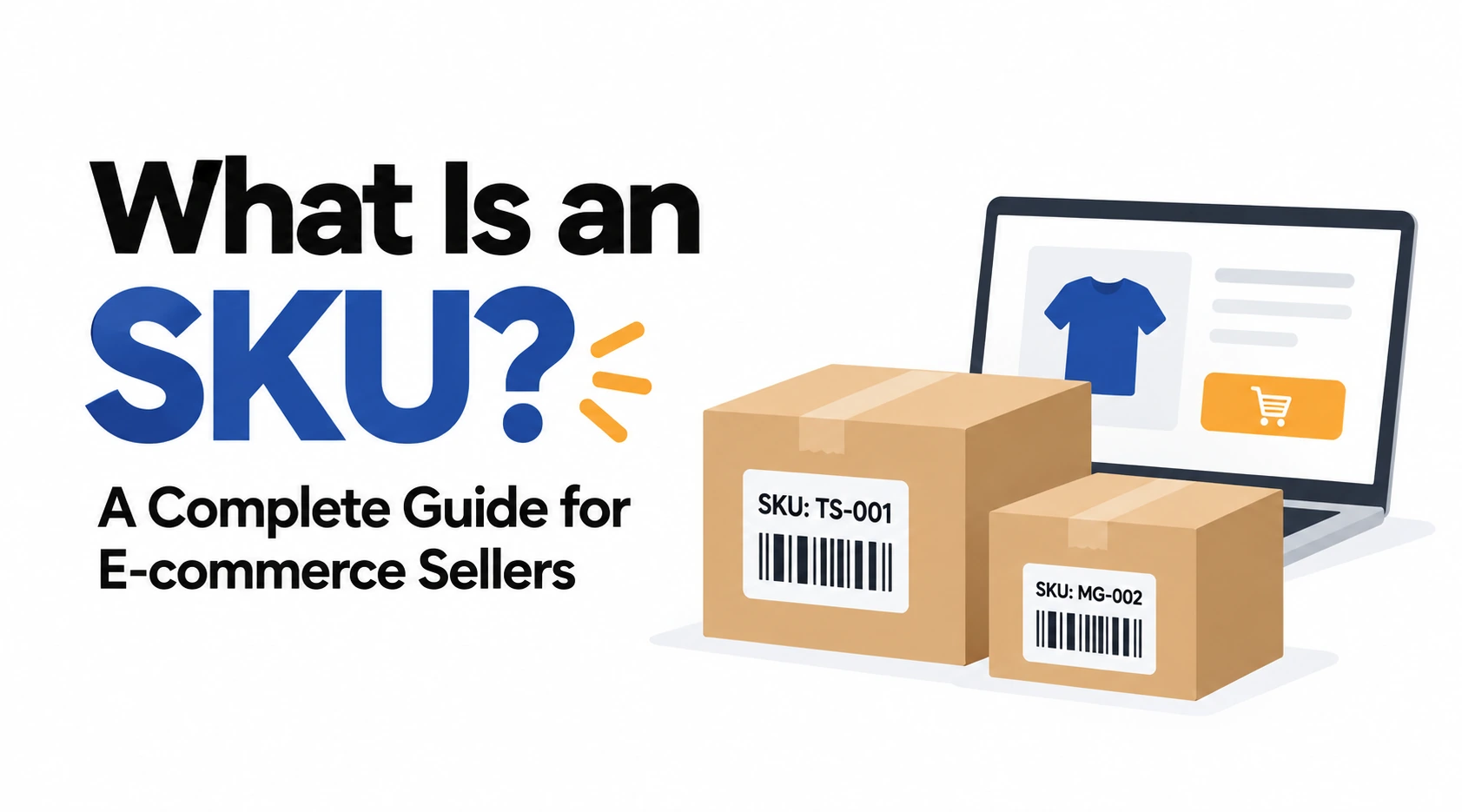

The acronym “UPC” represents the concept of “Universal Product Code”, which is a type of product identification system commonly used to identify retail products, especially within the United States and Canada. When manufacturing or selling products either in an online store or a marketplace, understanding UPC codes may be useful in ensuring that you create effective product listings, manage inventory, and satisfy marketplace requirements.
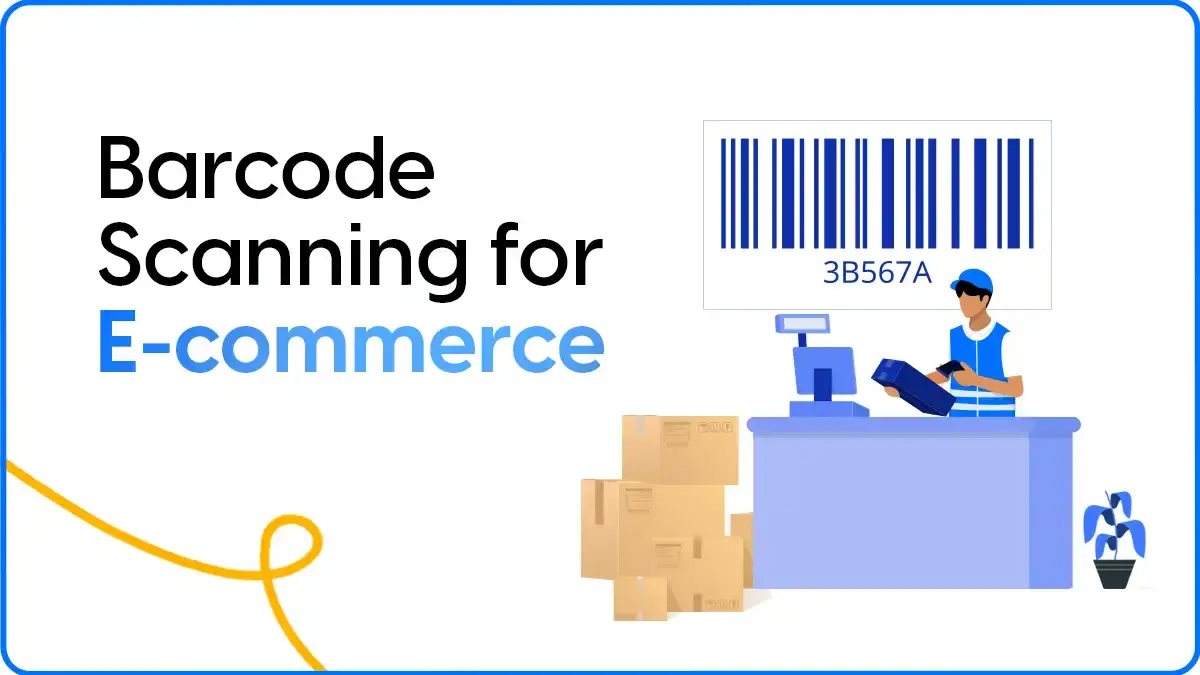
A UPC code is a specific product number identified using a barcode. Scanning a barcode in the checkout counter allows the system to recognize the product and pull up details such as the name of the product and its price. Companies can also use a UPC to track trade items, manage inventory in the store, and help in identifying products.
What Is a UPC?
UPC is the abbreviation of Universal Product Code.
It is a standardized product identification system. It is used to identify products in retail and e-commerce environment.
UPC-A is the most commonly known type of UPC. It contains 12 digits. These digits are converted into a bar code. These can be easily scanned at a retail point-of-sale system.
UPC is used to identify a particular trade item rather than a particular seller. It means that the UPC is helpful if the same product is available for purchase from various retailers and online sellers.
For instance, a manufacturer assigns a certain UPC to a particular packaged product. Then, different retailers use this product identifier in their databases of products.
How Does a UPC Barcode Work?
The UPC barcode is a combination of numeric identifiers and a graphical code readable by machine.
A typical UPC-A includes:
- Identification numbers of the manufacturer
- Identification numbers of the product
- Check digit
The barcode scanner analyzes the sequence of bars and spaces and encodes this data into barcode digits. The information is then retrieved using the number by the point-of-sale system or inventory management system.
Example process flow:
UPC number → Barcode scanning → Product database → Product information → Check-out
It helps retailers to identify the products easily without having to type a lengthy description or code for the item.
What are UPC Codes Used for
UPCs are widely used by businesses in retail and online sales as they help identify the products effectively.
Uses of UPC Codes
UPCs may be used to track trade items as products move through the supply chain.
UPCs help associate each product record with its code in a retail inventory system.
A UPC acts as a standardized product identifier across retail systems.
Online marketplaces may use UPCs or other GTINs to identify products and listings.
Thus, for an online seller, a valid UPC code can be critical while listing products online.
What Is The Difference Between UPC-A and UPC-E
There are basically two types of UPC codes – UPC-A and UPC-E.
UPC-A vs UPC-E
UPC-A is the standard format of UPC that people usually see in retail stores.
UPC-E is a type of barcode that uses a shorter form of certain UPC-A codes which contain zero.
It is necessary to remember that UPC-E is not just any independent invention of a barcode consisting of 8 digits but it is a compressed form of suitable UPC-A data.
What is a UPC-A Barcode
UPC-A barcode is the standard 12-digit barcode that is commonly seen in retail stores.
It consists of a sequence of bars and spaces that represent a UPC code. There is also a number printed under the barcode so that people can read the identifier too.
A UPC-A barcode usually consists of:
- Number system information
- Manufacturer prefix or company identification
- Item reference
- Check digit
Depending on the identification and numbering rules issued by GS1.
The last digit of the code is the check digit that is computed mathematically to ensure whether the barcode has been inputted or scanned properly.
What is a UPC-E Barcode
It makes use of zero suppression to encode some eligible UPC-A in a compact form of barcode.
Some of the items that can make use of this are:
- Cosmetic packing that is small
- Accessories sold in retail stores that are small
- Consumer products that are compact
- Products whose labeling area is limited
All the UPC-A barcodes cannot be converted into UPC-E. It depends on the underlying numbers to see if the criteria of conversion are met.
Digits of UPC Barcodes
A standard UPC-A has 12 digits.
| Component | Purpose |
|---|---|
| Number system | Helps identify the numbering category |
| Manufacturer/company identification | Identifies the assigned company range |
| Item reference | Identifies the particular product |
| Check digit | Validates the UPC |
The specific format structure needs to be viewed through the framework of the GS1 system and not just assume that all numbers have the same meaning in all contexts.
Manufacturer Prefix and Product Identifier
Company ID or Manufacturer Prefix is part of the identification structure assigned within the GS1 system.
It is used to connect product identifiers to the company that is responsible for their assignment.
This allows the business to utilize its assigned capacity to generate product codes in accordance with the required guidelines.
UPC vs. EAN vs. GTIN vs. SKU
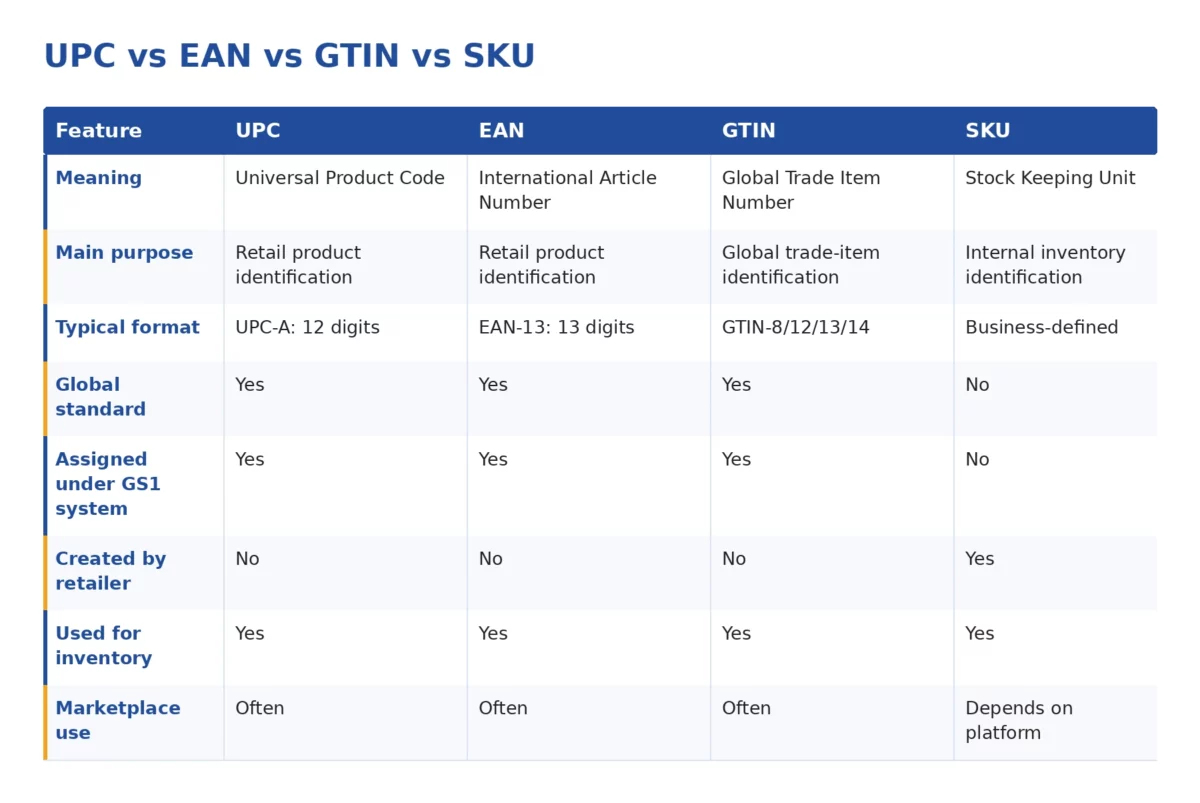
UPC vs. SKU
Product SKU is always created by a single retailer or company.
For instance:
SKU: SHOE-BLACK-10
Unlike SKU, UPC serves for providing uniform product identification across different companies.
Thus, the same product can have a UPC and several SKUs of various retailers.
UPC and E-commerce Sellers
For an e-commerce retailer, UPCs become useful while listing products.
Marketplaces use product codes to find out whether a listed product already exists in the marketplace’s catalogues and which products should be considered equal.
Depending on the marketplace, sellers could be requested to provide:
It is recommended to consult the marketplace for any updates regarding the latest requirements prior to purchasing or assigning a UPC.
Does Every Online Business Need a UPC
No.
Whether or not to use UPCs depends on the business model, products sold and sales channel used.
Some examples include:
- The manufacture of products
- The operation of a private-label business
- The listing of products on a marketplace requiring product identifiers
- The supply of retailers
- The production of standard retail packaging
However, an online store selling services, digital products or particular handmade products may not need UPCs.
Also, if you are a reseller of a branded product, you should consider using a legitimate identifier for your product rather than a newly purchased UPC.

How to Get a UPC
One should obtain legitimate product identifiers from the right GS1 organization, not from unknown third-party sources where UPCs can be bought.
How to Get a UPC
Obtain legitimate product identifiers through the relevant GS1 organization. The general process is:
Define Your Business
Identify whether you are a manufacturer, brand owner, private-label business, importer or another party responsible for product identification.
Assess Your Product Range
List the products you need to identify. Different sizes, flavours, colours or pack quantities may require separate identifiers under the relevant guidelines.
Register with the Relevant GS1 Organization
Complete the required business registration or licensing process.
Get Your Identification Capacity
Your applicable GS1 agreement determines the capacity available to assign unique product identifiers.
Assign UPCs Properly
Assign each identifier to the correct trade item.
Encode the Barcode
Encode the assigned UPC number into the appropriate barcode symbol.
One must not buy a random barcode just because the marketplace is requesting a UPC.
Product Identifiers for Private-Label Products
The private label businesses may require product identifiers as they are the ones handling the products sold using their brand names.
If an online private label business starts offering products like
- Face wash
- Moisturizer
- Sunscreen
- Face serum
Then each different trade item will need unique product identifiers.
UPC and Product Catalogue Management
The UPC will come in handy especially when a company’s product list is extensive.
With proper product cataloguing, the UPC code will match with:
- Name of product
- Brand name
- Description of product
- Size of product
- Color
- Category of product
- Price of product
- Images
- Stock
- Maker
- Information about packaging of the product
The UPC is not required to have all this information.
It is used as a reference number to get all the other details of the product from the record.
Using UPC for product management and identification is therefore convenient.
Common UPC Pitfalls to Avoid
- Using Random UPC
- The random barcode created using online tools is not necessarily a valid UPC.
- Confusing UPC with SKU
- Your internal UPC number is not necessarily the same as the company’s UPC.
- Using Same UPC for Trade Items that Require Separate Identification
- A different trade item is not supposed to use the same UPC code.
- Assigning another UPC to an Existing Product
- When you are dealing with an already existing product then there is no need to create another UPC number.
Disregarding Differences in Products
Size, color, packaging quantity, or any other feature might need separate identification.
Typing in Incorrect Numbers
Even one incorrect digit may cause product matching or scanning errors.
Advantages of UPC for Retail and E-Commerce
Standard product identification can offer several advantages:
Quick Payment
Barcodes enable faster scanning and can speed up checkout.
Effective Stock Control
UPCs help retailers manage inventory and track products.
Product Matching
Marketplaces can use identifiers to distinguish and match products.
Visibility in the Supply Chain
Identifiers help businesses trace trade items through stages of distribution.
Standard Product Information
A standard identifier makes it easier to link a trade item to consistent product information.
Frequently Asked Questions
A UPC is a product identifier used for identifying the retail products. The most popular UPC version is UPC-A. It contains 12 digits and can be scanned through the barcode.
No, the UPC code is a standardized code used throughout all business enterprises, while the SKU code is the internal code used by the particular seller or retailer.
Business enterprises should acquire genuine UPC codes via the GS1 organization. Do not buy any codes that are not verified from third parties especially if the UPC code is meant for marketplace or retail purposes.
Conclusion
UPC is a significant product identification technique for businesses, including retailers, manufacturers, private label companies and many e-commerce vendors. The UPC-A code consists of 12 numbers and can be represented by means of the bar code, whereas the UPC-E offers the condensed form of coding for eligible products with less packaging area.
UPCs allow organizations to identify and manage products, trade items and conduct inventory control. They can be used as a valuable technique within online markets, where standard product codes are used for matching products and creating catalogues.