
When you are listing products on the internet, you might have come across the terms UPC, EAN, barcode, SKU, and GTIN. While these terms are commonly used synonymously, they actually do not refer to the same thing. Knowing the difference between the two will prove useful when creating product listings, managing inventory, or listing products on marketplaces.
GTIN is used in retail and e-commerce to identify products, to list products in a catalogue, to manage inventory, and to post products on marketplaces.
What Is a GTIN?
Global Trade Item Number (GTIN) refers to a global numbering system that can be used to uniquely identify trade items.
A trade item can be defined as any product or service that might be billed, invoiced, or ordered during the supply chain process. GTINs enable businesses to uniquely identify such trade items in a consistent manner, regardless of the systems used in different places.
GTIN refers to a unique product number. The GTIN identifies the product but not the location of the product or the place where the product is sold.
For instance, an organisation may decide to assign a unique GTIN to a certain packaged product. The number may then be used by retailers and other marketplaces to identify the product in their catalog.
GTIN is managed using the GS1 system, which includes standards used in managing product identification and supply chain data.
Why Is GTIN Important for E-commerce Sellers?
Product identification is important for e-commerce sellers since there could be thousands or even millions of products in online marketplaces and retail databases.
GTIN enables the identification of the same product when different sellers use different inventory systems in the process. Businesses can use GTINs for:
Having a standardized product identification scheme will help prevent duplicating product listings and will also help in matching product data by the platform.

How Does a GTIN Function?
A GTIN is a standard identifier for a particular trade item.
Think about a manufacturing company selling three different products:
Each individual trade item can have an individual identification code.
Variations in aspects like dimensions, number, taste, color, and packaging will determine if a different GTIN will be needed based on GS1 rules of assignment.
This is relevant for e-commerce, as one GTIN code cannot be assumed to work for every variation of a product.
GTIN types
There are many different types of GTINs. The most common are GTIN-8, GTIN-12, GTIN-13, and GTIN-14.
Even though both formats have varying digits, they form part of the same GTIN product identification format.
What Is GTIN-8?
GTIN-8 has eight digits and is normally used for products where there is not enough room on the packaging to accommodate a long barcode symbol.
This is allocated by GS1 standards and is mainly used for small products.
Since GTIN-8 is meant for certain packaging conditions, it should not be shortened from other GTINs.
What Is GTIN-12?
GTIN-12 has 12 digits and forms part of a GTIN. GTIN-12 is normally referred to as the UPC (Universal Product Code).
This is widely used for retail products, especially in America and Canada.
A GTIN-12 code can be represented using the UPC barcode symbol in order for scanners to scan the product identifier.
UPC and GTIN-12 are thus closely related, although different terminologies since GTIN-12 refers to the numbering system while UPC is used to mean the barcode identification and symbol.
What Is GTIN-13?
GTIN-13 is a 13 digit GTIN that is normally referred to as EAN (International Article Number).
The use of EAN is prevalent around the world for product identification in retail.
A barcode in EAN format is capable of encoding GTIN-13 and making the product scannable in retail outlets.
Knowledge of GTIN-13 can come in handy for those who work internationally because EAN-based product identification is quite common around the world except North America.
What is GTIN-14?
GTIN-14 consists of 14 digits and is usually used to identify higher-level trade items such as a carton or a case that contains multiple products.
For example, a company will have:
• GTIN for one product.
• GTIN for one case containing multiple retail units.
This helps in distinguishing the level of packaging in supply-chain systems.
Difference between GTIN and Barcode
It is common knowledge that there is a difference between GTIN and barcode but many think both terms are the same.
But, the truth is that both terms mean different things.
A GTIN is the product identifier while the barcode is the machine readable representation of information and may include GTIN.
For instance, GTIN-13 can be encoded to EAN-13 barcode symbol that is scanable.
Thus, having a barcode image does not automatically make you the creator of a valid GTIN.
GTIN vs SKU: What Is the Difference?
While both GTIN and SKU have their own uses, there is a difference between the two.
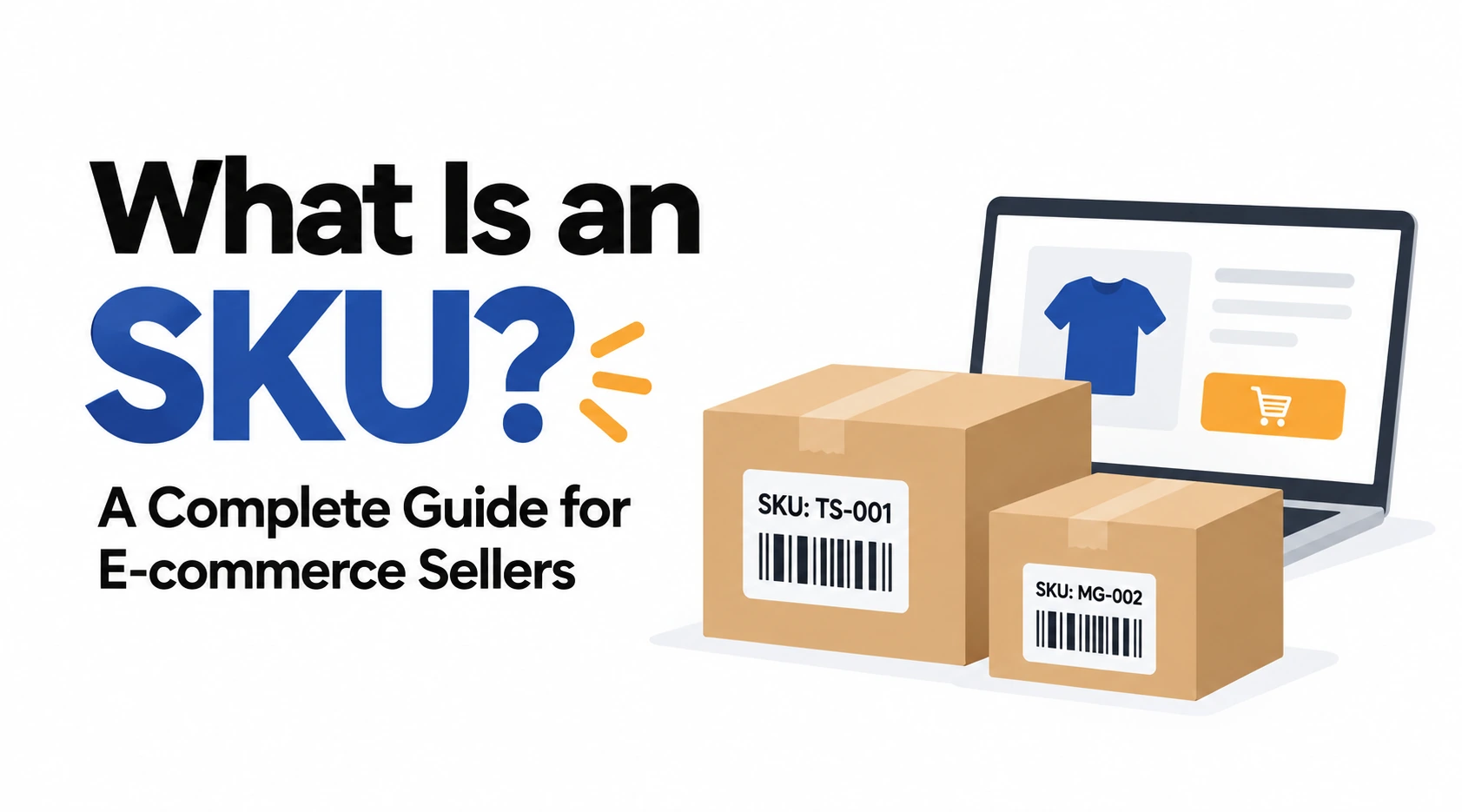
SKU is an internal inventory number used within a business. A GTIN, on the other hand, is a globally accepted product number.
However, there might be a globally accepted GTIN for that product.
A GTIN as well as a SKU can be used by the seller in this regard.

GTIN and Product Variations
The e-commerce sellers generally offer the product in various versions.
Some examples are:
Each of these individual trade items may have its own GTIN based on the GS1 allocation guidelines.
For example:
The use of the same GTIN for different items may lead to catalogue and inventory issues.
Are All E-commerce Products Required to Have a GTIN?
All products do not need to have GTINs in all selling scenarios.
It depends on:
Some marketplaces may ask for a product identifier while creating or mapping a product.
In case of a seller of any existing branded product, you should always use the valid GTIN for your product.
If you are manufacturing private label products, then you must get GTINs for your products.
Whose Duty Is It to Get a GTIN?
thatThe organization which is responsible for assigning the product trade item identification will need to comply with the relevant GS1 standards and allocations.
These organizations can be:
Where you are a reseller selling an already-branded product, in most cases, you should not create a new GTIN simply by virtue of being a new seller of that product. The legitimate identifier of that product is to be used in all normal circumstances.
How to Get a GTIN
Firms can obtain GTINs from GS1 membership organizations.
It usually goes like this:
Companies must be careful not to buy random numbers from non-official agencies just to meet the requirement of a marketplace field. Legitimacy and ownership may be important in catalog and retail validation for product identifiers.
GTIN Registration and Barcode Number
When people type in “GTIN registration,” what they really want is a GS1-assigned number.
A barcode number is the numerical code that is included in the barcode in most retail scenarios. Barcode is just its visualization.
For example:
This information is important since creating a barcode visualization does not automatically generate a globally valid product identifier.
GTIN and Product Data
While the GTIN codes identify the product, they do not have all the data about the product itself.
Product data may include:
GTIN is a key that makes possible linking the product to its data.
That is why product catalogues need to be accurate. Inaccurate product listing details even with a GTIN may lead to catalogue errors.
Common GTIN Errors Made by E-commerce Sellers
Use of Random Barcode Generator
Creating a barcode does not always guarantee legitimacy of GTIN.
Usage of One GTIN for Several Products
Several trade items may necessitate separate GTINs. It is up to sellers to stick to the relevant allocation rules.
Misconception That SKU Equals GTIN
Internal SKU does not equal an internationally accepted product ID that marketplaces are looking for.
Usage of GTIN from Another Company
GTIN creation belongs solely to the manufacturer of that product; therefore, sellers are not supposed to create and take ownership of another company’s GTIN.
Inaccurate Product Details
GTIN needs to go hand in hand with the right product details that should reflect the product itself.
Not Taking Product Variations into Account
There is a list of factors such as size, colour, pack quantity that affect product identification requirements.
Why GTIN Is Important for Product Listing?
The advantages for the seller may include:
Thus, a GTIN is not just a barcode on a package. This is a component of a wider system of product identification.
Conclusion
GTIN is a globally accepted product identifier that is used by businesses, retailers, marketplaces, and supply chains in order to identify the trade item in question. GTINs can come in several types, such as GTIN-8, GTIN-12, GTIN-13, and GTIN-14.
If you produce or own a private label product, obtaining legitimate GTINs via the right GS1 member organisation will enable you to set up a proper product identification process. If you sell an existing branded product, use its legitimate identifier instead of assigning a new one.

FAQ’s
No. GTIN is a numeric product identifier, whereas a barcode is a machine-readable representation that encodes the GTIN. GTIN exists independently of being encoded in a barcode.
GTIN is an identifier of a product recognized internationally. SKU is a unique identifier for inventory assigned by a specific seller to a certain product.
Organisations usually get GTINs via the appropriate GS1 member organisation and allocate them in accordance with GS1 Identification Standards. This is dependent on the particular business and their needs.
Not necessarily. It depends on the product, marketplace, retailer, geography, and business needs. Existing products with brands usually have their identifier, while products with a private label or brand ownership might require a business to obtain GTINs.