

India has emerged as a massive player in world manufacturing – a force to be reckoned with in sectors like textiles, handicrafts, machinery, food, chemicals, and pharma. However, not every manufacturer has the confidence or expertise to deal with customers overseas on their own. Exporting to the world involves a whole lot more than just making a product – you need to know your international trade law inside out, be on top of your game when it comes to logistics and shipping, and have a handle on customs forms, paperwork, and foreign market research. A lot of Indian businesses therefore opt for indirect export as their route into the global trade arena.
This method of exporting allows manufacturers to get their products on to the global market without having to deal with all the responsibilities that come with it. Instead, they sell their products to intermediaries like merchant exporters, export houses, agents, or trading companies who handle the overseas business side of things while the manufacturer just focuses on the product. For thousands of small and medium sized businesses in India, this is a much safer and a lot more budget-friendly way to take part in international trade.
What Exactly is Indirect Export?
If you want to expand internationally but don’t want to deal with the nitty-gritty of exporting yourself, then you need to have a good understanding of indirect export. In simple terms, it happens when a manufacturer sells their product to another domestic business or an intermediary, which then ships it on to a foreign buyer.
For example, a handicraft manufacturer in Jaipur might sell decorative items to an export house in Delhi who then ships them off to buyers in Europe or the US. Similarly, a spice producer in Kerala might sell their produce to a merchant exporter who handles all the international orders and logistics.
These indirect export examples show just how easy it is for manufacturers to get into global markets without having to build their own export infrastructure. They don’t have to worry about the hassle of customs, international marketing, and shipping. They can just rely on experienced intermediaries to handle all that for them.
Another good example is in the textile industry where garment manufacturers supply products to trading companies who then send them off to international fashion brands. By doing it this way, Indian manufacturers get access to overseas demand without having to deal with all the complexity.
Why Do Businesses Choose Indirect Export?
One of the main reasons Indian manufacturers choose to go this route is because of the many indirect export benefits it offers. Exporting on their own can be a huge financial risk and can require a lot of investment, expertise and compliance knowledge. Smaller businesses might not have the resources to do it all on their own.
The biggest indirect export benefits include reduced financial risk. Since the intermediary handles the shipping, foreign buyer negotiations, customs clearance and international payments, the manufacturer can just focus on getting the right quality product to market on time.
Another big benefit is that it gets you into international markets much faster. Established exporters already have established networks of foreign buyers, distributors, and logistics partners. This means manufacturers can get into global markets a lot more quickly than if they had to build those relationships on their own.
The indirect export benefits also include much simplified documentation. Exporting in India can be a nightmare with all the forms, certificates, customs paperwork and compliance regulations involved. An intermediary with experience can take care of all that, making it a lot easier for the manufacturer.
Merchant Exports vs Manufacturing Exports
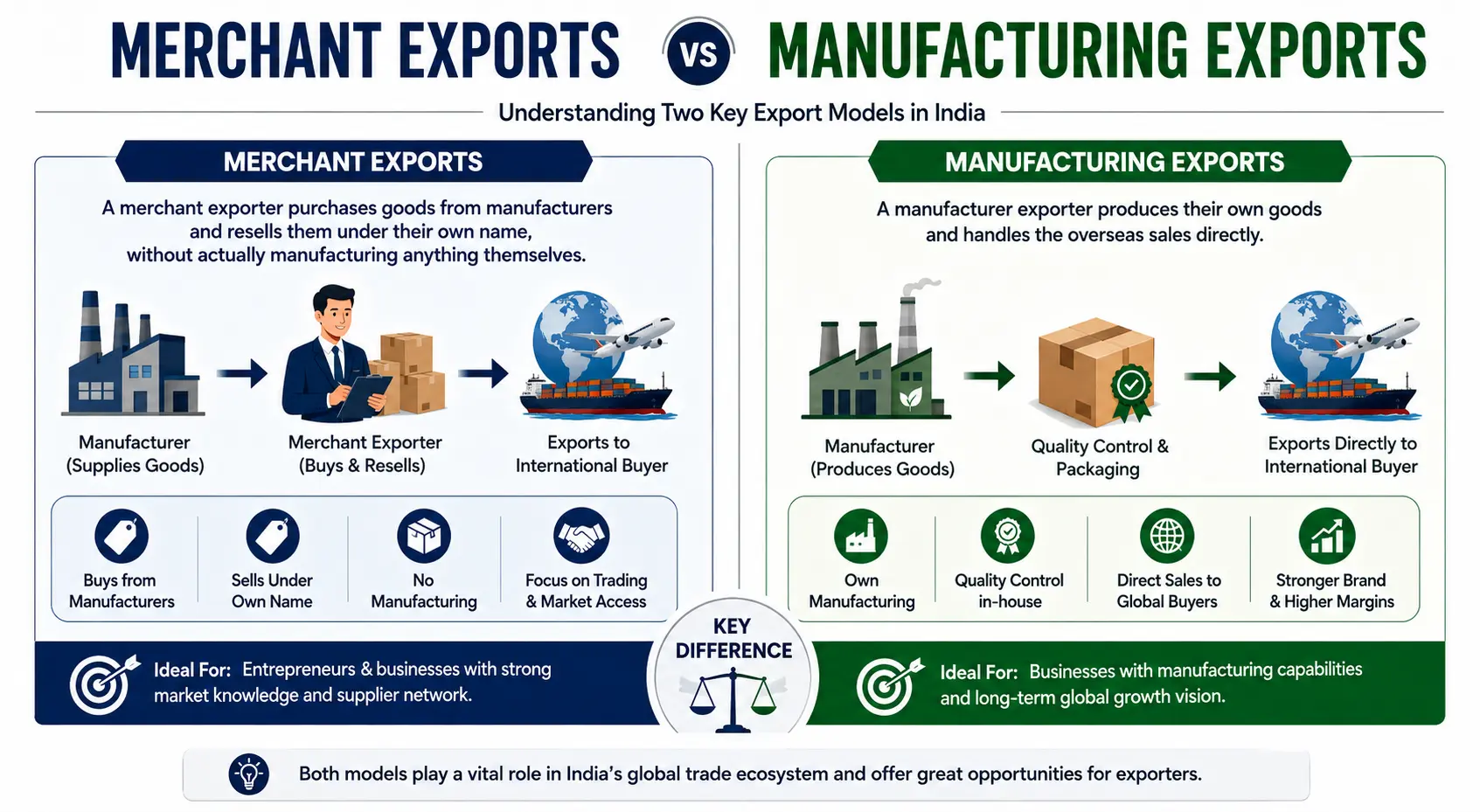
Its worth taking a look at the merchant exporter vs manufacturer exporter conundrum if you want to get a better grasp on the various export structures in India. At its core, a merchant exporter purchases goods from manufacturers and then resells them under their own name, without actually manufacturing anything themselves. On the other hand, a manufacturer exporter produces their own goods and handles the overseas sales directly.
When comparing merchant exporter vs manufacturer exporter, one of the biggest differences comes down to operational responsibility. Typically, merchant exporters handle international buyers, export documentation, logistics, and shipping arrangements, while manufacturers tend to just supply products in line with agreed upon specs.
But manufacturer exporters are a different story altogether – they’re the ones who actually deal directly with foreign buyers and take on the bulk of the export operations. This takes a lot of investment, export know-how, and market research on their part.
Exporting Through Trading Companies in India
The export through trading companies India setup has been a key factor in helping Indian manufacturers for decades now. Trading companies act as middlemen that connect foreign buyers up with domestic manufacturers.
You can see the popularity of export through trading companies India in just about any industry – garments, engineering goods, food processing, home furnishings, and handicrafts are just a few examples. For instance, a trading company might buy home furnishing products from multiple small factories in Panipat and then ship them all out to retailers in Europe as a single, consolidated order.
Another benefit of export through trading companies India is that they’re always on top of international market trends and buyer preferences. This lets manufacturers tweak their products to fit what the foreign market is looking for without needing to do their own research.
Understanding the Role of Export Houses in India
The export house role India plays is pretty big – especially for small and medium manufacturers trying to get their products onto the global market. Export houses are recognized organizations that specialize in pushing exports and managing overseas business operations.
The main point of the export house role India is to connect Indian manufacturers up with global buyers. These organizations attend international trade fairs, maintain relationships with foreign buyers, and handle export documentation and logistics – the whole nine yards.
The Export House Role in India becomes particularly valuable for companies where maintaining strong relationships with buyers and marketing internationally is key to growth. In the export houses, you often find years of international trade experience, enabling manufacturers to tap into global opportunities with a lot less hassle.
Third-Party Export India & Its Rapidly Growing Popularity
The idea of third-party export India has really taken off among start-ups and small manufacturers. Here’s how it works – one company makes the goods, but they are exported through another exporter’s infrastructure and all the paperwork.
Under third-party export India the goods are made by one company while another company handles all the customs procedures, shipping, export invoices and foreign transactions. This lets manufacturers take part in exporting without having to deal with all the operational headaches.
This third-party export model is really popular in industries like garments, processed foods, pharmaceuticals, electronics and handicrafts. A lot of smaller businesses use this model to get a feel for the international market before investing in their own exporting setup.
How Indian Manufacturers Export Via Agents – It’s a Key Form of Indirect Exporting
Understanding how Indian manufacturers export via agents helps explain another really important form of indirect exporting. Export agents act as middlemen who connect overseas buyers with Indian manufacturers.
In the system of how Indian manufacturers export via agents the agent makes a commission for setting up the export deal. These agents usually have a deep knowledge of international markets and what buyers are looking for.
Take for instance a buying agent who represents European retailers – they might source garments from factories in Tiruppur. Similarly, handicraft sourcing agents might work with artisans across Rajasthan and Uttar Pradesh.
Export Intermediaries Examples across Indian Industries
There are all sorts of practical export intermediaries examples operating throughout India’s export ecosystem. These intermediaries play a really important role in making international trade easier for manufacturers.
Common export intermediaries examples include merchant exporters, export houses, trading companies, buying agents and commission agents. Each one does their own thing depending on the industry and the export structure.
For instance in the textile sector, trading companies often source products from multiple garment factories and export them to international fashion brands. In the handicraft industry, export houses help artisans and small manufacturer’s access global markets by using their established buyer networks.
Export Intermediaries Examples – The Low-Risk Way to Export
You can find plenty of examples of export intermediaries in action – in engineering goods, agri-products, processed foods and even pharmaceuticals. These guys really make life easier for manufacturers – freeing them up from the burden of export hassle and making it much smoother for them to reach foreign markets.
Because export intermediaries have the expertise in logistics, customs, paperwork and international deal-making you can see why they’re so handy – they can help manufacturers avoid a lot of the common pitfalls of export.
The Benefits of Indirect Exporting for Small Businesses
In a developing economy like India, the benefits of indirect exporting for small business are especially important. Many of these firms have very limited resources and can’t afford to take on the risks of exporting on their own.
One of the biggest benefits of indirect exporting for small business is that you need to invest very little – no need to set up offices abroad, hire export experts, or waste money on international marketing.
Another advantage is that it reduces the risk – the intermediaries deal with all the headaches like shipping problems, talking to the buyer, dealing with foreign currency and customs compliance.
The benefits of indirect exporting for small business also mean they can expand internationally much faster – the intermediaries already have all the connections with buyers so you can get orders coming in a lot quicker.
And then there’s the fact that small manufacturers get to learn on the job about things like product quality standards, packaging requirements and global demand trends. This experience can later come in handy if they decide to start exporting directly.
For small manufacturers, indirect exporting is a practical and low-risk way to dip their toes into global trade.
Export without IEC (Import Export Code) – Yes It Can Be Done
Some businesses wonder if export without IEC (Import Export Code) is possible in India. Well, in most cases of direct exporting, you do need to get an IEC from the Directorate General of Foreign Trade.
However, there are some indirect export models where you can actually export without your own IEC – for example, if you’re supplying products to a merchant exporter or third-party exporter who already has an IEC. So, some manufacturers can still be involved in international trade even if they don’t have an IEC themselves.
The concept of export without IEC (Import Export Code) is often seen in vendor partnerships, job work manufacturing and third-party export deals. Even so, most businesses are advised to get their own IEC if they’re planning long-term export growth – it gives you more independence and flexibility to expand into direct exports.
Challenges of Indirect Export
While indirect exporting offers many advantages, it’s worth understanding its limitations. One common problem is lower profit margins because intermediaries take a cut of the export earnings.
You may also have limited control over your international brand and customer relationships – in many cases, your products are being sold under another company’s name, not your own brand.
Another challenge is being too dependent on your export partner – if the intermediary loses customers or changes their business priorities, you may find your export orders getting disrupted.
Despite these limitations, indirect export is still a great way for businesses to get into international markets without taking on too much risk.
Conclusion
For many Indian manufacturers, the thought of exporting directly can seem like a nightmare – all the paperwork, logistics complexities, foreign buyer management and compliance rules. That’s why indirect export is still one of the most effective methods for getting into international trade.
FAQs
Indirect export is when you sell your products to other countries using middlemen like merchant exporters, export houses or trading companies – rather than dealing with the buyers yourself, foreign or otherwise.
Indirect exporting can reduce the risk, lower the costs, simplify the paperwork, make logistics easier, and get you faster access to those new international markets.
A merchant exporter buys stuff from makers and then ships it off, while a manufacturer exporter makes their own products and then sends them to buyers overseas.
Well now, in some cases where the manufacturer teams up with an exporter who actually has an IEC, they can still send their wares off to other countries. However, businesses planning on exporting directly are usually the ones who have to get their own IEC.