

✨ AI Overview
Minimum Order Quantity (MOQ) is the minimum number of units a supplier or manufacturer is willing to produce or sell in a single order. It plays a critical role in product sourcing, manufacturing, inventory planning, and supply chain management, helping businesses balance production efficiency with profitability. Manufacturers often set MOQs to cover machinery, labor, and raw material costs, while buyers must carefully evaluate MOQ requirements to manage inventory levels, reduce costs, and maintain healthy cash flow.
Minimum Order Quantity (MOQ): Meaning, Importance, and How to Negotiate It
Whether you’re starting an eCommerce business, sourcing products from manufacturers, or exporting goods internationally, you’ve likely come across the term MOQ. Understanding Minimum Order Quantity (MOQ) is essential because it directly impacts your purchasing costs, inventory, cash flow, and supplier relationships.
In this guide, we’ll explain the MOQ full form, its meaning in business, why suppliers set MOQs, and practical strategies to negotiate better terms.
What is MOQ?
The MOQ full form is Minimum Order Quantity.
Minimum Order Quantity (MOQ) refers to the smallest quantity of a product that a supplier or manufacturer is willing to sell in a single order. It helps suppliers ensure that each order is profitable and covers their production, packaging, and operational costs.
For example:
- A clothing manufacturer may have an MOQ of 500 T-shirts.
- A packaging supplier may require a minimum order quantity of 1,000 boxes.
- A cosmetics manufacturer may set an MOQ of 200 bottles per product variant.
In simple terms, if the supplier’s MOQ is 500 units, you cannot place an order for just 100 units unless they agree to make an exception.
MOQ Meaning in Business
The MOQ meaning in business refers to the minimum purchase requirement that buyers must meet before a supplier accepts an order.
Businesses use MOQ to:
- Maintain profitability
- Reduce production costs
- Optimize manufacturing schedules
- Minimize inventory handling
- Improve supply chain efficiency
Whether you’re sourcing products domestically or internationally, understanding what is MOQ in business helps you plan purchases more effectively.
MOQ Meaning in English
The MOQ meaning in English is simply Minimum Order Quantity, which means the minimum number of units a customer must buy from a supplier in one order.
Why Do Suppliers Set a Minimum Order Quantity
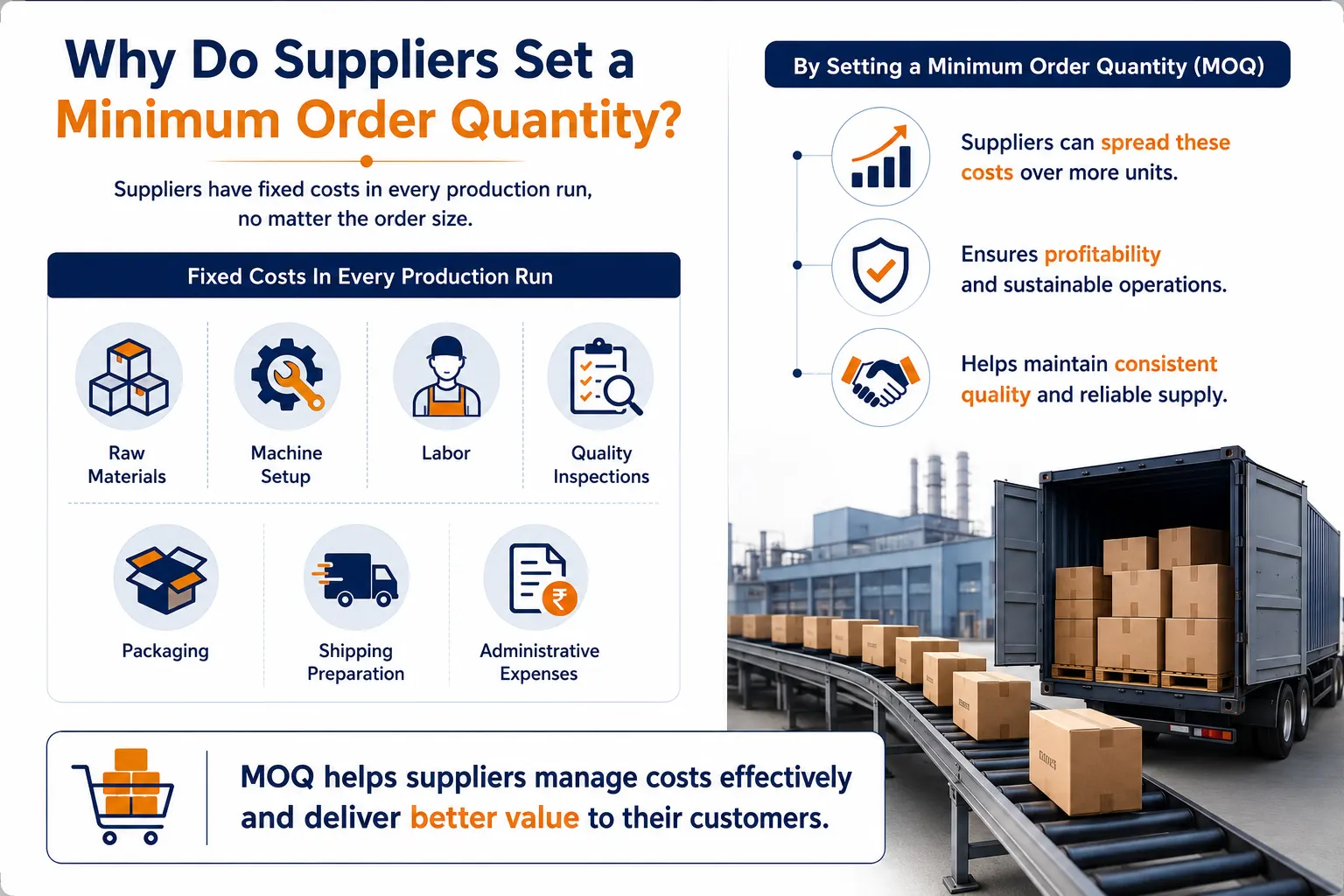
Manufacturers and wholesalers incur fixed costs for every production run, regardless of the order size. These include:
- Raw materials
- Machine setup
- Labor
- Quality inspections
- Packaging
- Shipping preparation
- Administrative expenses
By setting a minimum order quantity, suppliers ensure that these costs are spread across enough units to make the order financially viable.
What is MOQ in Manufacturing?
What is MOQ in manufacturing?
In manufacturing, MOQ is the smallest production batch a factory is willing to produce. Production lines often require setup time and resources, making very small orders expensive.
For example:
- Plastic bottle manufacturer: MOQ of 10,000 pieces
- Garment factory: MOQ of 300 pieces per design
- Furniture manufacturer: MOQ of 50 units
Manufacturing MOQs help factories improve production efficiency and reduce waste.
What is MOQ in Export?
What is MOQ in export?
In international trade, MOQ refers to the minimum quantity that exporters require from overseas buyers before processing an export order.
Export MOQs are often higher because international shipments involve:
- Export documentation
- Customs clearance
- Freight costs
- International packaging
- Insurance
- Compliance requirements
Meeting the export MOQ helps keep shipping costs economical and ensures profitability for exporters.
MOQ Meaning in Supply Chain
The MOQ meaning in supply chain refers to the minimum purchase level required to keep procurement, inventory, production, and logistics operations cost-effective.
MOQs help businesses:
- Plan inventory efficiently
- Forecast demand
- Reduce warehousing costs
- Improve production planning
- Optimize transportation
Low MOQ Meaning
Low MOQ meaning refers to suppliers that allow customers to purchase relatively small quantities.
For example:
- MOQ: 20 units
- MOQ: 50 units
- MOQ: 100 units
Low MOQ suppliers are ideal for:
- Startups
- Small businesses
- Online sellers
- Product testing
- New product launches
A low MOQ reduces financial risk and allows businesses to experiment without holding excessive inventory.
High MOQ Meaning
A high MOQ means the supplier requires buyers to purchase a large number of units before accepting an order.
Examples include:
- 5,000 bottles
- 10,000 packaging boxes
- 20,000 electronic components
High MOQs are common in industries with expensive production setups or large-scale manufacturing.
Why is Minimum Order Quantity Important?
1. Better Production Efficiency
Manufacturers can produce larger batches at lower per-unit costs.
2. Lower Manufacturing Costs
Producing more units reduces the cost per item through economies of scale.
3. Improved Profitability
MOQs ensure suppliers cover fixed costs and maintain healthy profit margins.
4. Inventory Planning
Businesses can better forecast stock requirements and avoid frequent reordering.
5. Efficient Shipping
Larger shipments often reduce transportation costs per unit.
Advantages of MOQ for Suppliers
Suppliers benefit from MOQs because they:
- Reduce production downtime
- Increase operational efficiency
- Lower packaging costs
- Improve cash flow
- Simplify inventory management
- Maximize factory utilization
Challenges of High MOQ for Buyers
While MOQs benefit suppliers, they can create challenges for buyers:
- Higher upfront investment
- Increased inventory costs
- Greater storage requirements
- Risk of unsold stock
- Cash flow constraints
These challenges are especially significant for startups and small businesses.
How to Negotiate Minimum Order Quantitty
What is an MOQ Surcharge?
An MOQ surcharge is an additional fee charged when a buyer places an order below the supplier’s minimum order quantity.
Instead of rejecting small orders, some suppliers accept them by charging extra to cover:
- Machine setup
- Labor
- Packaging
- Administrative costs
Paying an MOQ surcharge may be worthwhile if you’re testing a new product or supplier.
MOQ Examples
Example 1
A notebook manufacturer has an MOQ of 1,000 units.
If you need only 300 units, the supplier may:
- Decline the order
- Charge a higher price
- Apply an MOQ surcharge
Example 2
A T-shirt manufacturer requires an MOQ of 500 pieces, but allows:
- 200 Black
- 150 White
- 150 Blue
This helps buyers meet the total MOQ while offering multiple variants.
How to Choose the Right MOQ Supplier
Before placing an order, consider:
- Product quality
- MOQ flexibility
- Pricing
- Production capacity
- Lead time
- Shipping options
- Export experience
- Customer reviews
- Communication
Choosing the right supplier is about more than just finding the lowest MOQ.
MOQ Best Practices for Businesses
To manage MOQs effectively:
- Forecast demand accurately.
- Avoid over-ordering.
- Negotiate before placing large orders.
- Compare multiple suppliers.
- Start with low MOQ suppliers when testing products.
- Build long-term supplier relationships.
- Calculate storage and inventory costs before purchasing.
The full form of MOQ is Minimum Order Quantity.
MOQ in business is the minimum number of products a supplier requires a buyer to purchase in a single order.
A high MOQ requires buyers to purchase a larger quantity, helping suppliers reduce production costs and improve efficiency.