

Export Import Bank of India plays a vital role in boosting India’s international trade scene. Founded in 1982, it was created way back when to give Indian exporters and importers a helping hand with finances, expert advice and support for overseas investments. These days with the global marketplace getting increasingly competitive Indian businesses often need a bit of a leg up to break into foreign markets. That’s where the Export Import Bank of India really comes into its own.
The bank is the key financial institution for all cross border trade business in the country and gives support to exporters big or small, from Major Corporations right down to new start-ups and small to medium sized enterprises. With a range of financing options and advisory services on hand it enables Indian businesses to become more competitive in export markets and manage the risks associated with trading internationally.
EXIM Bank of India Schemes for Exporters and SMEs
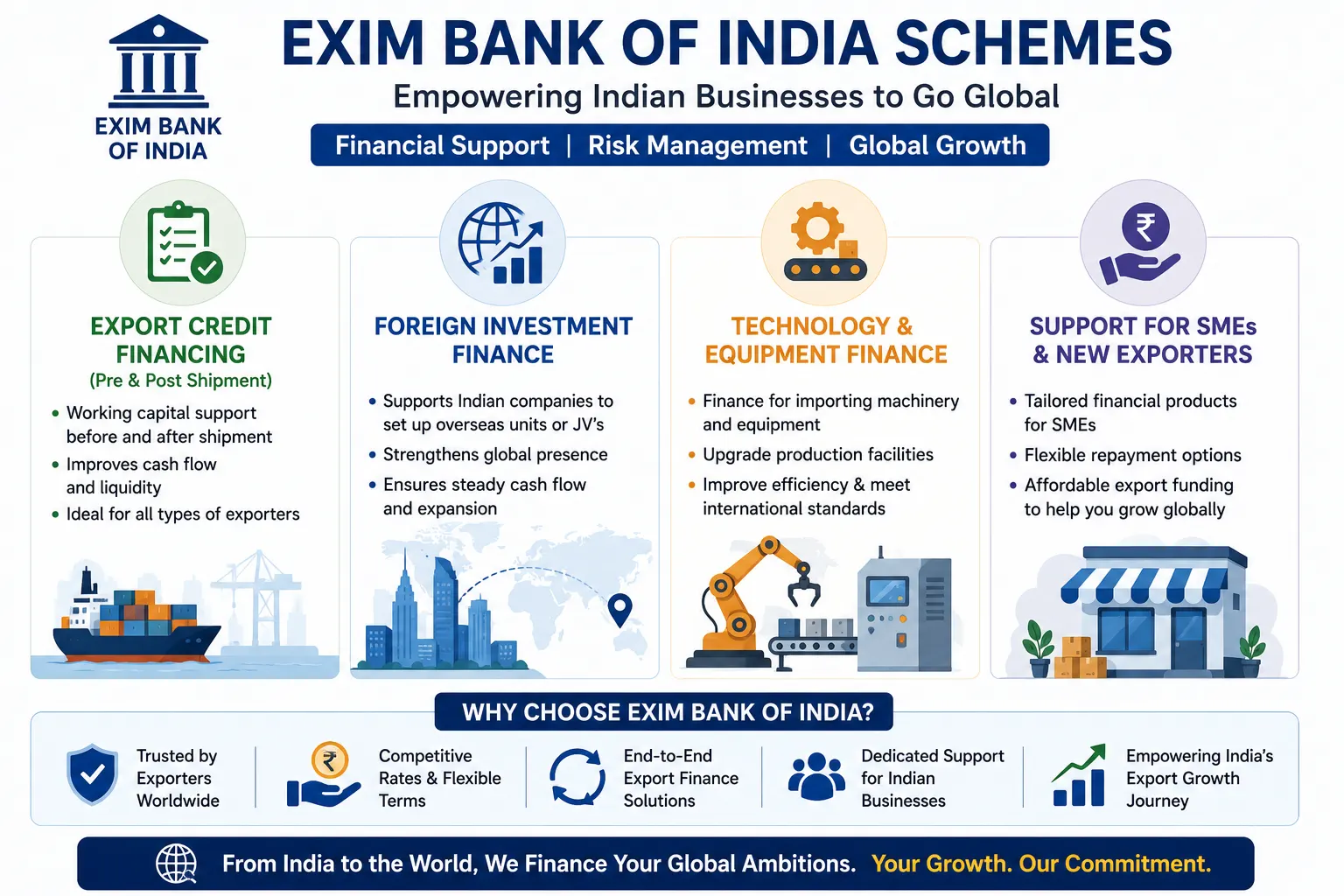
There are a number of EXIM Bank of India schemes in place to assist businesses at different stages of export activity. These are particularly useful for small and medium sized businesses and new exporters who are on the lookout for affordable capital and risk management support.
One of the most widely used schemes is pre-shipment and post-shipment export credit financing. The bank also provides foreign investment finance to Indian companies looking to set up outposts or joint ventures abroad. This helps Indian brands go global and maintain a stable cash flow.
The bank also has a technology and equipment finance scheme in place which helps exporters upgrade and modernise to meet international quality standards. This can be for importing new machinery, upgrading production facilities or simply making production more efficient.
If you are a small business looking for export funding for your SME’s in India the EXIM Bank has got you covered. They offer a range of financial products with flexible repayment options that are tailored to suit your needs. This support is especially helpful for any businesses that are new to exports.
Export Financing India EXIM Support for Working Capital Needs
One of the main challenges that exporters face is maintaining cash flow during long international trade cycles. The Export Import Bank offers various export financing India EXIM programs to help exporters keep up with their operations while they wait for overseas payments to come through.
International trade transactions often involve extended credit periods and exporters need to organise funding for manufacturing, packaging, shipping, customs clearance and all the rest before they even get paid. To combat this the EXIM Bank offers working capital assistance through a structured range of export financing solutions.
The bank works closely with other commercial banks and financial institutions to make sure that exporters can get the funding they need to do business. That lets businesses use this support to pick up the raw materials they need, pay their employees, sort out logistics, and get their export orders out the door in one piece.
Pre-Shipment and Post-Shipment Finance Explained
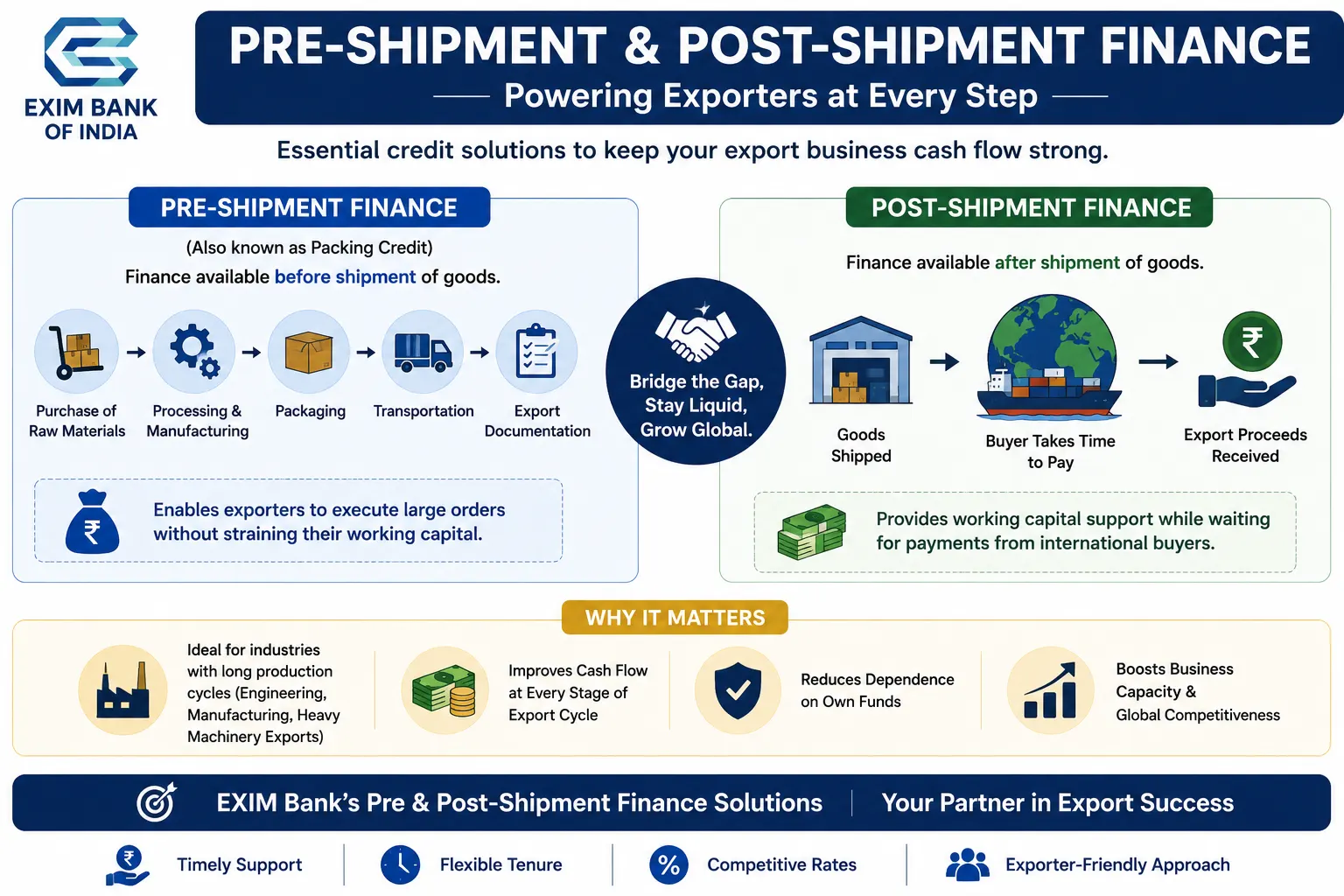
One of the really key financial services that EXIM bank offers is pre-shipment and post-shipment finance. These two types of credit are pretty essential for exporters who are dealing with international orders.
Pre-shipment finance (also sometimes known as packing credit) gets handed out before you ship anything. Exporters use these funds to buy the raw materials they need, process the goods, package the lot, get them transported, and sort out the export documentation. So it lets exporters deal with big orders without messing up their cash flow.
Post-shipment finance gets handed out after the goods have left the country. Because international buyers often take time to pay, exporters need a temporary injection of cash to stay liquid while they wait for their export proceeds to come in. That’s where post-shipment finance comes in: it helps businesses bridge that gap until the money shows up.
For industries with really long production cycles such as engineering, manufacturing, and heavy machinery exports it’s especially helpful to have pre-shipment and post-shipment finance available. It also takes the pressure off exporters to have to rely entirely on their own funds.
Export Credit India Government Initiatives and Institutional Support
The Indian Government has brought in various measures to help exporters be more competitive, and EXIM Bank plays a big role in putting these policies into action. There are loads of different government-backed export incentives and initiatives that aim to help exporters get better access to financing and reduce the financial risks that come with trade.
Government backed export incentives often get used in conjunction with EXIM Bank financing facilities. Exporters can get help with things like interest equalisation schemes, duty remission programs, export insurance, and even get some of their financing costs written down. That makes it easier for businesses to get involved in international trade.
The Indian government also has an export credit support system in place that includes collaboration between EXIM Bank, ECGC, RBI, and commercial banks. Together, these institutions can provide things like credit guarantees, trade risk insurance, and even help with managing foreign exchange.
Buyer’s Credit and Supplier’s Credit in International Trade
There are two key financing tools supported by the Export Import Bank of India that really help grease the wheels of international trade : buyer’s credit and supplier’s credit. These financial tools can be a big help to Indian companies looking to get their exports off the ground.
Buyer’s credit is essentially a loan given to overseas buyers so they can buy Indian goods and services – Exim Bank lends directly to the foreign buyer, allowing Indian exporters to get paid promptly while the buyer repays the loan over time.
But with supplier’s credit, it’s the Indian exporter who gets the loan from Exim Bank – this allows them to offer overseas customers flexible payment terms, making it more attractive to buyers who like to have options.
Export Import Bank of India Loan Eligibility and Application Process
Understanding Exim Bank loan eligibility is pretty key for any exporter looking for help – but you’ve got to meet the right criteria to get in.
It varies depending on the type of financing and the size of the exporter’s operation but basically you need to have a valid Import Export Code, be running a stable business, and have some export orders lined up and a good chance of getting paid back on time.
MSMEs, merchant exporters, manufacturer exporters and service exporters can all qualify under different Exim Bank financing schemes.
They take a look at things like your export record, how much business you’re doing, your financial statements, your reputation in the market and how reliable your overseas buyers are before deciding to lend you the cash. Even start-ups involved in export orientated manufacturing can get some help under certain special programs.
EXIM Bank Interest Rates India and Cost of Borrowing
One of the main things on an exporter’s mind is how affordable the finance is going to be – Exim Bank interest rates in India depend on a few things like the type of credit facility, how long you’re borrowing for, your credit history and international benchmark rates.
Interest rates will vary for working capital finance, overseas investment loans, project exports and buyer’s credit facilities – the stronger your financial record and the more established your international markets the better deal you can expect to get.
In comparison to traditional business loans, Exim Bank finance is often a lot more tailored to your export business cycle – they can offer flexible repayment terms and customized financing models to make things easier.
When you’re evaluating Exim Bank interest rates India you should also be thinking about the other benefits they offer like longer repayment periods, specialized advisory support and access to international trade networks.
Lower financing costs can help exporters negotiate better global pricing strategies and manage their foreign market expansion more confidently.
How Exporters Get Finance India through EXIM Bank Support
One of the really key financial services that EXIM bank offers is pre-shipment and post-shipment finance. These two types of credit are pretty essential for exporters who are dealing with international orders.
Pre-shipment finance (also sometimes known as packing credit) gets handed out before you ship anything. Exporters use these funds to buy the raw materials they need, process the goods, package the lot, get them transported, and sort out the export documentation. So it lets exporters deal with big orders without messing up their cash flow.
Post-shipment finance gets handed out after the goods have left the country. Because international buyers often take time to pay, exporters need a temporary injection of cash to stay liquid while they wait for their export proceeds to come in. That’s where post-shipment finance comes in: it helps businesses bridge that gap until the money shows up.
For industries with really long production cycles such as engineering, manufacturing, and heavy machinery exports it’s especially helpful to have pre-shipment and post-shipment finance available. It also takes the pressure off exporters to have to rely entirely on their own funds.
Benefits of EXIM Bank Support for Indian Exporters
EXIM Bank does a whole lot more than just lending out money to exporters. By getting financial support from them, businesses are better able to manage cash flow, reduce trade risks and get access to overseas markets.
The bank has loads of expertise in international trade finance which helps exporters navigate all the different rules and regulations, as well as handling the risks of dealing with foreign markets and cross-border payments systems. Exporters also gain more credibility when it comes to dealing with international customers thanks to EXIM-backed financing.
Another big plus is support for export diversification. Companies looking to break into new markets can use EXIM Bank assistance to help them expand into new territories and get involved in overseas projects.
Indian small businesses are a particular case in point because they often have trouble getting access to affordable international trade financing from the main banks. EXIM Bank bridges this gap with its specialized export-oriented funding programs.
Conclusion
The Export Import Bank of India has become an incredibly important institution for India’s global trade ambitions. By providing things like structured financing, export credit support and overseas investment assistance, it gives businesses the confidence to compete on the world stage.
Whether a company is just starting out or is already exporting on a big scale, EXIM Bank has got solutions that cater to the needs of international trade. From a small manufacturer to a big buyer, businesses across all sorts of industries can use these financial tools to make their export operations more stable and their presence in the global market more secure.
As India puts more of a focus on selling more to the rest of the world, and on improving its manufacturing competitiveness, the role of EXIM Bank is going to remain key to supporting exporters and driving economic growth.
FAQs
The main purpose of EXIM Bank is to provide financial support to Indian exporters and importers and give them access to things like export credit and overseas investment support as well as advice on international trade.
All sorts of businesses can apply for EXIM Bank financing – manufacturers, merchants, small and medium-sized businesses, new companies and anyone else who is involved in international trade can apply, as long as they meet the right criteria.
Pre-shipment finance is essentially a helping hand for manufacturers and packers to get their goods to the point of export. Post shipment finance comes in once those goods are out the door, and you’re just waiting on that foreign buyer to cough up the cash.
Exim Bank interest rates are often tweaked to fit the needs of exporters & may offer pretty flexible repayment plans as well as some competitive financing options – dependant on the exporter in question & what they’re trying to achieve.