
India’s export ecosystem has got a lot of support from government policies that aim to make domestic manufacturing stronger and more competitive on the world stage. One thing that people often get wrong is what’s called “deemed export”, even though it’s a crucial part of the Foreign Trade Policy. Deemed exports are basically when goods are supplied within India but treated like exports because they support industries that help with international trade.
For business’s in the manufacturing, infrastructure and export sectors, understanding what Deemed Export for Indian Manufacturers means can unlock some seriously valuable financial and tax benefits like getting GST refunds, not having to pay duties, export incentives and being able to get more working capital working for them.
As India goes on with initiatives like Make in India and Atmanirbhar Bharat, understood Deemed Exports are going to be a lot more important to manufacturers who want to make good profits while supporting big domestic and export linked industries.
Deemed Export Meaning India and why it Matters
Getting to grips with Deemed Export India is a must before you can start thinking about what benefits come with it.
Under India’s Foreign Trade Policy, deemed exports refer to when goods are made in India and payments are received in Indian rupees or foreign currency, but the goods don’t actually leave the country. Just because the product is still in India, the government treats these transactions the same as exports because they support industry that contributes to international trade.
Examples of goods that are considered for Deemed Export include supplies to Export Oriented Units, Projects that are funded by multilateral agencies, Advance Authorization license holders and units that operate under the EPCG scheme.
The idea is valuable because it lets manufacturers get the benefits of being an exporter without having to deal with the headaches of international logistics, customs clearance, and shipping overseas.
Benefits of Deemed Exports for manufacturers in India
The main Benefits of Deemed Export for Manufacturers all centre around saving money, getting tax refunds and becoming more competitive.
Manufacturers who are providing goods under the deemed export category can get their hands on various incentives that cut their operational costs. This all helps out businesses by improving their cash flow and making more money while serving strategic domestic industries.
One of the biggest pluses is that manufacturers can get the incentives of an exporter even if their goods are being sold in India. This creates opportunities for smaller businesses and industrial suppliers that may not directly be involved in international trade.
The overall framework of Deemed Export for Indian Manufacturers encourages domestic production while supporting industries that contribute to India’s export economy.
GST Refund Deemed Exports and Tax Savings
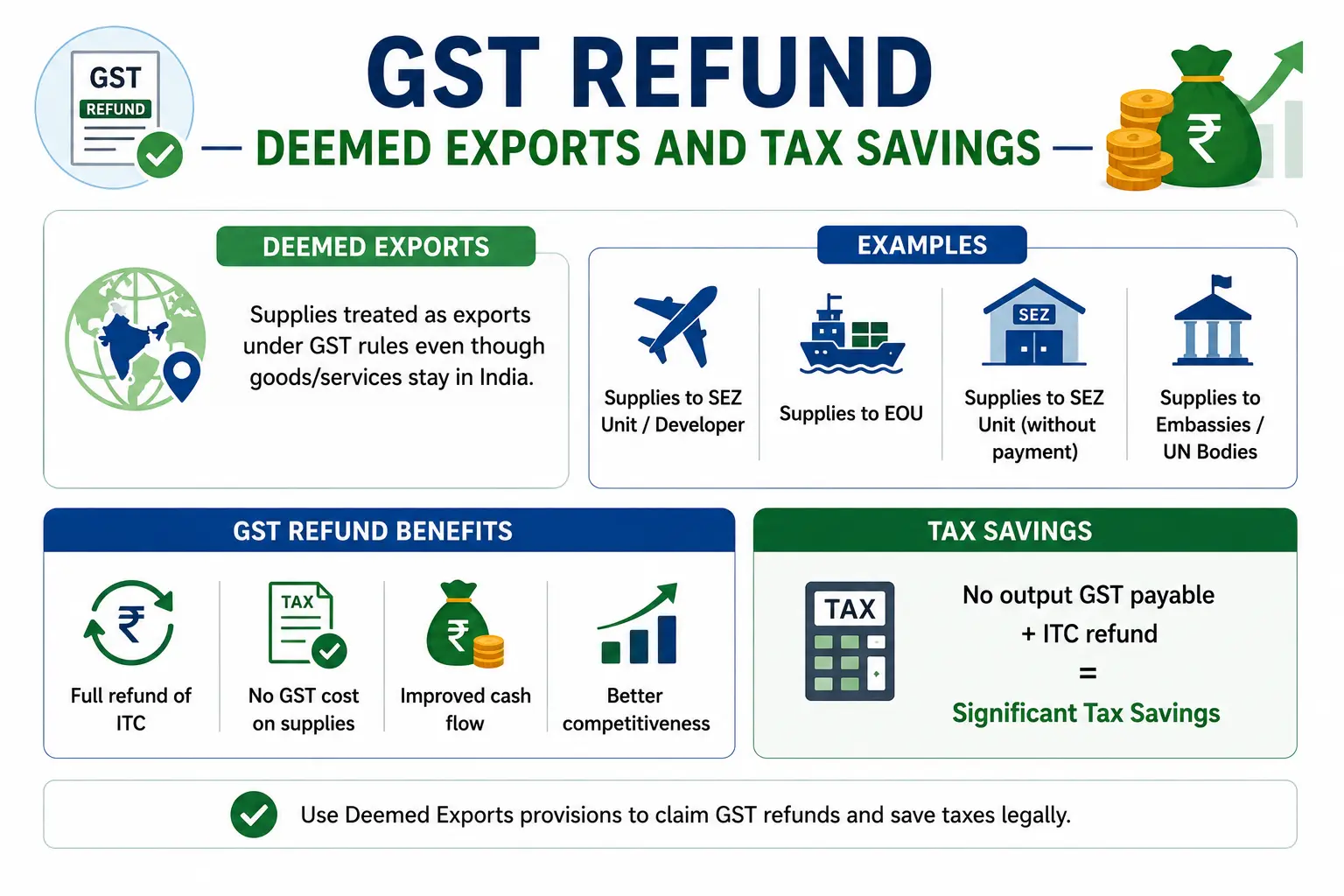
One of the best things for manufacturers is the GST refund benefits on Deemed Export.
Under the deemed export provisions, either the supplier or the recipient can claim a GST refund depending on the transaction, so they can reduce their tax burden and make some working capital available.
For manufacturers dealing with high value goods, machinery, engineering products or raw materials, getting back that GST money can make a huge difference to their cash flow.
The government introduced these provisions so that taxes don’t increase the cost of production for export linked sectors, which means businesses involved in deemed exports can stay competitive on the global scene.
Except for the refunds they get for their GST, there are loads of tax benefits for deemed export transactions available under various schemes and government notifications.
Deemed Exports vs Physical Exports: They’re Not the Same Thing
If you’re looking to make some strategy decisions for your business, then understanding the difference between deemed export vs physical export is kind of a must.
With physical exports, goods actually get shipped outside India, and theoretically at least, the foreign exchange earnings are mandatory. Businesses are left to handle the whole customs procedures, shipping goods internationally, and then there’s the export documentation.
With deemed exports, the goods stay right here in India, but the transaction still qualifies for all the export related benefits under the Foreign Trade Policy.
Now, one of the biggest advantages of deemed exports is the reduced logistical headache. Manufacturers can get all the export incentives without having to worry about international transportation or the risks associated with overseas markets.
But, physical exports generally give you direct access to the global market and foreign customers, whereas deemed exports mainly support domestic entities like export promotion zones or strategic sectors.
Financially speaking, both models have their advantages, but deemed exports offer a simpler route for manufacturers to get access to export incentives.
Tax Refunds for Deemed Exports: A Boon for Manufacturers
The concept of duty drawback deemed export is just another way Indian manufacturers can save some serious cash.
Duty drawback basically means the refund of customs duties or taxes paid on imported inputs that were used in manufacturing goods supplied under deemed export categories.
This benefit really helps manufacturers keep their production costs down and stay competitive in terms of pricing.
For industries that rely on imported raw materials, components or machinery, duty drawback can make a huge difference to profit margins.
The availability of these incentives under Deemed Export for Indian Manufacturers really encourages businesses to take part in sectors that are linked to export promotion and infrastructure development.
Deemed Exports: The Export Incentives India Government is offering
The Indian Government is offering a bunch of export incentives India deemed export schemes to strengthen domestic manufacturing capabilities.
These incentives are designed to really help manufacturers supplying strategic sectors and export linked industries by reducing their cost burden.
Benefits may include tax exemptions, refund mechanisms, concessional taxes, and priority support under industrial promotion programs.
Manufacturers that supply capital goods, engineering products, renewable energy equipment, or industrial machinery often benefit a lot from these schemes.
The government policies supporting deemed exports are actually aligned with India’s broader objective of increasing manufacturing output and boosting exports globally.
Government Schemes for Deemed Export: What Manufacturers Need to Know
There are a few important government schemes deemed export transactions that manufacturers need to be aware of.
The Advance Authorization Scheme lets manufacturers import inputs duty-free for manufacturing products supplied under eligible categories – it’s a big deal.
Similarly, Export Oriented Units (EOUs) can procure goods from domestic manufacturers under deemed export provisions.
Infrastructure and power projects funded by international agencies may also qualify for deemed export benefits.
These schemes help manufacturers improve their production efficiency while reducing tax and import related expenses.
For a lot of businesses, participation in deemed export projects actually creates stable long term industrial demand and opens up new growth opportunities.
EPCG Scheme: It’s Relevance in Deemed Exports
The EPCG (Export Promotion Capital Goods) scheme relevance in deemed exports is massive for industrial manufacturers.
Under the EPCG scheme, businesses can import capital goods at reduced or zero customs duty, subject to export obligations – it’s a pretty sweet deal.
Manufacturers who supply goods to EPCG authorization holders may qualify for the benefits of deemed exports because these supplies, while not being sent abroad, will ultimately help facilitate exports.
This creates new opportunities for domestic machinery manufacturers, engineering companies, and industrial suppliers to boost their sales.
By weaving deemed exports into the EPCG policies, India is able to strengthen its entire manufacturing ecosystem by pushing domestic sourcing over imports.
Financial Benefits Exporters in India Receive Through Deemed Exports
The overall financial benefits that Indian exporters get through these deemed export mechanisms are quite substantial.
Manufacturers get to tap into tax refunds, lower production costs, duty exemptions – and of course – better cash flow management.
Since many of these export transactions involve big industrial or infrastructure projects, businesses also get the benefit of a stable demand and long-term supply contracts.
For MSMEs, these benefits are particularly valuable because they get lower taxes and faster refunds which in turn improves their working capital availability.
The fact that all this can be done without actually stepping into the international market makes deemed exports a pretty attractive option for many manufacturers.
Tax Benefits for Deemed Export Transactions
The various tax benefits available for these deemed export transactions definitely help reduce the burden on manufacturers.
Eligible transactions may get GST refunds, customs duty exemptions, or concessional tax treatment under various government notifications.
All these incentives are designed to make sure that taxes don’t get embedded into the cost structure of goods supplied to sectors linked to exports.
By cutting down those indirect tax costs, manufacturers can offer more competitive pricing and boost their overall profitability.
The tax structure that supports deemed exports is actually designed to create a strong domestic supply chain that complements India’s export growth strategy.
Deemed Export for Indian Manufacturers and MSME Growth
The importance of Deemed Export for Indian Manufacturers is really highlighted in the MSME sector.
Small and medium enterprises often lack the resources to take the plunge and hit the international markets on their own. Deemed export opportunities give them a chance to participate in those all-important export-linked supply chains while still operating within India.
Many MSMEs supply components, industrial goods, packaging materials, and engineering products to large export-hungry businesses or infrastructure projects.
Through these deemed export incentives, these businesses get that much needed financial support which helps them expand their operations and improve their competitiveness.
This policy framework ends up strengthening domestic manufacturing while promoting inclusive industrial growth right across India.
Long-Term Impact of Deemed Export Policies on Indian Manufacturing
The long-term impact of these deemed export policies goes far beyond individual business success.
By giving domestic manufacturing a leg up and reducing tax burdens, these policies encourage more industrial investment and infrastructure development.
Manufacturers become more capable of producing those globally competitive products while still keeping costs down.
The growth of the deemed export sectors also cuts down our reliance on imports and strengthens India’s industrial self-reliance.
As more and more government initiatives keep pushing manufacturing and exports, deemed exports are expected to play an increasingly important role in India’s economic development.
Conclusion
The concept of Deemed Export for Indian Manufacturers holds significant financial, operational, and strategic advantages for businesses operating within India’s industrial ecosystem.
From actual GST refunds and duty drawback benefits to tax breaks and government support schemes, deemed exports help manufacturers boost their profitability without getting bogged down in all the complexities of shipping products abroad.
For Indian businesses looking to get ahead with sustainable growth and a lower tax bill, while also getting more out of export-orientated sectors – Deemed Exports can be a real game-changer.
Frequently Asked Questions
Deemed exports are when Indian made goods are treated as exports under the country’s Foreign Trade Policy – even if they don’t actually leave the country.
The rules can vary, but either the supplier or the recipient can apply for and get a GST refund on eligible Deemed Export deals – depending on what the documentation says.
The big benefits here are GST refunds, some cash back in the form of duty drawback, tax breaks, lower production costs and improved working capital management.