
India’s export ecosystem gets a leg up from several government policies that aim to give a boost to domestic manufacturing, industrial growth, and global competitiveness. One key concept within this framework is regarded as deemed exports. Unlike exports that actually leave the country, deemed exports involve stuff made on the ground that are treated as exports regardless – and that’s because they contribute to export-oriented production or are part of some strategic industrial project.
Understanding the different Deemed Export Categories is pretty crucial for manufacturers, suppliers, contractors and exporters who want to get their hands on tax refunds, duty exemptions and export incentives. Loads of businesses unknowingly qualify for these deemed export benefits but they miss out on claiming them because they just don’t know that they’re eligible.
Getting Deemed Export Categories in India
Deemed export categories India refers to specific local transactions that are treated as exports even though the goods don’t actually leave the country.
These transactions are pretty important for the simple reason that they contribute to export-oriented production, infrastructure development, and strategic industrial projects. The government gives export-related benefits on these supplies to encourage domestic manufacturing and spread the tax burden.
The various Deemed Export Categories include things like supplies to Export Oriented Units (EOUs), Advance Authorization holders, EPCG authorization holders, projects that are funded by international agencies, and several government-notified transactions.
The main idea behind these categories is to strengthen India’s industrial ecosystem and all that comes with growth that may happen.
Deemed Exports Explained and Why It’s Actually Important
Before getting into the classifications lets cover off how deemed exports differ from the usual exports.
Normal exports see goods shipped out of India and foreign exchange earnings. Deemed exports on the other hand – the goods stay within India – but the transaction gets export related treatment under government policy – even though they don’t actually leave the country.
These provisions lets manufacturers and suppliers play in export linked sectors without having to worry about international shipping, customs, or overseas buyers.
Loads of businesses in industries such as industrial machinery, engineering products, infrastructure equipment, and raw material supply get to benefit from these rules.
The end result is that taxes don’t become part of the production cost in sectors that help promote exports or any national development.
How Deemed Exports get classified under Indian Policy
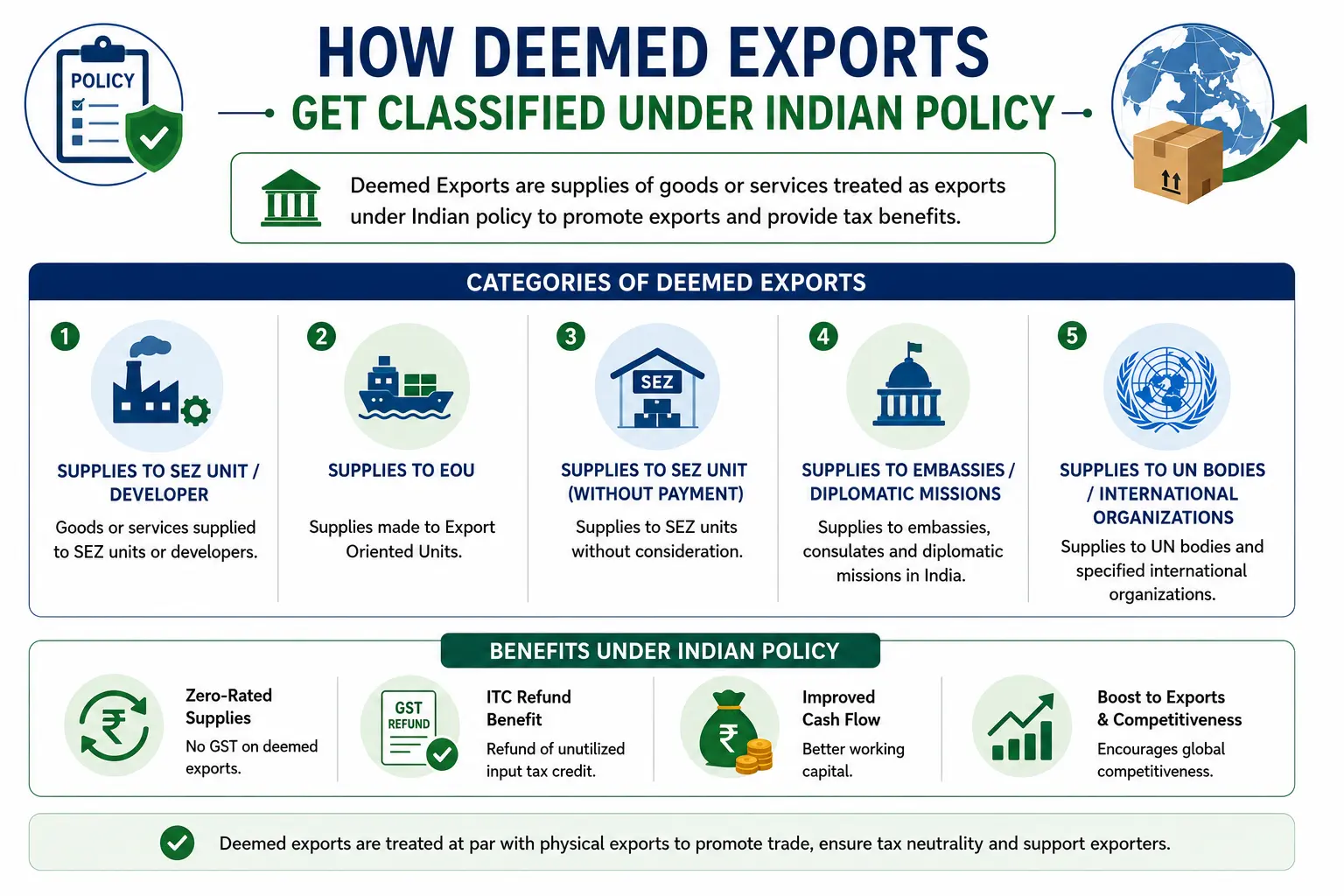
The classification of deemed exports is mainly based on who the recipient is, or what kind of project you’re working on, or the authorization you have in place.
The government pops up new eligible categories every now and then through the Foreign Trade Policy and related government notices.
Some transactions qualify because the recipient is export orientated, while others qualify because they support infrastructure or some strategic industrial development project that’s funded by international bodies.
The broad framework of Deemed Export Categories makes sure that domestic suppliers get similar advantages to exporters even though goods stay within the country.
This policy gives a boost to local sourcing and supports the “Make in India” drive.
EOU Export Oriented Unit – Supplies
One of the most common categories is supply to EOU (Export Oriented Unit) transactions.
EOU’s are companies set up primarily to crank out exports. They often end up buying raw materials, components, machinery and other industrial gear from Indian manufacturers.
When Indian suppliers sell goods to EOU’s, those deals can sometimes qualify as deemed exports under government rules.
Including EOU’s under deemed export categories India is a huge win for MSMEs and industrial suppliers.
Supply to SEZ Deemed Export Transactions
Supplying goods to Special Economic Zones – SEZ’s for short – is sometimes confused with deemed exports.
The thing is, while SEZ supplies are generally zero-rated supplies under GST laws rather than deemed exports under foreign trade policy, they still count as export linked transactions because SEZ’s are designed to get exports moving.
Businesses supplying goods to SEZ units or developers can get tax breaks and other GST perks as a result.
An example might be a steel manufacturer selling raw materials to a company in an SEZ – they might qualify for various tax perks.
SEZ related transactions are a big part of India’s overall export infrastructure and industrial development strategy.
Projects Funded by International Agencies India
Another example is when projects funded by international agencies India qualify as deemed exports.
To qualify, you need supplies made to projects financed by international cash – like the World Bank or the Asian Development Bank or the UN for example.
These projects usually involve major infrastructure development, renewable energy, transport systems, and factory upgrades.
An example might be a domestic manufacturer selling electrical equipment to a metro rail project that got a loan from a global financial institution – they might get some deemed export benefits.
This helps Indian businesses get in on the action for large-scale infrastructure projects while getting some export incentives at the same time.
The inclusion of internationally funded projects into Deemed Export Categories is a big encouragement to Indian manufacturing to play a part in national development projects.
Government Notified Deemed Exports and Their Importance
Some older transactions qualify under government notified deemed exports – which are laid out in official notices and policy updates.
Quite regularly the government will identify sectors or projects or transaction types that are eligible for deemed export benefits.
The idea is to promote industries and make up for some of India’s import shortfalls.
Examples include supplies to projects that got special authorizations, or ones under specific government schemes.
Manufacturers do a lot of business in selling machinery, components, chemicals and other industrial gear to companies who are eligible for these benefits.
So businesses need to keep an eye out for official updates, so they know what’s eligible and what paperwork is required.
Examples of Deemed Export Transactions in Real Business Scenarios
Actually seeing how deemed export transactions work in practice is usually the best way to figure out your chances.
Example – a manufacturer selling machinery that makes garments for international markets – that qualifies as a deemed export.
And another example – an engineering firm selling kit to a power project that got cash from the World Bank – that’s another valid one.
Yet another example – a domestic supplier selling raw materials to a company that’s got an Advance Authorization for making export stuff.
Supplies made to people with EPCG authorization are also eligible in many cases because they help support export linked industrial expansion.
These examples show how domestic transactions can get export-related incentives even when there is no actual physical shipment of goods outside of India.
Domestic Supply Counts as Export in Indian Policy
The idea that domestic supply counts as export is a central part of how India thinks about deemed export policy.
Ordinarily, exports involve international trade but the government has come to see that some domestic supplies contribute to export generation or strategic industrial growth in other ways.
By treating these supplies as exports, the government makes sure that taxes and duties don’t pile up as costs for export-oriented sectors – it makes their costs more competitive.
This all helps create a more level playing field for manufacturers who can import stuff instead of making it at home or who do end up making stuff at home to sell on the export market.
Lots of industrial suppliers benefit quite a bit because they can get access to incentives for exports while still operating entirely in India.
Eligible Transactions for Deemed Export Businesses You Need to Know
Understand the rules on eligible transactions for deemed exports so businesses can get the incentives and refunds they’re after.
Eligible transactions tend to be things like supplies to businesses that get special treatment like EOUs, Advance Authorization holders, and EPCG authorization holders, as well as internationally funded projects.
Certain other transactions can qualify as well, involving things like big nuclear power projects, huge infrastructure developments, and strategic sectors – these will all depend on government notifications that are specific to each case.
It is very, very important to keep proper records and documentation like invoices and certificates to claim the benefits because if you mess this up, you might not get the refunds you are supposed to.
Therefore manufacturers and suppliers should take a close look at the policy rules before jumping into any of these deemed export deals.
Deemed Export Cases in India and How They Impact Industry
Some pretty important deemed export cases in India have shown just how important these policies can be.
Industries like engineering, renewable energy, railways, defence equipment, electronics and heavy machinery have really benefited from these export incentives.
Many small to medium sized businesses that supply parts to export orientated companies are now making a lot more money through their GST refunds and duty exemptions.
The policy framework also encourages domestic procurement for big government and internationally funded projects – which really helps out the infrastructure side of things.
As India continues to grow its manufacturing and export capabilities, deemed exports are getting more and more important across a whole bunch of different industries.
Tax Breaks and Incentives Under Deemed Export Categories
One of the main advantages of Deemed Export Categories is that they give you access to tax refunds and other financial benefits.
Businesses are able to claim their GST back on eligible transactions, giving them some breathing room with their cash flow and helping to make it a bit easier to stay in business.
In some cases, you can even get duty drawback or customs duty exemptions.
These benefits mean that the taxman isn’t eating into the profit margins of businesses that are supplying products to export linked sectors.
In short, manufacturers can keep their prices competitive, and at the same time improve their profitability.
It’s clear that government support through deemed export incentives is a really important part of helping India’s industrial ecosystem.
How important is Documentation in Deemed Export Deals?
Documentation is super important when it comes to deemed export deals because the government is going to want to see that you’re complying with the rules to get any benefits.
Businesses need to keep all the right paperwork like invoices, payment records, and certificates that prove that your transaction is eligible for deemed export status.
If you get this wrong, you might end up missing out on the refunds and incentives you should be getting.
Conclusion
Treat some home supplies like exports and the Government will help businesses cut down on taxes – which in turn helps them get more profits and build up their supply chains at home. It’s a win-win.
The categories of supplies to EOUs, internationally funded projects, Advance Authorization and EPCG guys – these are just some examples of how Indian manufacturers and suppliers can start taking advantage of some really sweet deals.
But to get the most out of deemed export incentives, you need to know which transactions are eligible, what paperwork is needed and keep up to date with any new government announcements. If you can get that right, it can be a real game changer for your business.
As India keeps pushing for growth and becoming more export competitive, deemed exports will continue to play a huge part in the country’s economic strategy.
Frequently Asked Questions
Deemed export categories are the things that get treated like exports even though they’re not actually leaving the country – things like supplies to EOUs, EPCG guys and internationally funded projects – this is all under the foreign trade policy.
No, they’re actually zero rated under GST laws, unless you count them as exports under the Foreign Trade Policy, but usually they don’t.
Think of stuff like supplies to Export Oriented Units, EPCG types, Advance Authorization guys and even projects that are funded by international agencies – these are all considered deemed export transactions.