

When shipping products domestically or internationally, courier companies don’t always charge based on actual weight. Instead, they often use volumetric weight (also called dimensional weight) to determine shipping costs.
A Volumetric Weight Calculator helps businesses estimate shipping charges accurately before dispatching parcels. Understanding volumetric weight is essential for any business that ships products regularly. Whether you run an eCommerce store, export products globally, or manage warehouse operations, shipping costs can directly impact your profit margins.
Many businesses assume courier charges are based only on the actual weight of the parcel. However, logistics companies also consider how much space a package occupies during transportation. This is where volumetric weight becomes important.
For example, imagine shipping two packages:
- A compact box filled with metal tools weighing 10 kg
- A large box filled with pillows weighing only 3 kg
Although the pillow package weighs less, it takes up much more space inside the delivery vehicle or aircraft. Since cargo space is limited, courier companies charge based on whichever is higher: actual weight or volumetric weight.
This pricing method ensures fair utilization of transportation space and prevents oversized lightweight parcels from occupying excessive room at low shipping costs.
In this guide, we’ll explain what volumetric weight is, how it is calculated, why it matters in logistics, and how to reduce unnecessary shipping costs.
What is Volumetric Weight?
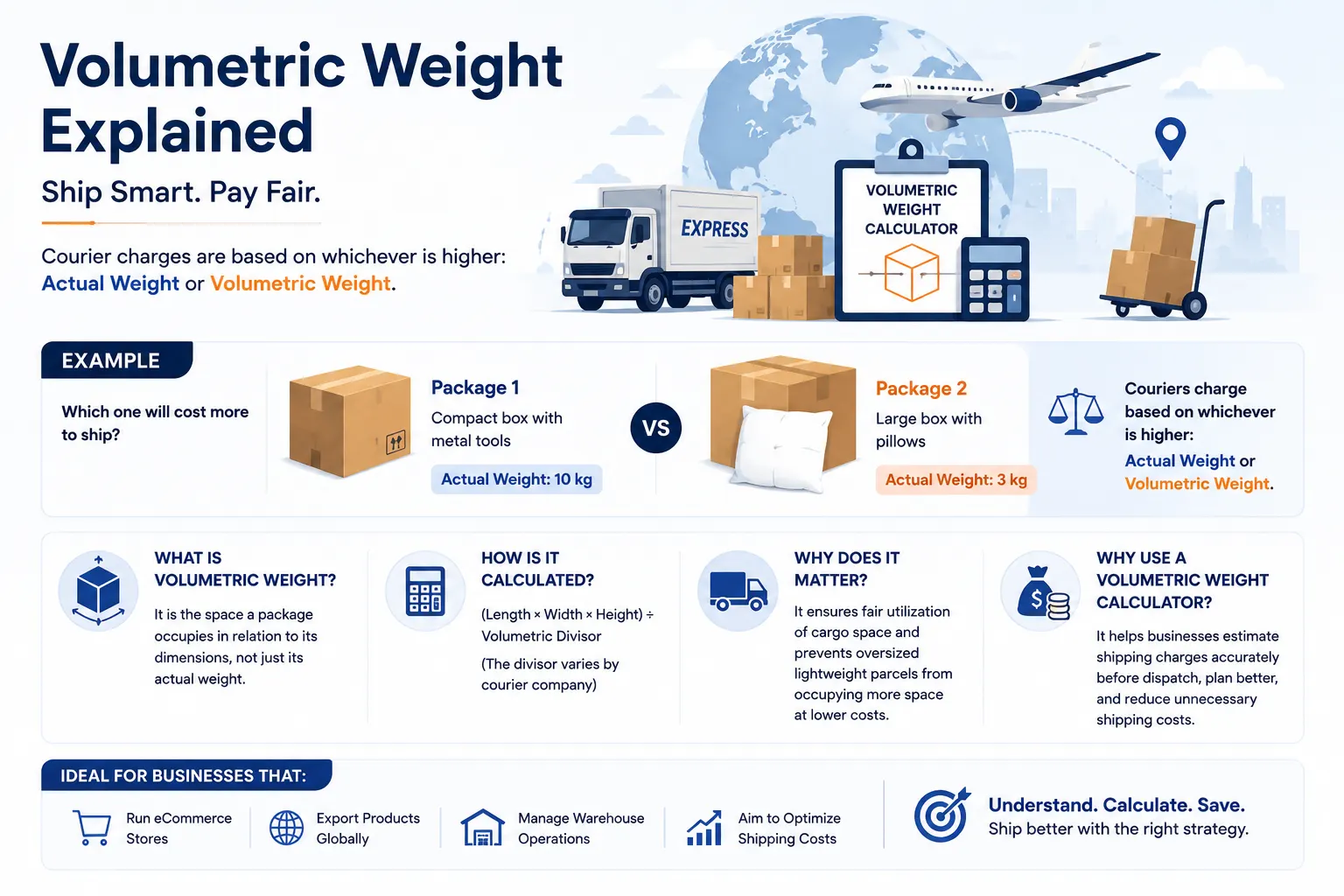
Volumetric weight is the space a package occupies in relation to its actual weight. Volumetric weight, also known as dimensional weight, is a shipping pricing method used by courier and logistics companies to calculate delivery charges based on the amount of space a package occupies rather than just its actual weight.
In logistics, transportation space is limited. Whether shipments move through trucks, cargo containers, or aircraft, every parcel occupies a certain amount of physical space. Sometimes, lightweight packages can take up more room than heavier but compact shipments. To ensure fair pricing and efficient space utilization, courier companies use volumetric weight calculations.
For example, a large carton filled with cushions may weigh only 2 kg but occupy significant space inside a delivery vehicle. On the other hand, a small box of metal tools may weigh 8 kg while taking up very little space. In such cases, logistics providers often charge based on the larger value between actual weight and volumetric weight.
This system helps courier companies balance both weight capacity and storage space during transportation.
Courier companies use this method because large but lightweight packages take up more space in delivery vehicles and aircraft.
For example:
- A box filled with pillows may weigh only 2 kg
- But due to its large size, it occupies the same space as a 10 kg package
In such cases, shipping charges are calculated based on volumetric weight instead of actual weight.
Why is Volumetric Weight Important?
Volumetric weight is important because courier companies charge shipping fees based not only on actual weight but also on the space a package occupies during transportation. Large, lightweight parcels can take up significant cargo space, affecting vehicle and aircraft capacity. By using volumetric weight, logistics providers ensure fair pricing and efficient space utilization. For businesses, understanding volumetric weight helps estimate shipping costs accurately, optimize packaging, reduce unnecessary courier charges, and improve profit margins. It is especially crucial for eCommerce and international shipping, where packaging size directly impacts logistics expenses and overall operational efficiency.
Understanding volumetric weight helps businesses:
- Estimate accurate courier charges
- Avoid unexpected shipping costs
- Optimize packaging size
- Improve profit margins
- Compare courier pricing efficiently
It is especially important for:
- E-commerce sellers
- Exporters
- D2C (Direct-to-Consumer) brands
- International shipping businesses
Volumetric Weight Formula
The standard volumetric weight formula used by most courier companies is:
Volumetric Weight (kg)=5000Length (cm)×Width (cm)×Height (cm)
Where:
- Length = Package length in centimeters
- Width = Package width in centimeters
- Height = Package height in centimeters
- Divisor = 5000 (may vary depending on courier or transport mode)
Length (cm) × Width (cm) × Height (cm) ÷ 5000
Package length in cm
Package width in cm
Package height in cm
Usually 5000
Example of Volumetric Weight Calculation
Suppose your package dimensions are:
- Length = 40 cm
- Width = 30 cm
- Height = 20 cm
Then:
500040×30×20=4.8 kg
So, the volumetric weight is 4.8 kg.
If the actual weight is:
- 3 kg → Courier charges apply on 4.8 kg
- 6 kg → Courier charges apply on 6 kg
Courier companies always charge based on the higher value between actual weight and volumetric weight.
Actual Weight vs Volumetric Weight
| Factor | Actual Weight | Volumetric Weight |
|---|---|---|
| Based On | Physical mass | Space occupied |
| Measured In | Kilograms (kg) | Kilograms (kg) |
| Important For | Heavy products | Large lightweight packages |
| Used By Couriers | Yes | Yes |
Different Volumetric Divisors Used by Couriers
Different logistics providers may use different divisors:
| Shipping Type | Common Divisor |
|---|---|
| Air Freight | 5000 |
| Express Couriers | 5000 |
| International Shipping | 5000 or 6000 |
| Surface Shipping | 4000 or 5000 |
Always check your courier partner’s pricing policy.
How a Volumetric Weight Calculator Helps
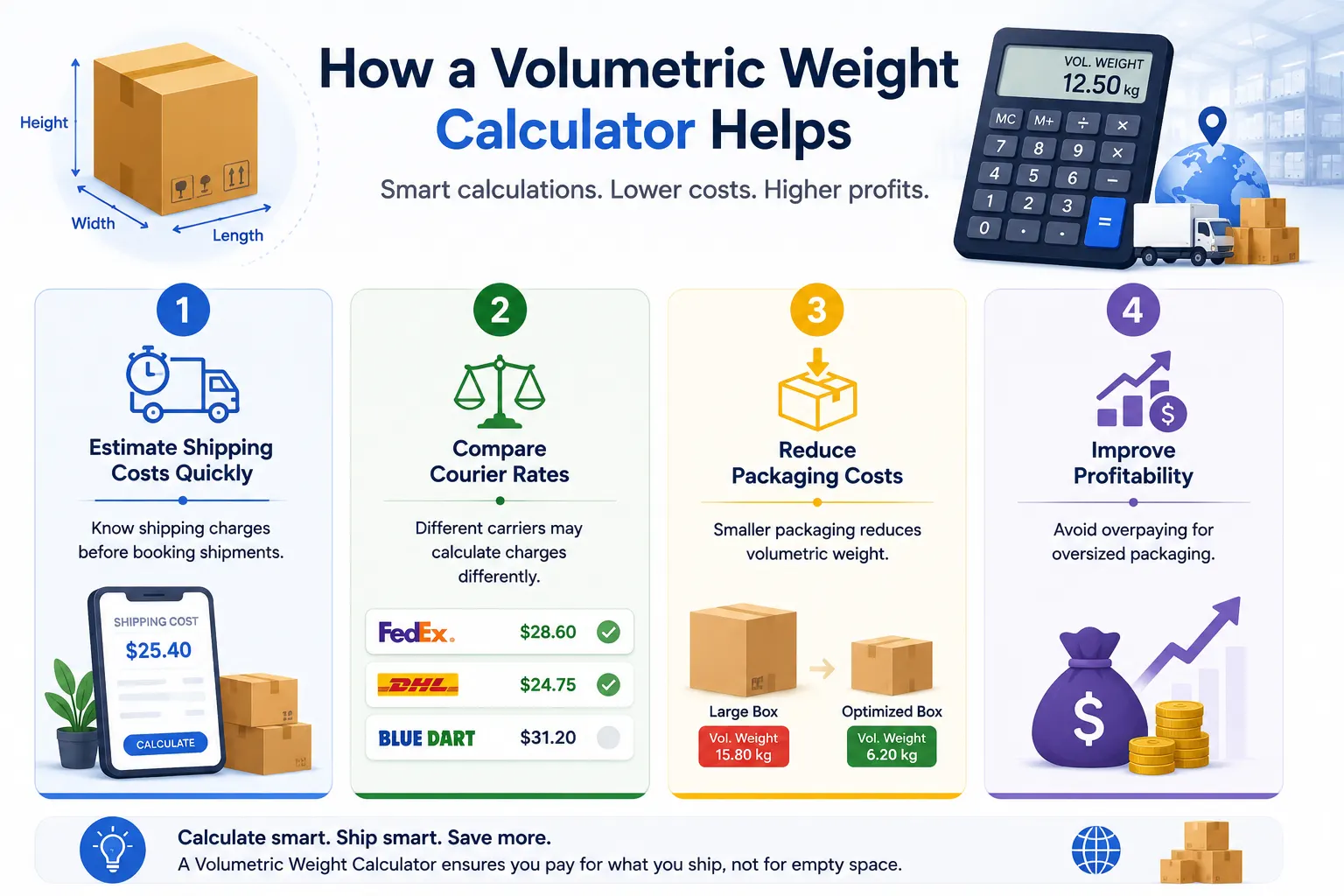
Using an online volumetric weight calculator helps businesses:
1. Estimate Shipping Costs Quickly
Know shipping charges before booking shipments.
2. Compare Courier Rates
Different carriers may calculate charges differently.
3. Reduce Packaging Costs
Smaller packaging reduces volumetric weight.
4. Improve Profitability
Avoid overpaying for oversized packaging.
Tips to Reduce Volumetric Weight Charges
Use Compact Packaging
Avoid oversized boxes with empty space.
Use Lightweight Packing Materials
Replace heavy fillers with lightweight alternatives.
Fold or Compress Products
Especially useful for clothing, bedding, and soft goods.
Optimize Carton Sizes
Use multiple box sizes based on product dimensions.
📦 Tips to Reduce Volumetric Weight Charges
Smart packaging practices can help businesses lower shipping costs and improve profitability.
Who Should Use a Volumetric Weight Calculator?
A volumetric weight calculator is useful for:
- E-commerce businesses
- Amazon sellers
- Shopify brands
- Exporters
- Freight forwarders
- Manufacturers
- D2C brands
Frequently Asked Questions (FAQs)
Volumetric weight (also called dimensional weight) is a shipping calculation method used by courier companies to determine charges based on the space a package occupies instead of only its actual weigh
Courier companies use volumetric weight to ensure fair pricing because large lightweight packages occupy more cargo space in trucks or aircraft.
The standard formula is:
Volumetric Weight (kg)=5000Length × Width × Height (cm) The divisor may vary depending on the courier company or shipping mode
You need:
Length (cm)
Width (cm)
Height (cm)
These dimensions are multiplied and divided by the courier divisor.