
India’s export scene is more than just about the big cities – its specialisation in specific products has earned several regional manufacturing clusters international recognition. In an effort to give a boost to these smaller export-driven clusters the Indian government came up with the concept of Towns of Export Excellence under the Foreign Trade Policy. These small towns play a major role in making up India’s export figures and do a lot more – they create jobs, strengthen the MSME sector and generally give the regions an industrial boost.
The idea behind Towns of Export Excellence was to give recognition to product specific export hubs that have genuine export potential and are in demand on the global stage. Once a town gets recognized under this program the local exporter’s manufacturers, artisans and MSMEs get access to loads of support measures and incentives that improve export competitiveness.
The DGFT TEE Scheme – A Breakdown
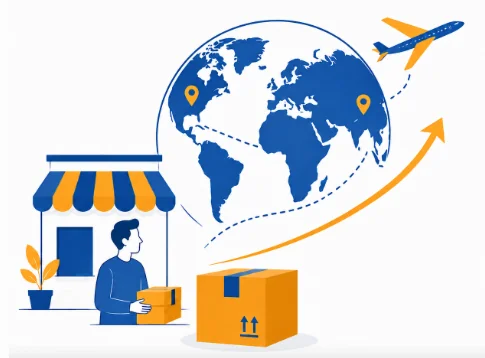
So let’s talk about the DGFT (Directorate General of Foreign Trade) TEE program which was launched as part of the Indian Foreign Trade Policy to encourage export focussed industries all over the country. Under this program towns that manage to hit an export target in a specific product category get recognized and get the TEE tag.
The government’s main intention was to help localised industrial strengths and turn regional manufacturing ecosystems into top notch export centres. These small towns often specialize in things like textiles, handicrafts, engineering products, gems and jewellery, leather products, fish products or agricultural goods.
Getting TEE recognition helps the local industries get better infrastructure support, easier access to the export promotion schemes India has to offer and better communication between exporters and government agencies.
What Are Product-Specific Export Hubs India Is Playing Up?
India has got a number of regional manufacturing clusters that dominate specific export categories these are often referred to as product-specific export hubs that have come up over time due to traditional craftsmanship, industrial specialization or natural resource advantages.
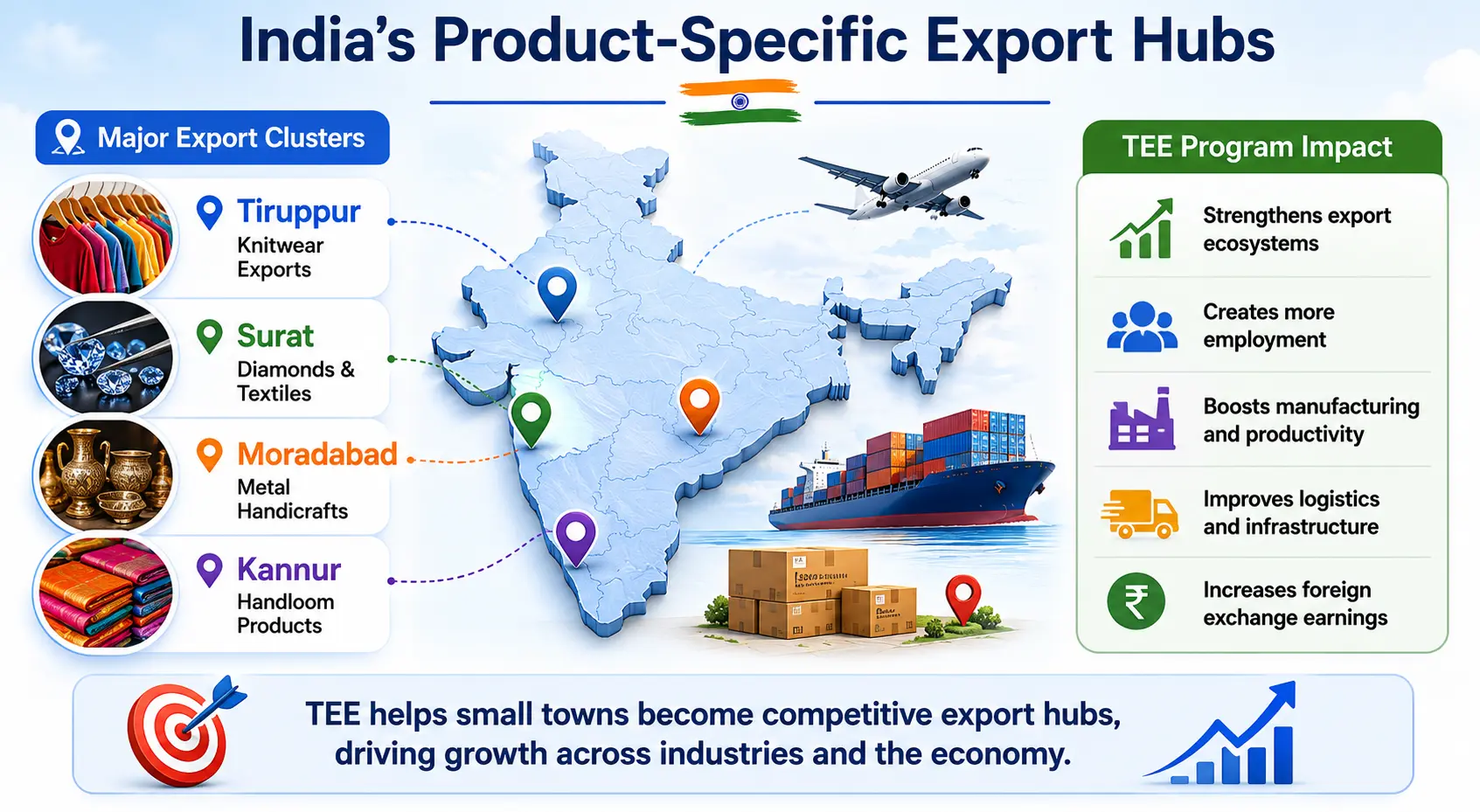
Places like Tiruppur for knitwear exports , Surat for diamonds and textiles , Moradabad for metal handicrafts , and Kannur for handloom products are examples of these clusters – they all have strong logistics support , skilled workforce , export infrastructure and established global buyer relationships.
The government is using the TEE program to look at and strengthen such export ecosystems and it makes sense – when a small town becomes competitive in a particular export category supporting that cluster can create a chain reaction across employment , manufacturing , logistics and foreign exchange earnings.
The Official Towns of Export Excellence India List
Below is the official list of recognised export clusters from across India – these towns have achieved a significant export turnover in their respective categories. The government keeps adding to this list by expanding it every now and then based on export performance and emerging industrial clusters.
TEE Eligibility Criteria for Recognition
The government has laid down very specific rules for TEE eligibility criteria that towns need to meet in order to get recognition under the scheme. Generally, a town becomes eligible when its exports of a particular product category manage to hit a certain annual export value threshold.
The authorities take a close look at a town’s export performance – not just in terms of individual products but how specialized and cluster-based the town’s economy is. They also want to see that a town has developed its own manufacturing ecosystem, with lots of export-oriented units, good logistics connections, and active participation from MSMEs and merchant exporters.
The main goal behind TEE eligibility criteria is to make sure that only towns with genuine long-term export potential get the recognition and benefits that go with it.
Benefits of Towns of Export Excellence for Exporters
The main advantage of the TEE framework is that it gets Indian exporters and manufacturers access to all sorts of export promotion schemes, thanks to the recognition. This also improves the support local industries get from institutions and encourages them to develop in clusters.
Exporters operating in TEE regions get priority for all sorts of infrastructure development projects – like roads, warehouses, testing facilities, inland container depots, and logistics parks. This simplifies their operations and gives them a competitive edge in exports.
Another big plus is that exporters get better access to export incentives, financial assistance programs, and marketing support. MSMEs especially benefit because they get more attention in international markets and also get support to participate in trade fairs, exhibitions, and buyer-seller meets.
How MSME Export Benefits India Improve Under TEE Recognition
One of the really important bits about this scheme is the way it helps improve MSME export benefits India gives to small businesses and local manufacturers.
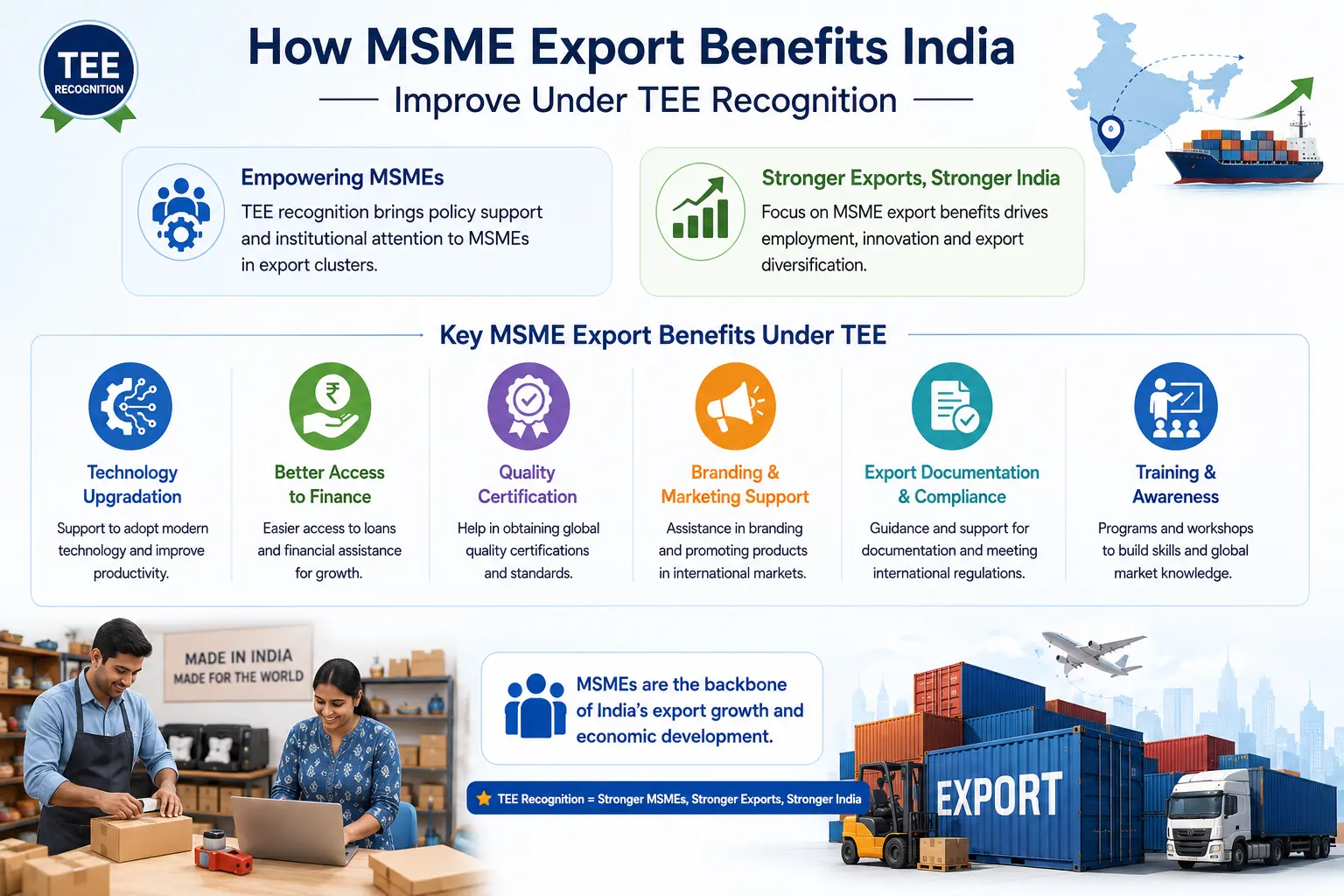
Most export clusters in India are dominated by MSMEs, but these businesses often struggle to adopt new technology, access finance, get quality certification, and figure out how to market themselves internationally. Once a town gets TEE recognition, these MSMEs get more institutional support and policy attention.
Local businesses may get help with modernizing, setting up export documentation, branding initiatives, and skill development. The government and export councils also run awareness programs to educate smaller exporters about what they need to do to comply with international rules and tap new international markets.
The focus on MSME export benefits India is especially important because small businesses are the backbone of the employment generation and export diversification in India.
Government Incentives for Export Towns and Cluster Development
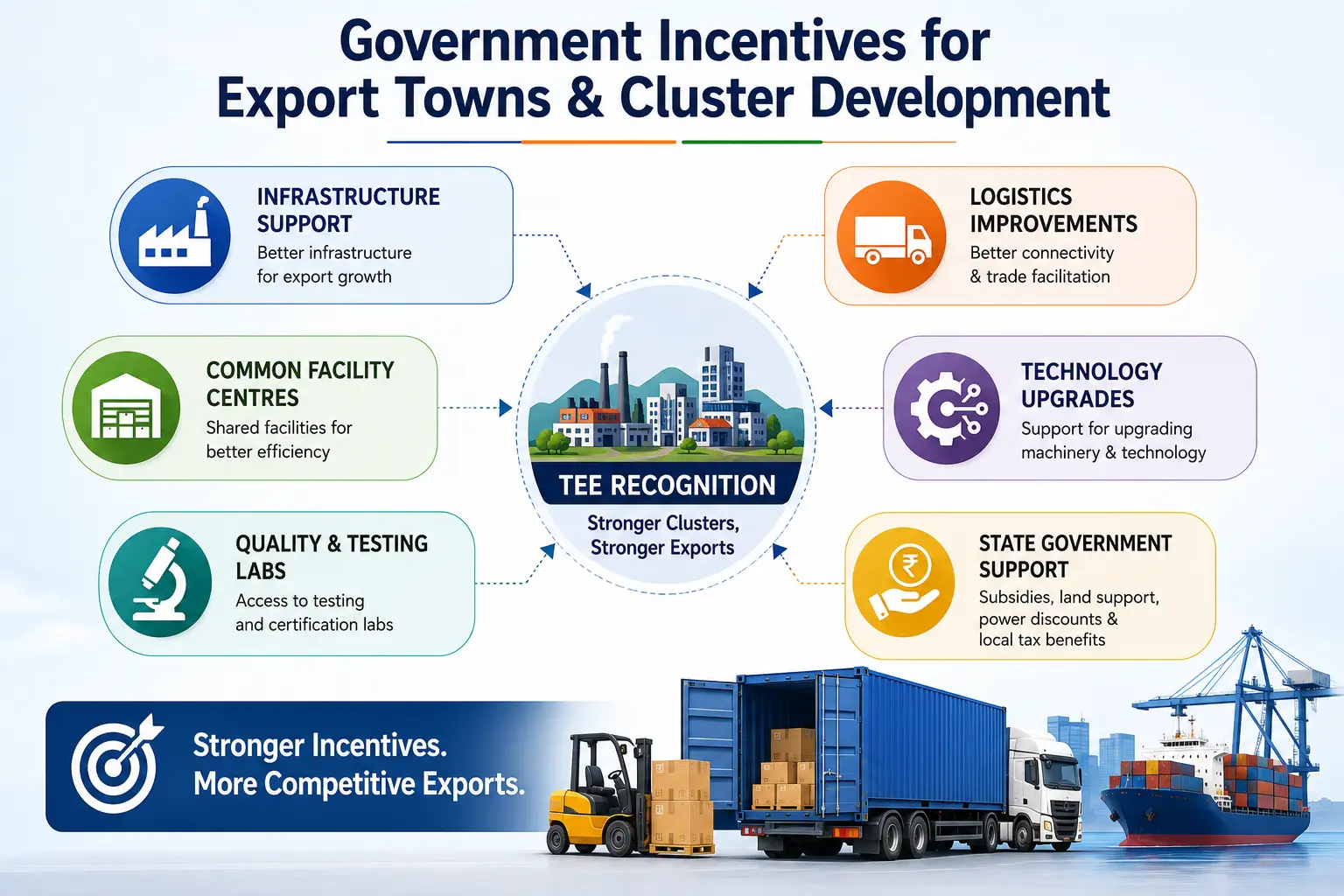
The Indian government does a lot to help out the towns that get recognized – they provide all sorts of government incentives for export towns. These incentives are not always direct subsidies, but can include help with infrastructure, trade facilitation and maybe even easier access to policy.
Recognized TEE clusters may get support under various schemes related to export infrastructure creation, setting up common facility centres, technology upgrades, logistics improvements, and quality testing labs.
State Governments often do their part by adding to the central initiatives with industrial subsidies, land support, electricity discounts, and local tax breaks for export-focused businesses in those towns.
Government Incentives for Export Towns Really Come into Their Own when International Competition is Fierce and Operational Costs Start to Eat into Export Profitability.
How Indian Export Promotion Schemes Support TEE Clusters
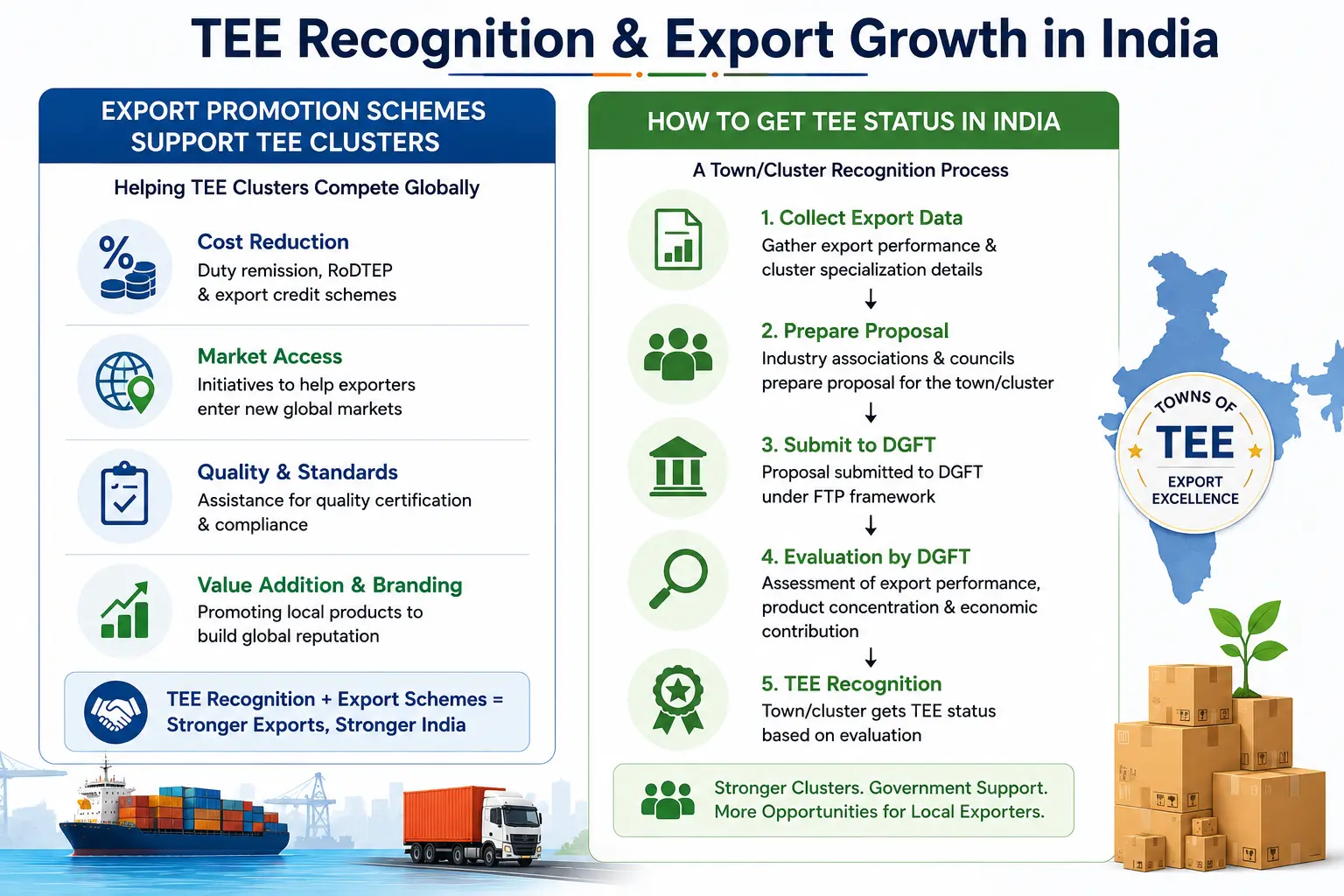
India has got a few export promotion schemes India that exporters can use alongside getting TEE recognition. These schemes aim to cut export costs, boost competitiveness, and encourage more value to be added in the manufacturing process.
Exporters in TEE clusters can take advantage of duty remission and export credit schemes, EPCG and RoDTEP, market access initiatives and quality certification assistance. Putting TEE recognition alongside these schemes lets businesses grow their international operations a lot more effectively.
The Government also puts its weight behind boosting the image of local products that come from these export clusters – so that they can command a better price overseas.
By working together through coordinated policy support the TEE initiative and other export promotion schemes India strengthen India’s overall export ecosystem.
How to Get TEE Status in India
Anyone looking to apply for TEE status won’t actually be able to do as directly as recognition is given to the town or cluster as a whole rather than individual exporters. But industry associations, export promotion councils and state authorities play a pretty important role in the process.
If you’re looking to understand how to apply for TEE status then the process usually involves collecting export data, showing that the cluster is specialising in a particular area, and then submitting a proposal to the DGFT authorities to have it considered under the Foreign Trade Policy framework.
Export promotion councils often help out by working with local industry groups to get all the necessary documents in place and make the case for why a particular town should be given TEE status.
The DGFT then looks at export performance, how concentrated the industry is, the products being made and exactly how much the town contributes to the economy before granting TEE status.
Understand how to apply for TEE status then and regional trade groups and industry associations can get the support they need to get more backing from the Government for local exporters.
Challenges Faced by Towns of Export Excellence
Despite their importance towns of export excellence are still facing all sorts of operational and structural challenges. You get things like gaps in the infrastructure, rising logistics costs, power failures, old technology and compliance issues.
Traditional export towns also struggle with environmental regulations, labour shortages and competition from lower-cost suppliers from other countries. In areas like textiles and handicrafts global consumer preferences are constantly changing and so it’s a case of needing to innovate and diversify all the time.
Another challenge is that a lot of small exporters just aren’t aware of all the export incentives and compliance procedures out there. A lot of them fail to take full advantage of the support on offer from Government schemes.
To have growth that lasts in the long term then there needs to be a continuous investment in technology, training, upgrading the infrastructure and boosting the international image of local products.
The Future for Towns of Export Excellence in India
India’s long term export strategy is taking a drastic shift, and this time it’s focusing on small, district-level communities that have a real shot at becoming world-class export leaders – and the TEE initiative is right at the heart of it all.
As global supply chains start breaking apart and getting reassembled in new and different ways, India sees a massive opportunity to build up its own specialized manufacturing clusters – and turn them into the go-to places for reliable, top-notch goods – in sectors such as electronics, textiles, food, pharmaceuticals, engineering and handicrafts, just to name a few.
Export towns that get on board with e-commerce, digital trade platforms, and slick logistics will have a serious leg up on the competition. And the government is getting in on the act with initiatives like Make in India, Districts as Export Hubs and Production Linked Incentive schemes – all designed to supercharge the growth of export excellence towns.
The success of India’s Towns of Export Excellence will come down to how well it can stamp together its local strengths with global opportunities.
Conclusion
The Towns of Export Excellence idea is basically India’s long term plan to give local regions the tools they need to build their own export strength and push for industrial specialization around specific products. Think textiles, carpets, handicrafts, engineering goods – the usual suspects that India is world famous for making and selling. Exporters are already benefiting from being part of these regions – with easier access to infrastructure, support from the government and other perks that come with being a member of the export crew.
As India expands its global trade network even further, it’s going to need places like these export towns to really drive the growth. Businesses and small enterprises that make the most of what TEE has to offer are in a great position to boost their exports and secure a steady, long-term growth track.
Frequently Asked Questions
So, Towns of Export Excellence are basically places the Government of India has picked out as superstars of the export world – based on how well they’re doing in a specific industry.
In India, the DGFT (that’s Director General of Foreign Trade, in case you were curious) under the Ministry of Commerce and Industry gets to make the call.
Well, it means you get real infrastructure support, help with exports, more support for small businesses, better logistics – and a whole lot more.
No, sorry. It’s all about the town or cluster as a whole. The government doesn’t give it to individual businesses.
Well, getting TEE status means your small business gets better support from the government, a leg up on the market, some export awareness and education, and more access to the facilities and money you need to succeed.