
Exporting products from India does not mean merely locating a foreign buyer and making arrangements for exporting. The exporter must have the right documents ready in order to get the goods exported.
Depending on the type of product being exported, the country where it is going to be shipped, mode of export, value of the transaction, payment terms and applicable regulations, the documentation will differ.
What Documents Are Required to Export Goods From India?
There are four types of documents that are typically required to ship goods from India.
Export documents can be grouped into four broad categories:
- Business and tax documents — such as IEC, GST records and LUT.
- Commercial and payment documents — such as invoices, purchase orders and letters of credit.
- Customs and regulatory documents — such as shipping bills, HS codes and certificates of origin.
- Transport and shipment documents — such as packing lists, airway bills, bills of lading and insurance certificates.
The following is a practical overview of these documents:
Not all shipments require every document listed above. The documents needed depend on the particular transaction.
Import Export Code (IEC): The Basic Exporter Requirement
The Import Export Code (IEC) is an essential identification number for companies involved in imports or exports in India. It is provided by the Directorate General of Foreign Trade (DGFT).
An exporter normally needs to have an IEC before making any commercial exports based on the exemptions that exist.
The IEC belongs to the exporter’s business identity.
Commercial Invoice
The commercial invoice is one of the most essential documents in an export transaction.
This document holds commercial information about the deal and usually includes:
- Exporter’s name and address
- Name and address of the buyer
- Invoicing number and date
- Description of products
- Quantity
- Unit price
- Value
- Currency
- Country of origin
- Harmonized System code
- Terms of delivery
- Terms of payment
Customs officers rely on invoices to ascertain the nature and value of exported products.
Packing List
A packing list gives the customs officers information about the packaging of the products being shipped.
This could include:
- The number of packages in the shipment
- The package type
- Quantity of the product
- Net Weight
- Gross Weight
- Size of the packages
- Marks and Numbers
- Details of the product
It is important for the packing list to match the actual shipment and other export documents.
Shipping Bill
Shipping bill is one of the main customs documents involved in the export clearance process.
It provides information about the exporter, the consignee, goods being exported, value, classification and other shipment information. The customs authority will use the information contained in the document for processing the export.
The exporter or its authorized customs intermediary normally submits the necessary information electronically through the relevant customs system.
Airway Bill
The airway bill is an important document used during cargo transport by air.
It provides information on the shipper, consignee, goods, destination and mode of transport.
The airway bill acts as a proof of the transport contract between the shipper and carrier.
When it comes to courier exports, the logistics company can provide the appropriate transport documents during the process of shipment.
Bill of Lading
The bill of lading is usually used in sea transportation.
Its use includes, among other things, the documentation of goods transported by sea as well as shipment information.
Information included in the bill of lading includes:
- Shipper
- Consignee
- Notify party
- Port of loading
- Port of discharge
- Description of goods
- Quantity and packaging
- Information about vessel
There can be different types and uses of the bill of lading depending on the nature of the transport and transaction.
Certificate of Origin
The certificate of origin proves the origin of the goods being exported.
It can be required by the buyer, destination country custom authorities or some trade agreement.
In such cases, the document gains extra importance since preferential tariff treatment is sought to be availed through a relevant trade agreement.
Exporters need to decide beforehand whether a Certificate of Origin is needed prior to shipment rather than after the goods have been shipped.
Letter of Credit
Letter of Credit is a payment mechanism usually used in certain international trade transactions.
An LC basically works through an undertaking from the buyer’s bank to pay, depending upon the fulfillment of some documentary requirements.
This is why it becomes very necessary that the documents should match with the terms of the LC. In case, the exporter’s documents fail to conform to the terms of the letter of credit, then the exporter may encounter difficulties in payments despite successful shipment of the goods.
Prior to accepting the LC deal, the exporter must ensure:
- Documents needed
- Delivery deadline
- Terms of Payment
- Port requirements
- Insurance requirements
- Description of goods
- Requirements regarding document presentation
HS Code and Export Declaration
It is used for classification of goods for purposes of international trade and customs.
Right classification is important since it affects:
- Customs treatment
- Export control
- Import tariffs in the destination country
- Statistics
- Trade policy requirement
- Documentation
The exporter should ascertain the HS classification prior to preparation of the export declaration.
Use of wrong HS code can result in query from customs authorities or incorrect processing of the cargo.
Customs Documentation and Customs Clearance
Clearance is a procedure through which the authorities check and process the goods prior to permitting them to be exported out of India.
The necessary customs documentation would include the shipping bill, commercial invoice, packing list, transport document and others.
Depending upon the cargo, the customs authorities can check:
- Description of the product
- H.S. code
- Declared value
- Quantity
- Information regarding the exporter
- Destination country
- Applicable restrictions
- Necessary certificates
While customs broker, freight forwarder and logistics facilitator may help in preparing the documentation and facilitating clearance, it is the duty of the exporter to provide information regarding the commercial and product nature.
Export License and Product-Specific Approvals
Not all the products have the same export procedure.
Some of the products might require export license, NOC, registration, certificate or other approval.
Thus, it is necessary for the exporters to identify whether the products fall into any of the following:
- Freely exportable
- Restricted
- Prohibited
- Subject to conditions
- Subject to permission from the government
This is especially important for the controlled categories like agricultural products, drugs, chemicals, specific food products, wildlife related products and strategic products.
Depending upon the category of the product and the regulations of India, the exporter has to follow the appropriate compliance process.
GST Documents and LUT
GST registered exporters need to consider the GST provisions relating to export.
Exports are considered as zero rated supply under the GST regime of India subject to the relevant provisions and procedures.
Appropriate exporter may export through LUT without payment of IGST.
On the other hand, an exporter may opt to adhere to the relevant route of payment of IGST followed by refund where applicable.
The relevant GST documentation and records should be maintained meticulously because exports should be reconciled through tax records and documentary evidence.
AD Code
An AD Code or Authorized Dealer Code pertains to the authorized bank branch which will conduct foreign exchange for the exporter.
Exporters are supposed to ensure that the appropriate bank and customs information have been entered when required for exporting purposes.
AD code requirements and procedures differ based on the export route used and the customs procedure used, and it is therefore important to confirm the correct procedure to use before exporting.
eBRC and Bank Realization Certificate
The eBRC or electronic Bank Realization Certificate pertains to the realization of export proceeds.
Traditionally, exporters would refer to the Bank Realization Certificate (BRC) as the document pertaining to realization of export proceeds. The process has now been digitized.
Exporters are expected to keep proper banking records of payments received from overseas clients.
These documents could prove vital not only for showing compliance but for claiming the relevant export advantages in case of meeting certain eligibility requirements.
Documents Required Based on the Export Process
The documents could also be classified in accordance with the time when these documents are usually issued.
| Export Stage | Common Documents |
|---|---|
| Business setup | IEC, GST registration where applicable |
| Buyer negotiation | Proforma invoice |
| Order confirmation | Purchase order, sales contract |
| Payment arrangement | Letter of credit, bank/payment documents |
| Product preparation | Packing list, commercial invoice |
| Product classification | HS code |
| Customs filing | Shipping bill, export declaration |
| Transportation | Airway bill or bill of lading |
| Origin verification | Certificate of origin |
| Cargo protection | Insurance certificate, where applicable |
| Export proceeds | Banking records, eBRC |
| Tax compliance | GST records, LUT where applicable |
This sequence is only a general framework. Actual documentation varies by product and transaction.
Documents Required for Different Shipping Methods
The transportation method also affects documentation.
| Shipping Method | Key Transport Document |
|---|---|
| Air freight | Airway bill |
| Sea freight | Bill of lading |
| Courier | Courier/shipping documentation |
| Postal export | Applicable postal/export documentation |
However, for small consignments in the B2C sector, an international courier will make customs clearance easier.
In case of cargo shipments, it is the exporters that deal with freight forwarders, customs brokers, and shipping companies.
How to Prepare Export Documentation Correctly
Proper documentation starts with being consistent.
The below should be the same whenever possible:
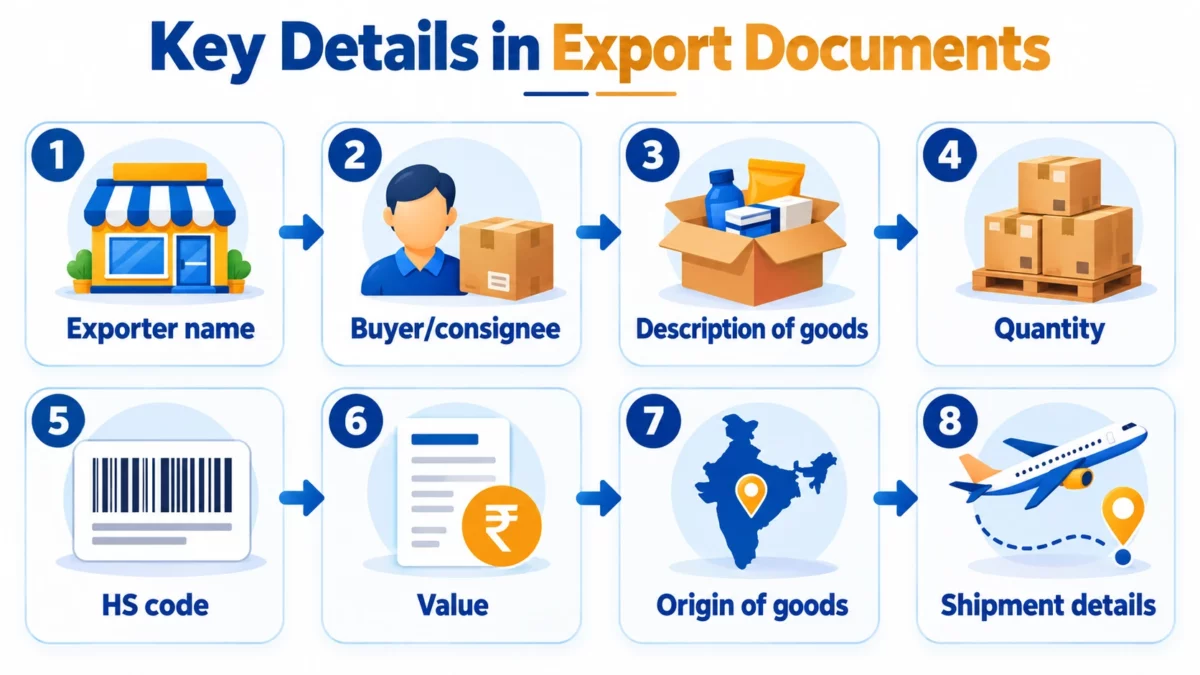
For instance, in case the commercial invoice mentions 500 units and the packing list states 450 units, there might be problems with customs clearance.
A description of goods in the invoice should be correct according to the HS code and actually shipped products.
Before shipping goods, one needs to do a document check, which includes:
- Exporter data
- Buyer data
- Description of goods
- Quantity
- HS code
- Declared value
- Currency
- Country of origin
- Shipping terms
- Payment terms
- Package number and weight
- Regulatory certificates
- Customs declarations
- Banking details
How Professional Export Documentation Support Can Help
A seasoned customs broker, freight forwarder or export documentations specialist can help businesses with the following:
- Export documentation
- Shipping bill preparation
- Customs clearance
- International shipping/courier services
- HS code classification assistance
- Transport documentation
- Certificate coordination
- Shipping
- Export compliance check
But exporters need to examine the information provided by their agents for them. Incorrect product description, value and classification can cause trouble despite third-party documentation services.
FAQs
The key documents are IEC, commercial invoice, packing list, shipping bill or other relevant export document, along with an airway bill or bill of lading according to the mode of transport. There could be additional documentation requirements depending upon the commodity and the country of destination.
It is usually necessary for commercial imports or exports except where exceptions exist. Please note the DGFT requirements for your specific transaction.
Airway bills are used for air freight shipments while bill of lading is used for sea freight shipments. Both contain crucial information about the transport and the shipment.
No, only in case if there is a requirement from the buyers, the destination country’s customs or where preferential tariff benefits have been availed as per any agreement.
Conclusion
It is important to have knowledge about the necessary documents to ship products abroad from India. IEC helps in establishing who the exporter is, and the commercial invoice and packing list serve as proof of the transaction and shipment. On the other hand, the shipping bill allows the cargo to pass through the custom process, and an airway bill or bill of lading proves the shipment mode.