
The e-commerce industry has opened up a wide range of opportunities for businesses to sell products online. Nowadays brands have the option to either sell direct to customers through their own websites or use the likes of Amazon and Flipkart. Both options come with their unique benefits and downsides so the argument over D2C vs Marketplace Selling is a big one for entrepreneurs to be thinking about.
Loads of start-ups in India are stuck deciding whether to invest in building their own e-commerce store or rely on marketplaces that already have a built in customer base. While marketplaces offer the advantage of getting your product in front of people quickly and with less hassle, D2C brands can give you control over the customer experience and ultimately much better long term profits.
Understanding D2C vs Marketplace Selling in Modern E-commerce
The debate around D2C vs marketplace selling is really all about how businesses interact with their customers and handle online sales.
D2C – or direct to consumer sales – is when brands sell their products directly to their customers through their own websites or mobile apps. In this model, the company is in control of everything from branding and pricing to customer data and marketing – without having to rely on some third party platform.
Marketplace selling on the other hand involves listing your products on e-commerce platforms like Amazon, Flipkart, or Meesho. These platforms already have a massive customer base and are trusted by people all over the world, making it a lot easier for businesses to sell to new customers quickly.
D2C vs Marketplace Selling and E-commerce Profitability Comparison
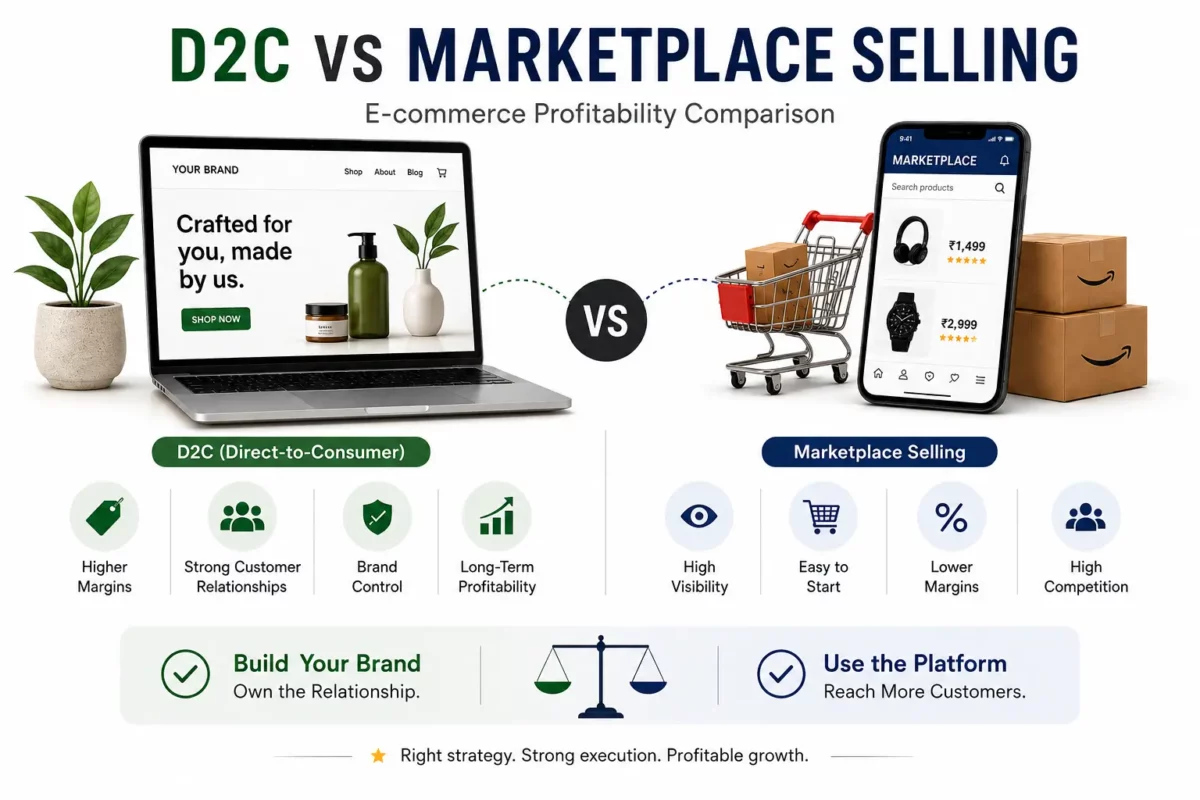
Profitability is a big factor in deciding which e-commerce route to go down. While both options can be super profitable, their financial structures are as different as chalk and cheese.
With marketplace selling you often pay the platform for listing your products, advertising, storing them, sending them out and just about every other thing. That all eats into your profit margins. And when you’re selling products that don’t have a lot of profit margin in the first place, the idea of marketplace commission vs D2C margin can be a real headache.
With D2C e-commerce you avoid the fees that the marketplace charges and get to control how much you charge for your products. But, you do have to stump up cash for building/maintaining your own website, running marketing campaigns, sorting out logistics and getting customers to the site in the first place.
While marketplaces might get you a lot of sales in the short term, D2C businesses often end up with a much stronger long term game because they get to keep more of the profit and build up direct relationships with customers.
Own Website vs Amazon Selling – Which Gives You Better Control?
The debate over own website vs Amazon selling comes down to what level of control you have and how much you care about getting to know your customers.
When you’re selling through marketplaces, the platform is really in the driving seat when it comes to customer interactions. You may not even get access to most of the customer data or have any control over the way they buy from you – which really limits your chances of selling to them again in the future.
With a D2C business the whole customer journey is yours to control – from how you design your website and what kind of packaging you use to what emails you send them and what rewards you offer them. All of which makes it much easier to build a strong, loyal customer base that will keep buying from you.
Customer ownership is becoming a really valuable thing in the world of e-commerce because the better you know your customers the more you can tailor your sales and marketing to them – which means you get repeat sales and a much better profit per customer.
Brands Operating Their Own Ecommerce Stores Can Get A Whole Lot Of Valuable Insights On How Customers Are Buying
Brand Building D2C vs Marketplaces: Which Helps You Build A Stronger Identity?
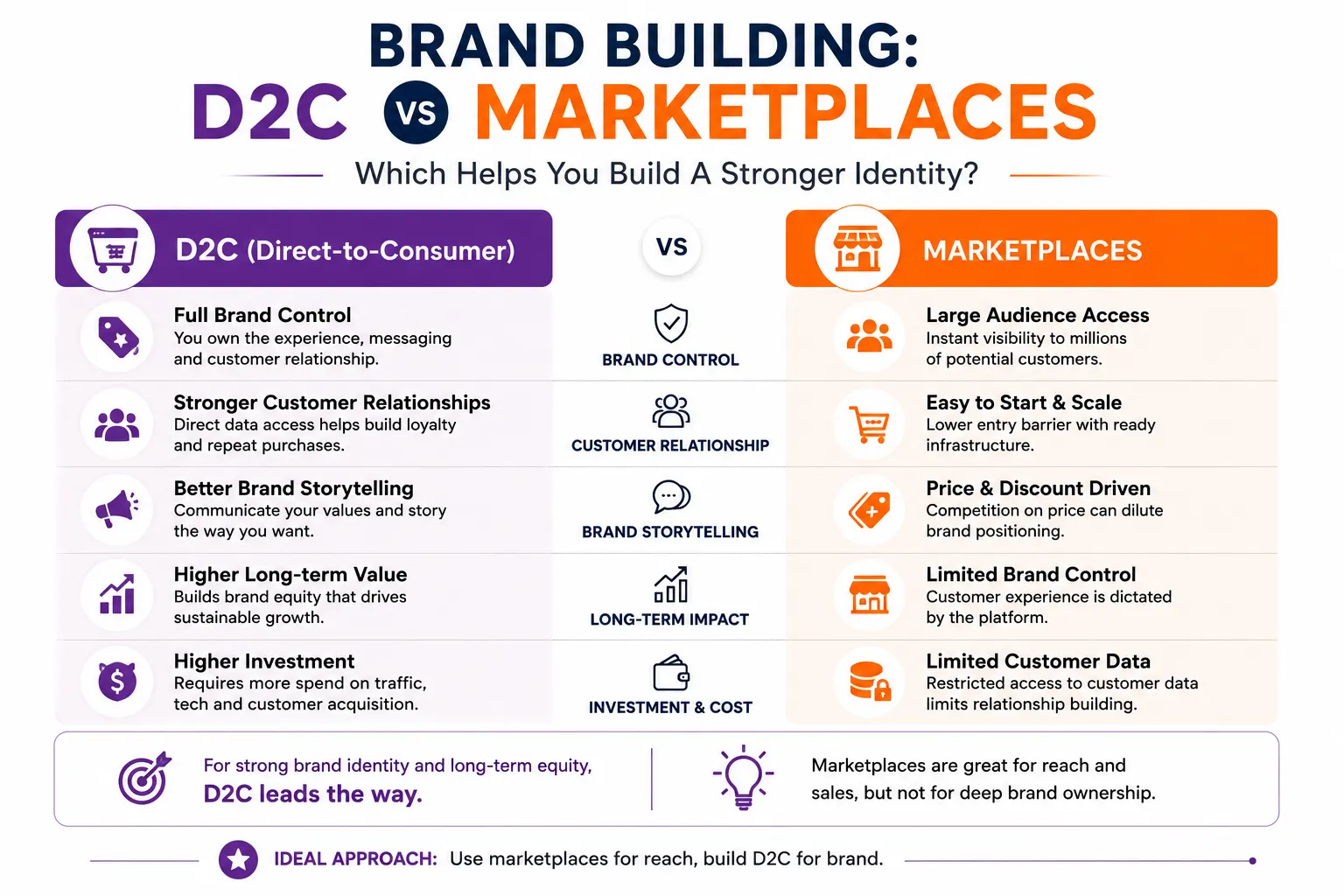
When it comes to building your brand, there’s another really important thing to consider in the D2C vs marketplace debate.
Marketplaces like Amazon really focus on letting people compare products and see who’s got the best prices. As a result, customers are constantly comparing multiple sellers at the same time – which makes it super tough for brands to stand out from the crowd.
This can cause a few headaches for people trying to build their brand through marketplaces because the algorithms used to manage the platforms tend to put the emphasis on getting the best price, getting good ratings, and getting products delivered quickly rather than on telling the story behind the brand.
D2C brands on the other hand have the flexibility to create a unique identity through custom websites, engaging content marketing, social media, influencer partnerships, and even just nice touches like personalized packaging.
And we can see this in action with successful Indian brands like Nykaa and Mamaearth who have shown how the benefits of a D2C business can really pay off in terms of building relationships with customers.
By being able to have that direct line of communication and storytelling, D2C brands often end up building way more trust and customer loyalty than generic sellers on marketplaces.
Customer Acquisition D2C Strategies Compared To Marketplace Traffic
One of the big reasons marketplaces can be attractive is because they already have millions of customers visiting every day looking for products to buy.
For start-ups, this can be a real draw because they can get visibility without having to spend loads on digital marketing right from the off.
But customer acquisition with a D2C business is a bit more complicated. You’ve got to generate traffic yourself through things like SEO, paid ads, influencer marketing, email campaigns and social media promotions.
It might seem like it’s going to cost a lot at first but in the long run customer retention strategies can really cut down on marketing expenses and make for a more profitable business.
D2C brands often have a stronger hold on customers because they can speak directly to them and set up loyalty programmes and all that sort of thing.
While marketplaces can give you a quick in, D2C businesses get the long game – they get to build up a community of customers and have a direct relationship with them.
Amazon Seller Challenges Most Indian Businesses Will Face When Selling On the Platform
Lots of businesses who start out selling online through marketplaces end up facing some major headaches.
Common Amazon seller challenges in India include ridiculous commission fees, crazy competition, fake reviews, constantly changing policies, and ever rising ad costs.
As marketplaces get more and more crowded, you get into this price war thing where everyone’s trying to undercut each other and that can really bring down overall profits. Small businesses in particular can struggle against bigger brands with bigger budgets and more warehouse space.
Another big issue is that you’re at the mercy of the platform’s algorithms – when they decide to tweak their rankings, it can really cut down on visibility and sales.
All these marketplace risks encourage loads of businesses to look at the long term and transition over to a D2C model.
Despite all that, marketplaces can still be a useful way to get discovered, reach new customers and get some initial sales.
D2C Business Advantages for Better Long-Term Growth
The benefits of D2C go way beyond just making a profit. Brands that sell directly to customers get to be in charge of the whole customer experience from start to finish.
This means they can try out different pricing strategies, subscription models, bundle deals and loyalty schemes without having to worry about the marketplace rules.
It also means D2C businesses can focus on building premium brands – they can focus on telling a story, offering exclusivity and building relationships with customers rather than just competing on price.
They get to be in the driving seat and make decisions about how to position their products and communicate with customers.
Another major plus point is scalability through retaining customers. Retention in direct to consumer (D2C) brands is often higher because customers interact directly with the brand, and don’t have to go through the hassle of third party marketplaces.
Companies like boAt and Lenskart show us how focusing on D2C growth strategies can create rock solid long-term market positions in India.
Ecommerce Platform Comparison India: Which Model Makes Most Sense?
The ecommerce platform comparison India businesses make often depends on their product category, budget and how they want to grow.
For new sellers on a tight budget, marketplaces offer a more straightforward entry because they take care of website development, technical management and logistics setup for you.
However most established brands tend to shift towards D2C strategies once they have some initial traction because selling directly to customers improves profit margins and strengthens customer relationships.
A lot of successful businesses now combine marketplace selling with their own D2C websites – a hybrid approach that lets them cash in on marketplace visibility while building their own customer base.
The comparison between the profitability of D2C vs marketplace ecommerce models tends to shift over time. Marketplaces may deliver fast short-term sales, while D2C operations often yield stronger long-term profitability.
D2C vs Marketplace Selling for Small Businesses and Start-ups
For start-ups the ideal strategy usually depends on what resources they have and what they want to achieve.
Marketplace selling is great for businesses that want to test product demand and get customers right away. It’s a low-cost way to validate market interest before investing in branding or website infrastructure.
D2C models on the other hand are better suited to businesses that want to create premium brands and build long term customer loyalty.
When deciding between D2C and marketplace selling you also need to think about how unique your product is. Commodity products usually perform ok on marketplaces, while niche and premium products often do better through D2C branding strategies.
Businesses selling innovative or emotionally driven products tend to benefit more from direct customer engagement and storytelling.
The Future of D2C and Marketplace Ecommerce
In the future ecommerce is likely to involve a mix of marketplace presence and direct to consumer growth.
Customers are increasingly looking for personalized shopping experiences, fast delivery and strong brand engagement – a trend that favours D2C businesses that can deliver customised shopping experiences.
At the same time marketplaces will continue to be the go-to platform for online product discovery because they’re just so convenient and have huge traffic.
As competition grows brands that manage to combine marketplace visibility with D2C customer ownership strategies may end up with the strongest market positions.
Technology, AI driven personalisation, and social commerce will all keep evolving how businesses approach online selling in the coming years.
Conclusion
The debate between D2C and marketplace selling doesn’t have a single right answer as both models serve different business objectives.
Marketplace platforms can offer immediate visibility, customer trust and easier operational setup making them a good fit for start-ups and product testing. But with high competition, platform dependence and lower margins, long term profitability can suffer.
Frequently Asked Questions
Direct to consumer (D2C) sales mean selling straight to customers through your own website – whereas marketplace selling is all about using third party platforms like Amazon or Flipkart to get your products out there.
In the long run, D2C businesses tend to be way more profitable because they avoid those pesky marketplace commission fees and get to keep a tighter hold on their customer relationships.
Getting to keep hold of customer data lets you personalise the shopping experience, keep customers coming back and cut those long-term marketing bills down.