
In e-commerce, there is no lack of time dedicated to boosting marketing efforts, fine-tuning product pages, or minimizing cart abandonment. In e-commerce, there is plenty of time spent on trying to enhance marketing campaigns, optimize product pages, and minimize cart abandonment. But a surprisingly common issue goes astray. The shipping address.
It sounds almost too simple. A missing landmark. A wrong pin code. An incomplete apartment number. A customer is in a rush to check out on a mobile phone and accidentally enters the number ‘Road 15’ instead of ‘Road 51’. Little errors, hardly noticeable on the surface. However, when an order is placed in the logistics network, these small mistakes can lead to delays, delivery failures, customer complaints, and ultimately, returned shipments.
Shipping Address Errors are one of the most ignored causes of business losses for many businesses. They impact delivery schedules, customer satisfaction, logistics expenses and most importantly, Return to Origin rates.
If you’re having a lot of failed deliveries for your e-commerce business, odds are the issue starts much before the last mile.
Understanding the RTO meaning in logistics (Return to Origin) and its connection to address accuracy
Before diving deeper, it helps to understand RTO meaning in logistics (Return to Origin).
RTO happens when a product cannot be delivered to the customer and is returned to the seller’s warehouse or fulfillment center. Each returned package generates extra transportation costs, operational load, inventory management issues and customer service costs.
Consider a simple example.
A customer enters: “House 24, Green Park.” The city is missing. The pin code is incorrect. No landmark is provided. The courier executive arrives at the area but is unable to find the correct address. Several phone calls are not answered. Eventually, the package is marked undeliverable and returned.
What appeared to be a minor checkout mistake now becomes a complete delivery failure. In reality, there are lots of courier return reasons and many of them are due to incorrect or incomplete addresses. The product is in the hands of the shipper, the customer is genuinely interested in the product and the seller has done everything correctly. However, the order keeps failing.
Why Shipping Address Errors Create Expensive Delivery Problems
The impact of Shipping Address Errors extends far beyond a single failed shipment.
Every incorrect address triggers a chain reaction across the logistics process.
First, the courier attempts delivery. Then, customer support teams become involved. Additional verification calls may be required. Delivery agents spend more time locating the address. Routes become less efficient.
Eventually, if resolution fails, the shipment enters the return process. The financial impact grows quickly.
You might notice something interesting here.
None of these issues is related to product quality. None are related to pricing. Yet they directly affect customer experience. A perfectly packed order can still become a failed order if the address is wrong.
Common delivery failure reasons India’s e-commerce businesses face
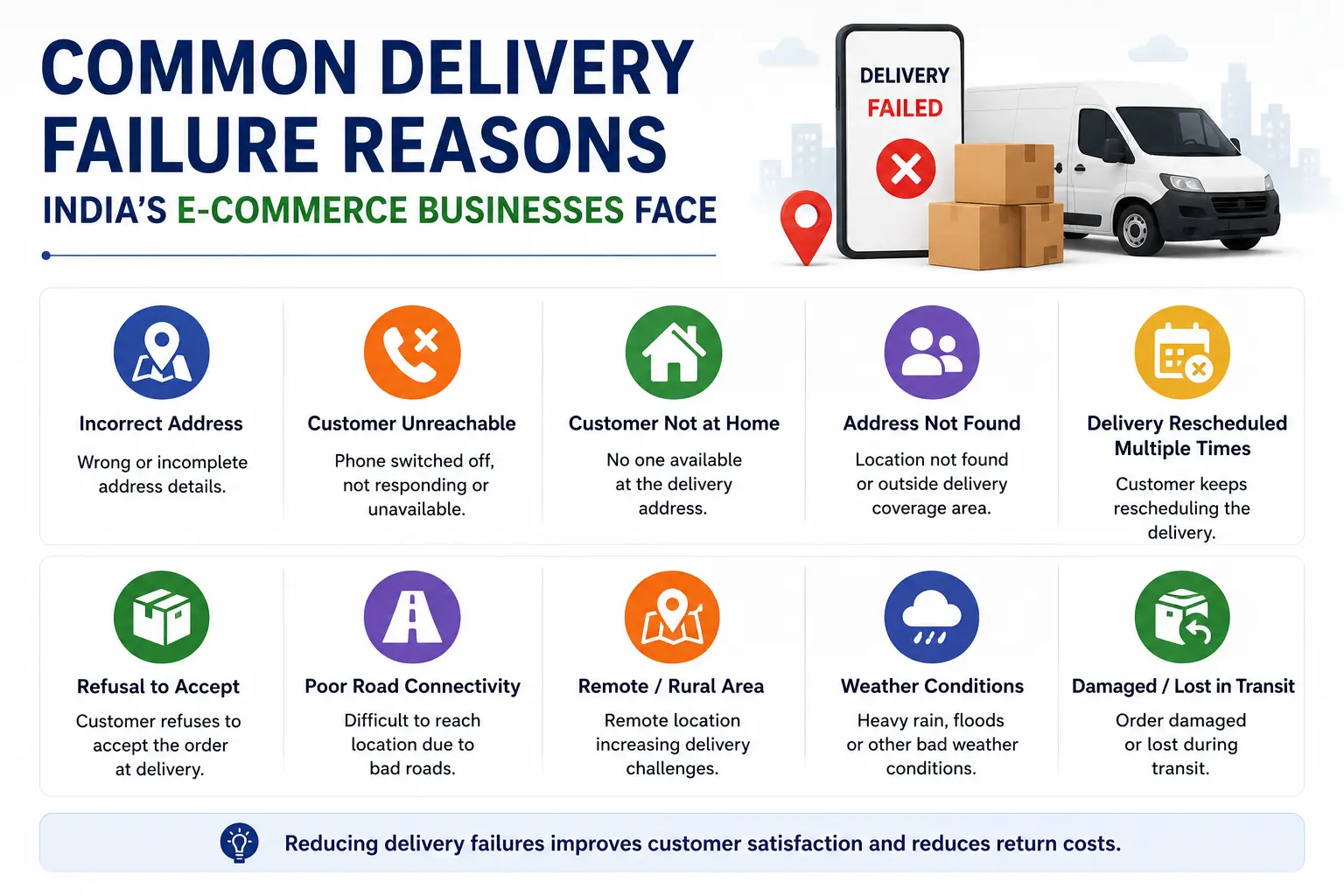
When discussing delivery failure reasons India companies encounter, address quality consistently appears near the top of the list.
India presents unique delivery challenges. Deliveries may be more complex than they are in countries where the addressing system is very standardised, due to rapid urban growth, informal address formats, new residential developments and different use of landmarks.
Some of the most frequent causes include:
Incomplete address details
Customers often provide only the building name while forgetting tower numbers, floor details, or apartment numbers.
Incorrect PIN codes
A single-digit mistake may ship to an entirely different sorting center.
Missing landmarks
In many Indian cities, landmarks are often more useful than street names. Without them, locating the destination may become difficult.
Typographical mistakes
Mobile checkout forms increase convenience, but they also increase typing errors.
Outdated addresses
Customers occasionally forget to update saved addresses after relocating.
These incorrect address courier issues may appear minor individually. Together, however, they create a significant operational burden.
How Shipping Address Errors contribute to last mile delivery issues
The last-mile delivery issues are often the most costly component of logistics. This is where the problems with the last-mile delivery become especially expensive.
Imagine a delivery executive navigating crowded city streets during peak traffic. They arrive at the destination only to discover that the building number does not exist.
Now what happens? The courier calls the customer. The customer may be unavailable. Additional attempts may be scheduled. The package occupies vehicle space. Delivery routes become less efficient. Time is lost. Resources are consumed. The problem is not transportation. The problem is information.
That is why address quality is often a key metric for logistics professionals. A shipment may be able to go hundreds of kilometers without any issues, but then end up a few hundred meters short due to incorrect customer data.
Address validation tools that ecommerce businesses should consider
One practical solution is implementing address validation tools ecommerce companies increasingly rely on.
These tools verify customer-entered information before the order is processed.
Rather than discovering errors during delivery, businesses can identify problems immediately at checkout.
Common validation features include:
| Validation Feature | Purpose |
| Pin code verification | Confirms location accuracy |
| Auto-complete suggestions | Reduces typing mistakes |
| Address standardization | Creates consistent formatting |
| Duplicate detection | Prevents repeated errors |
| Landmark prompts | Encourages complete address entry |
Address validation does not eliminate every problem. No system can.
Still, it may significantly reduce failed deliveries and improve operational efficiency.
Address validation is a preventive rather than a corrective action for many successful e-commerce brands. It is much cheaper to correct errors before the product is sent out than to handle returns afterwards.
E-commerce logistics problems India businesses cannot ignore
Address quality is one of the major e-commerce logistics issues that Indian businesses face and is one that isn’t given enough attention.
The performance of the couriers, warehouse speed, or delivery times is often the point of interest for businesses. Those areas are important, of course. However, bad customer information slowly sabotages all those efforts.
Think of logistics like a relay race. The warehouse completes its part. The courier completes its part. Customer support completes its part. Then, right before the finish line, the address turns out to be wrong. The race is lost.
Maybe that’s not an exact match, but it does bring the point across. No logistics operation can handle the problems of inaccurate fundamental customer information.
This is one reason experienced logistics teams regularly monitor address-related failure rates alongside broader delivery metrics.
How to reduce RTO in e-commerce through better address management
Businesses searching for ways regarding how to reduce RTO in e-commerce often begin with courier selection or shipping policies.
Those strategies help.
But address accuracy deserves equal attention.
Several practical steps can make a noticeable difference:
- simplify checkout forms without removing critical fields.
- encourage customers to provide landmarks.
- verify mobile numbers before order confirmation.
- use automated address validation systems.
- contact customers proactively when suspicious address patterns appear.
Another useful approach involves analyzing recurring courier return reasons. Patterns often emerge surprisingly quickly.
Maybe one city generates more address-related returns.
Perhaps a specific PIN code frequently contains errors.
Sometimes businesses discover that customers consistently skip apartment numbers.
These insights can help reduce future failures.
As companies implement these improvements, they often see progress in improving delivery success rate metrics. Better address quality generally means fewer failed attempts, fewer returns, and happier customers.
The hidden business cost of incorrect addresses
Many sellers calculate shipping expenses, packaging costs, and warehouse overhead.
Fewer calculate the true cost of address-related failures.
An undelivered package may create:
- Forward shipping costs
- Return shipping costs
- Customer support expenses
- Inventory handling costs
- Refund processing costs
- Customer dissatisfaction
- Lost repeat purchases
The immediate cost is visible. The long-term damage is less obvious.
A customer whose order fails repeatedly may never return. They may leave a negative review. They may switch to a competitor.
That is why reducing Shipping Address Errors is not simply a logistics objective. It is also a customer retention strategy.
Conclusion
A simple address field might appear to be a small component in the e-commerce experience. It’s completed in seconds by customers, usually without much thought. But those few lines of information dictate all that follows.
Correct addresses enable efficient deliveries, reduced operating expenses, improved customer experiences and better profits. Errors, on the other hand, result in delays, returns, frustration, and wasted time and money.
The truth is very simple. There are numerous delivery failures that start long before a package arrives at the doorstep of the customer.
However, for companies that want to cut down their RTO, address the frequent logistics issues, and enhance delivery efficiency, the solution isn’t necessarily a faster delivery or bigger carrier network. It can begin with a more modest beginning. A complete address. A correct pin code. One extra landmark. It may be the little things, but the little things that make the difference between an order reaching its destination or returning home.
FAQs
The most common mistakes include incorrect house numbers, wrong pin codes, missing apartment details, incomplete addresses, outdated customer information, and missing landmarks.
RTO increases transportation costs, warehouse handling expenses, customer support workload, and refund processing costs. High return rates can significantly reduce overall profitability.
Address formats vary widely across cities and regions. Missing landmarks, incorrect pin codes, and rapidly developing residential areas often contribute to delivery challenges.