
Understanding HSN Code for Saree
The saree is one of the most iconic garments of India and a major contributor to textile exports. Whether it’s cotton, silk, or synthetic, every saree traded globally needs classification under the Harmonized System (HS) codes.
Sarees are classified under Chapter 62 – Articles Of Apparel And Clothing Accessories, Not Knitted Or Crocheted. Specifically, sarees fall under HS Code 6211, which covers “other garments” including sarees, dupattas, and ethnic drapes.
For silk sarees, certain subheadings under Chapter 50 (Silk) and Chapter 52 (Cotton) also apply depending on trade documentation, but the widely accepted classification in India is 6211.
Importance of HS Code for Saree
Accurate HS code classification for sarees is critical because:
HS Code Classification for Sarees
HS Code for Woven Cotton Garments for Women or Girls
The Harmonized System (HS) is an international standard used to classify traded products.
Broadest classification
Product category
Detailed product description
Country-specific tariff use
The classification varies depending on fabric type:
For finished apparel trade, sarees are generally documented under 6211 at the 6-digit level.
GST on Sarees In India
GST rates on sarees are structured based on fabric type and price range:
This tiered structure ensures traditional cotton and silk sarees remain affordable, while higher-end designer sarees fall in the higher slab.
HS Codes And GST Rates For Sarees
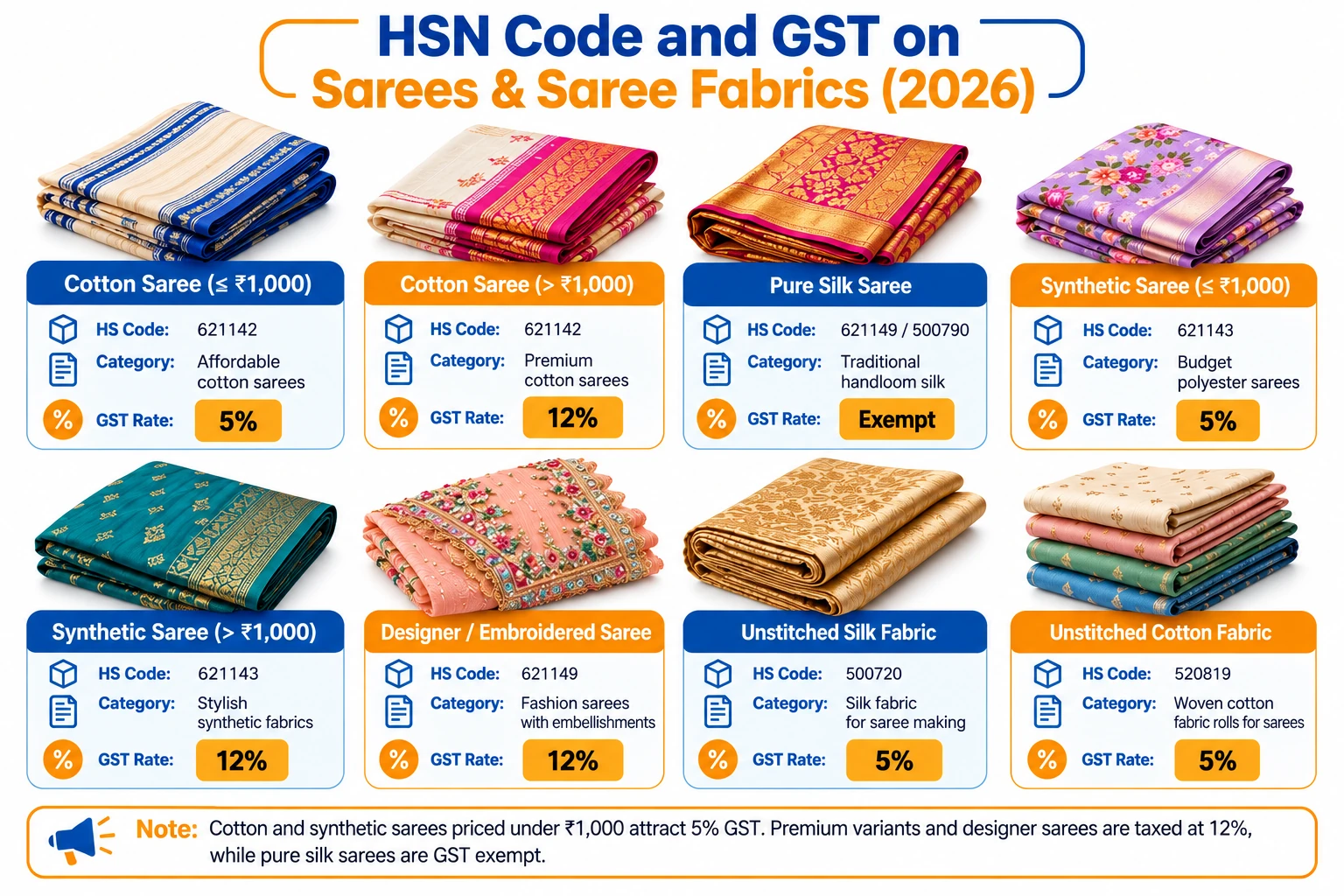
Here’s a detailed table listing the most common saree categories with HS codes and GST rates:
Final Thoughts
Sarees fall under HS Code 6211, with sub-classifications depending on fabric type: cotton, silk, or synthetic. In India, cotton and synthetic sarees attract 5% or 12% GST, depending on price, while pure silk sarees are exempt from GST.
For exporters, correct HS classification helps in claiming government incentives, while for domestic sellers it ensures correct GST compliance and avoids penalties.
Explore International Saree Shipping Routes
Ship sarees from major Indian textile cities to key international markets.
FAQs
Sarees are generally classified under HS 6211, with subheadings for cotton, synthetic, and silk sarees.
Cotton and synthetic sarees attract 5% (≤ Rs.1,000) or 12% (> Rs.1,000), while pure silk sarees are exempt.
Yes, fabrics like silk (5007) and cotton (5208) have separate HS codes if sold as unstitched material.
Yes, designer and embroidered sarees typically attract 12% GST.
Yes, the 6-digit HS code is standardized globally, though national extensions (8/10 digits) differ.