
Understanding HS Code For Dress
In international trade, apparel items like dresses, gowns, and frocks are classified using the Harmonized System (HS) codes. These codes ensure uniformity across countries, making imports and exports smooth and transparent.
Dresses are mainly classified under Chapter 62 – Articles of Apparel and Clothing Accessories, Not Knitted or Crocheted and Chapter 61 – Articles of Apparel and Clothing Accessories, Knitted or Crocheted.
Whether a dress falls under Chapter 61 or 62 depends on the material and method of production:
- Knitted or crocheted dresses → Chapter 61 (HS code 6104)
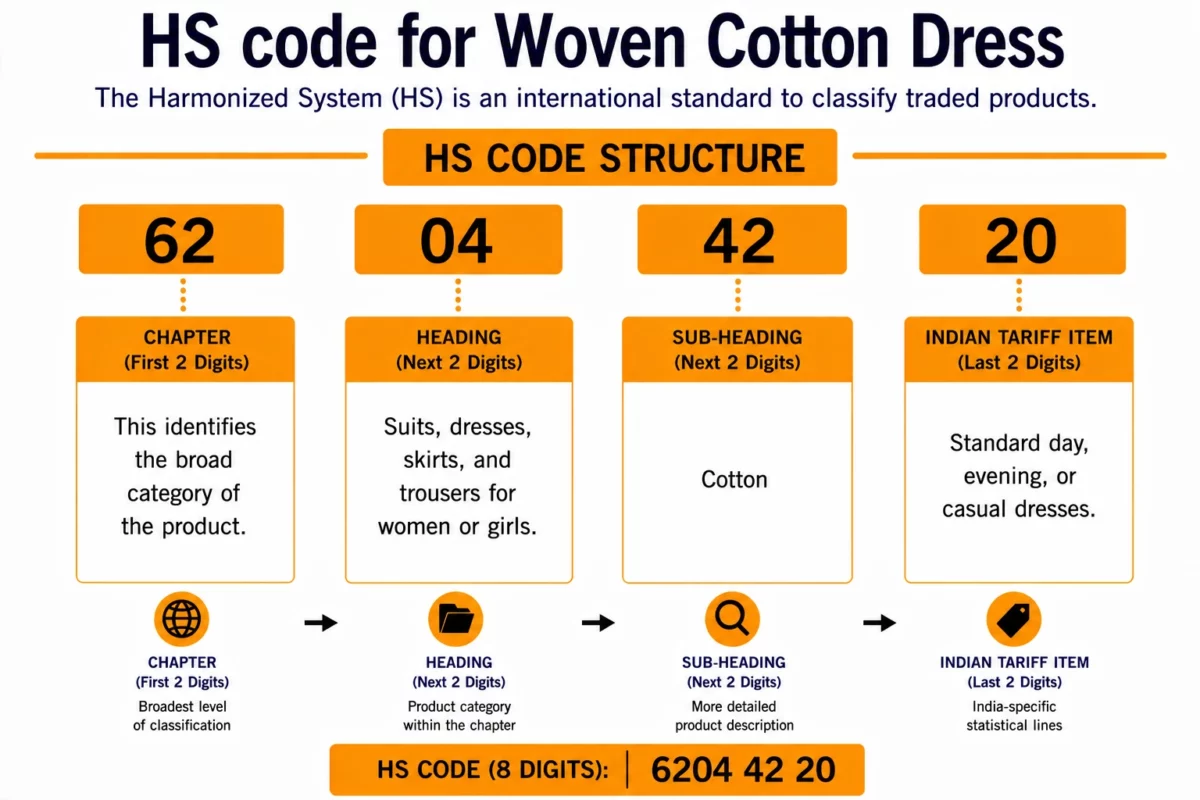
- Woven (non-knitted) dresses → Chapter 62 (HS code 6204)
Importance of HS Code for Dress
For manufacturers, exporters, and retailers, getting the HS code correct is essential. Here’s why:
- Customs Compliance: Avoids fines and shipment delays.
- Accurate GST Application: Helps in charging the correct tax rate.
- Trade Statistics: Used for government data reporting and trade analysis.
- Market Access: Necessary to claim duty benefits under trade agreements.
HS Code Classification for Dresses
Dress classification depends mainly on fabric type, garment construction, and whether the product is for women, girls, men, or boys.
6104
Category: Women’s / Girls’ Dresses
Description: Knitted or crocheted dresses.
6204
Category: Women’s / Girls’ Dresses
Description: Woven dresses that are not knitted or crocheted.
6103
Category: Men’s / Boys’ Garments
Description: Knitted or crocheted suits and related garments, included here for category reference.
6203
Category: Men’s / Boys’ Garments
Description: Woven suits and related garments, included for category comparison.
Additional Key Points
- HS Codes help customs authorities identify garments correctly during international trade.
- The first 4 digits define the core garment category.
- Material composition matters, including cotton, synthetic fibres, wool, silk, and blended fabrics.
- Knitted and woven dresses are classified under different headings.
- Incorrect HS Code selection can lead to customs delays, duty mismatches, or compliance issues.
- Exporters should verify country-specific tariff schedules before shipment.
GST Rates for Dresses in India
The GST rate for apparel depends on the sale value of the garment:
- 5% GST – For apparel priced up to Rs. 1,000 per piece.
- 12% GST – For apparel priced above Rs. 1,000 per piece.
This rule applies to dresses, sarees, shirts, trousers, and other garments. The distinction was introduced to keep budget-friendly garments affordable while applying higher tax on premium apparel.
HS Codes and GST Rates for Dresses
Here’s a detailed table showing the most common HS codes for dresses and applicable GST rates:
👗 GST Rates on Women’s Dresses (2025 vs Earlier)
👗 Cotton Dress (Knitted/Crocheted)
📦 HS Code: 610442
📋 Category: Cotton knitwear
💰 GST Rate (2025): 5% ≤ ₹1,000 / 12% > ₹1,000
📅 Earlier Rate: Same
👗 Synthetic Dress (Knitted/Crocheted)
📦 HS Code: 610443
📋 Category: Synthetic knitwear
💰 GST Rate (2025): 5% ≤ ₹1,000 / 12% > ₹1,000
📅 Earlier Rate: Same
👗 Cotton Dress (Woven)
📦 HS Code: 620442
📋 Category: Woven cotton fabric
💰 GST Rate (2025): 5% ≤ ₹1,000 / 12% > ₹1,000
📅 Earlier Rate: Same
👗 Synthetic Dress (Woven)
📦 HS Code: 620443
📋 Category: Woven synthetic fabric
💰 GST Rate (2025): 5% ≤ ₹1,000 / 12% > ₹1,000
📅 Earlier Rate: Same
👗 Wool Dress (Woven)
📦 HS Code: 620441
📋 Category: Wool or fine hair fabric
💰 GST Rate (2025): 5% ≤ ₹1,000 / 12% > ₹1,000
📅 Earlier Rate: Same
👗 Silk Dress (Woven)
📦 HS Code: 620449
📋 Category: Silk or blended fabrics
💰 GST Rate (2025): 5% ≤ ₹1,000 / 12% > ₹1,000
📅 Earlier Rate: Same
👗 Note: GST for women’s dresses remains unchanged — 5% for items priced at ₹1,000 or less, and 12% for higher-value items.
Final Thoughts
The HS code for a dress depends on whether it is knitted (Chapter 61) or woven (Chapter 62), and further by fabric type such as cotton, silk, wool, or synthetic.
In India, dresses are taxed at 5% GST if priced up to Rs. 1,000 and at 12% GST if priced above Rs. 1,000. This dual GST rate helps balance affordability with revenue generation.
For traders and businesses, using the correct HS code ensures compliance, avoids penalties, and supports smoother export/import processes.
FAQs
The HS code is 6104 for knitted dresses and 6204 for woven dresses.
Yes, GST is 5% for dresses priced up to Rs. 1,000 and 12% for dresses above Rs. 1,000.
No, men’s garments fall under 6103/6203, while women’s dresses are classified under 6104/6204.
Yes, cotton, synthetic, wool, and silk dresses all have distinct HS subheadings.
Yes, HS codes are standardized globally at the 6-digit level, but extended with 8- or 10-digit codes in each country.