
Firms can offer their goods and services to individual customers, businesses, or both. This is referred to as B2C and B2B. While both models provide value to customers, they differ in target audience, decision-making process, pricing, sales techniques, marketing, and customer relationships.
The distinction between the two models matters, as business owners need to understand which one to use, since all subsequent processes, such as production of goods or services, lead generation, sales management, and customer retention, depend on the chosen business model.
What Is a B2B Business Model?
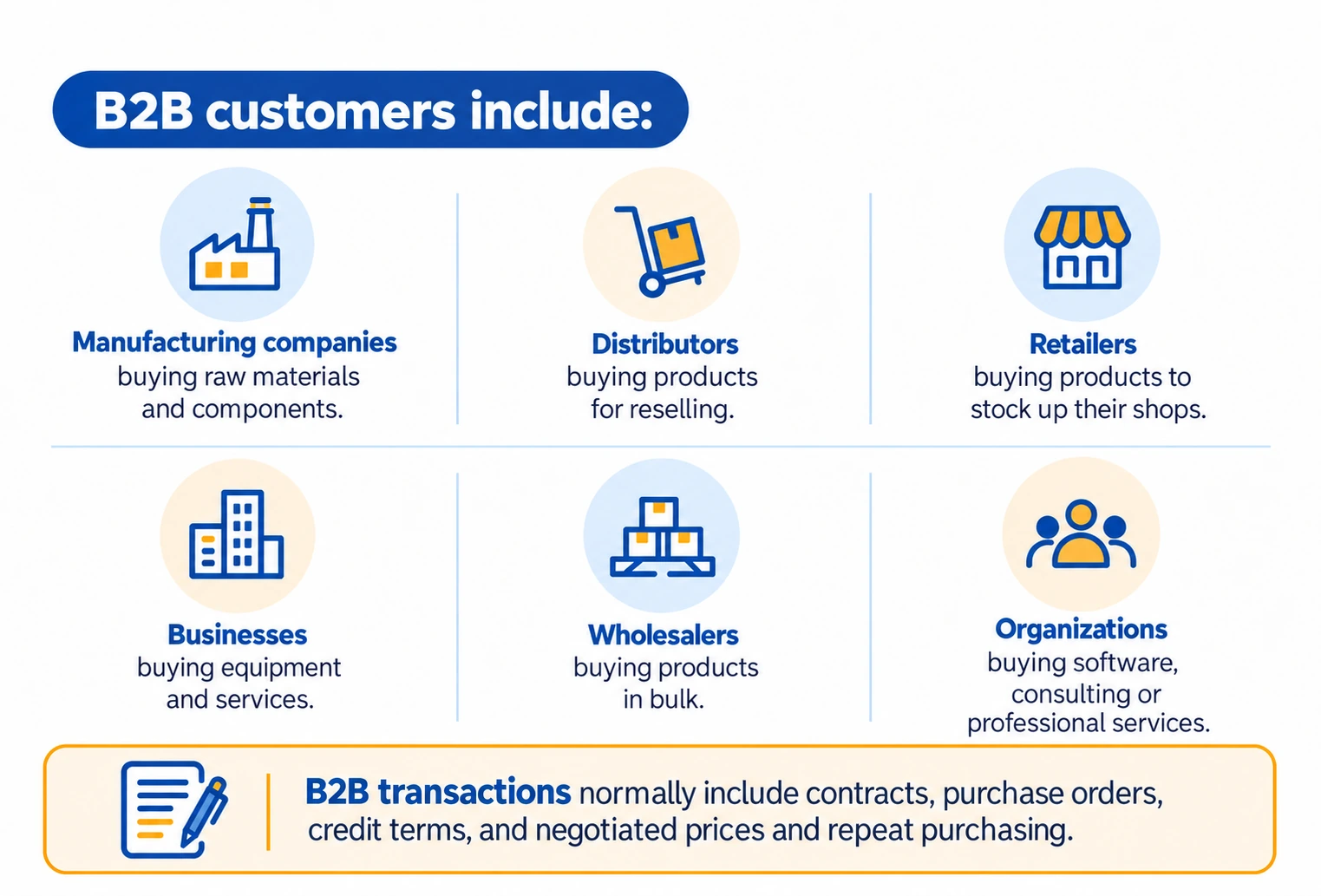
A B2B business model involves when one business selling products or services to another business. Potential customers can be a manufacturer, wholesaler, distributor, retailer, professional services company, or any other firm.
Examples include a software firm providing enterprise-level software to a corporation, a manufacturer selling parts to other manufacturers, or a drug company supplying drugs in bulk to distributors.
B2B transactions require more than one decision-maker. Procurement, finance, management, technical teams, and others may need to approve before a purchase can be made. Consequently, the purchasing decision will depend on factors such as cost, quality, reliability, compliance, return on investment, and longevity.
What Is a B2C Business Model?
A B2C business model is where you are selling your products and services directly to consumers. Retail stores, marketplaces, restaurants, subscriptions and most e-commerce businesses run on B2C models.
A B2C business sells products directly to its customers via physical stores, websites, apps, social media platforms and marketplaces. The customer is normally the final consumer.
Price, convenience, brand image, review, packaging, availability and customer experience can all influence the purchasing process. Sometimes emotions may have more weight in the buying process than usual in B2B.
Direct to consumer or D2C business is one type of B2C sale. This is the process where producers or brands sell products directly to the end users and not use traditional distribution channels.
B2C vs B2B: What Are the Key Differences?
The basic difference is the kind of customer and the purpose for which the customer purchases the products or services.
The above differences imply that a business cannot simply adopt a successful B2C approach in a B2B environment, and vice versa.
B2B Sales vs. B2C Sales
There is more consultation involved in B2B sales than in B2C sales. The salesperson has to know the needs of the customer in terms of their operations, budget, technical specifications, and procurement process before selling.
The buyer could ask for specifications, documents, warranties, service agreements, and customized prices. For example, before ordering industrial machinery from a manufacturer.
On the other hand, B2C sales would be easier because the consumer will discover a product either through a search engine, social media, advertising, or even purchase in minutes.
The above differences result in two distinct sales cycles. There is a long sales cycle in B2B transactions, whereas there is a short sales cycle in B2C transactions. But this is not a universal principle. B2C high-value transactions like vehicles, real estate, and even higher education take quite a bit of research.
B2B Marketing and B2C Marketing Strategies
B2B marketing strategies are designed to show expertise, reliability, and tangible business value. Some of the strategies include SEO, industry media, webinars, LinkedIn marketing, case studies, white papers, email marketing, and account-based marketing.
In some cases, content might be designed to solve certain issues related to the business. For example, a supplier could produce a technical manual describing how its products could help minimize downtime and boost efficiency.
However, B2C marketing focuses more on reaching out to customers, raising brand awareness, product benefits, and engaging customers. Such channels as search advertising, social media, influencer marketing, email campaigns, video content, and promotion on e-commerce websites are used in such cases.
The messaging becomes simpler since consumers have to make their decisions quickly. Various discounts, limited-time offers, product reviews, and even personal recommendations could drive consumers’ actions.
Pricing and Order Size
Another issue that differs greatly between B2B and B2C businesses is pricing.
Negotiation-based pricing is quite common in business-to-business relationships. A company that places a large order could get volume discounts, contract pricing, and other custom options. In addition, suppliers might offer various price structures to distributors and retailers.
The order size matters in wholesale business transactions, and that is why the unit price is a crucial parameter in the negotiation. The order size, delivery conditions, contract period, and future business opportunities are used for the negotiation.
B2C pricing is much more straightforward. The consumer sees the price either on the website or in a store and decides whether the product is worth its price.
Yet, some B2C enterprises dealing with expensive goods can offer financial support, subscription service, or even special offers.
Purchasing Decisions and Customer Experience
Purchasing decisions in B2B usually become quite a rational and fact-based process. Customers can look through a number of suppliers and consider specifications, service, implementation issues, warranty, and the total cost of ownership.
Moreover, the decision-making process can include various individuals. Someone can detect the need, someone can assess the technical compatibility, someone can negotiate the price, and the purchase itself can finally be approved by the top managers.
In the case of B2C enterprises, the consumer makes the decision personally. It can include rational analysis together with factors such as convenience, personal taste, social proof, and emotion.
Customer experience is relevant in both types of enterprises; however, it can be delivered in different ways. B2B customers can appreciate efficient account management, timely delivery, and technical support, while B2C customers can prefer convenient navigation, an easy checkout procedure, a flexible return policy, and good customer service.
Marketing Channels and Lead Generation
The most effective marketing channels depend on the target audience and not on the type of enterprise.
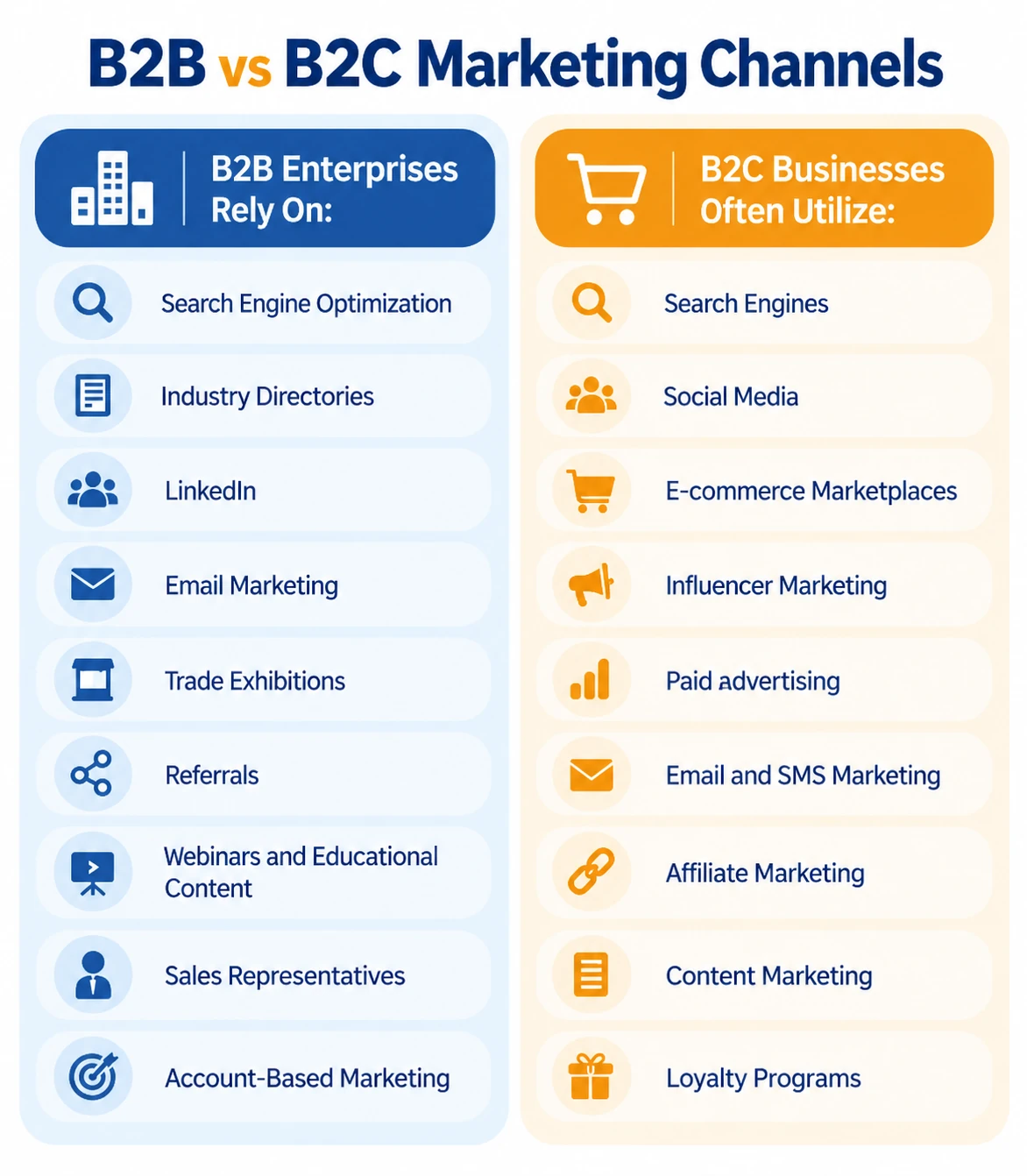
While a B2B supplier might require a small number of highly qualified leads, a B2C retailer would probably need many visits to create enough sales volume.
Customer Relationships and Retention
Relationships in B2B are more account-oriented; therefore, losing an important client means losing revenue, especially when this client orders regularly.
That is why many B2B companies focus greatly on account management, technical support, service-level agreements and relationship building.
The same can apply to B2C companies as well, but their customer retention usually depends on quality, price, convenience, loyalty program, personalization, and overall customer experience.
Repeat purchase can be very valuable for a consumer brand since attracting a new client can be more expensive than keeping the current one.
Which Model Is Right for Your Business?
A B2B strategy could work well if you are dealing with goods intended mostly for companies, ordered in large amounts, with consulting being needed or regular purchases being required. Such categories as industrial equipment, enterprise software, raw materials, or wholesale products fit well into this category.
B2C could be considered if your goods are meant for individual customers, there is no need for a complicated purchasing process and a retail or online sales channel could be applied.
Sometimes businesses are able to combine these strategies. For example, a manufacturer is able not only to supply distributors and retailers but also to sell some products directly to consumers. In this case, there must be developed two distinct strategies for each market.
B2B vs B2C: How Should Businesses Choose?
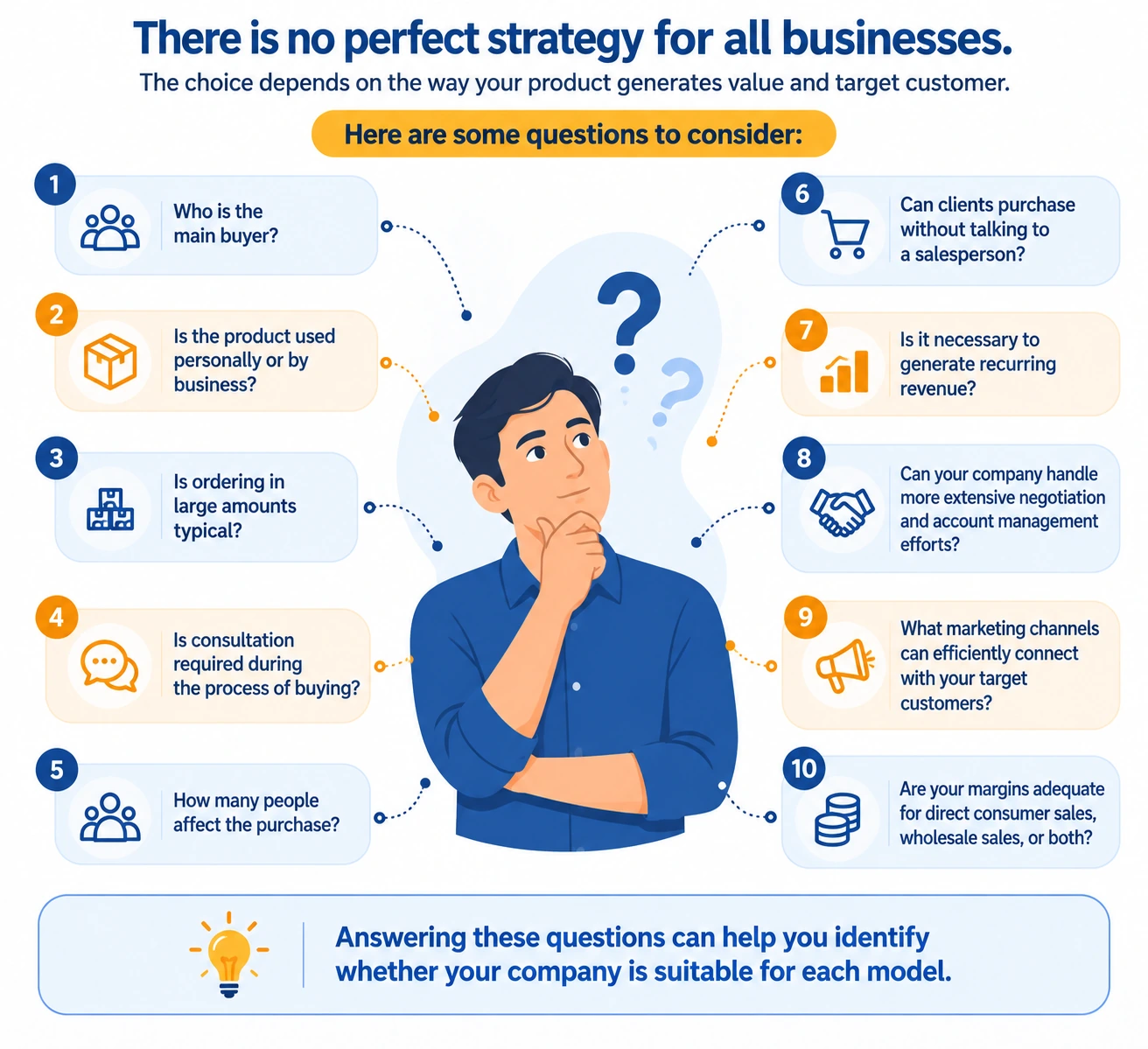
Answering these questions can help you identify whether your company is suitable for each model.
Can a Business Serve Both B2B and B2C Customers?
Yes. A company can work with both types of customers if its products, infrastructure and pricing strategy support them.
For instance, the producer can deliver in bulk to wholesalers and run the online shop to sell directly to consumers. But there must be proper segmentation to address the two audiences.
The firm needs different product catalogues, price ranges, payment conditions, marketing messages, and customer support processes. It must also avoid channel conflict, especially when wholesalers of the company are competing with the company’s direct online sales.
A well-thought-out hybrid approach allows diversification of revenue streams and reaching various markets.
Final Thoughts
Generally, B2B is about business value, procurement, relationships and bigger transactions, whereas B2C is about individuals, convenience, customer experience and easier access. There is no universal winner in these two models.
Businessmen need to choose which of these two models suits their business better in terms of the type of customers, nature of the products, sales skills, and growth strategy. A combination of B2B and B2C can create extra revenue streams when applied properly.
FAQs
Neither model is necessarily superior to the other. B2B models can offer bigger contract sizes and recurring income streams, while B2C models offer larger markets and faster transaction cycles. However, the right model depends on what you sell and how you do it.
No. Most companies that manufacture or produce goods use both types of business models. Some of their products are sold to other companies; others go straight to the consumer via a website or retail stores.
B2B sales usually take longer because the purchase process involves research, demonstration, negotiation, the procurement process, and getting an agreement from various decision-makers. In B2C sales are done relatively fast, except in cases where the product purchased is valuable for the customer.