
Understanding HS Code For Honey
Honey is one of the oldest natural sweeteners in the world and a key product in global trade. Whether raw, organic, or processed, every honey variety must be classified under the Harmonized System (HS) codes to ensure correct customs duty and taxation.
Honey falls under Chapter 04 – Dairy Produce; Birds’ Eggs; Natural Honey; Edible Products Of Animal Origin. Specifically, natural honey is classified under HS Code 0409. This code covers honey produced by bees or other insects, packaged for retail or bulk trade.
Importance Of HS Code For Honey
Correct HS classification for honey is essential because:
- Customs Clearance: Prevents delays and penalties during international shipments.
- Accurate GST Application: Helps businesses charge the correct tax rate.
- Trade Agreements: Ensures exporters avail duty benefits under FTAs.
- Market Recognition: HS codes are globally standardized at the 6-digit level, making trade easier.
Types Of Honey Covered Under HS Code 0409
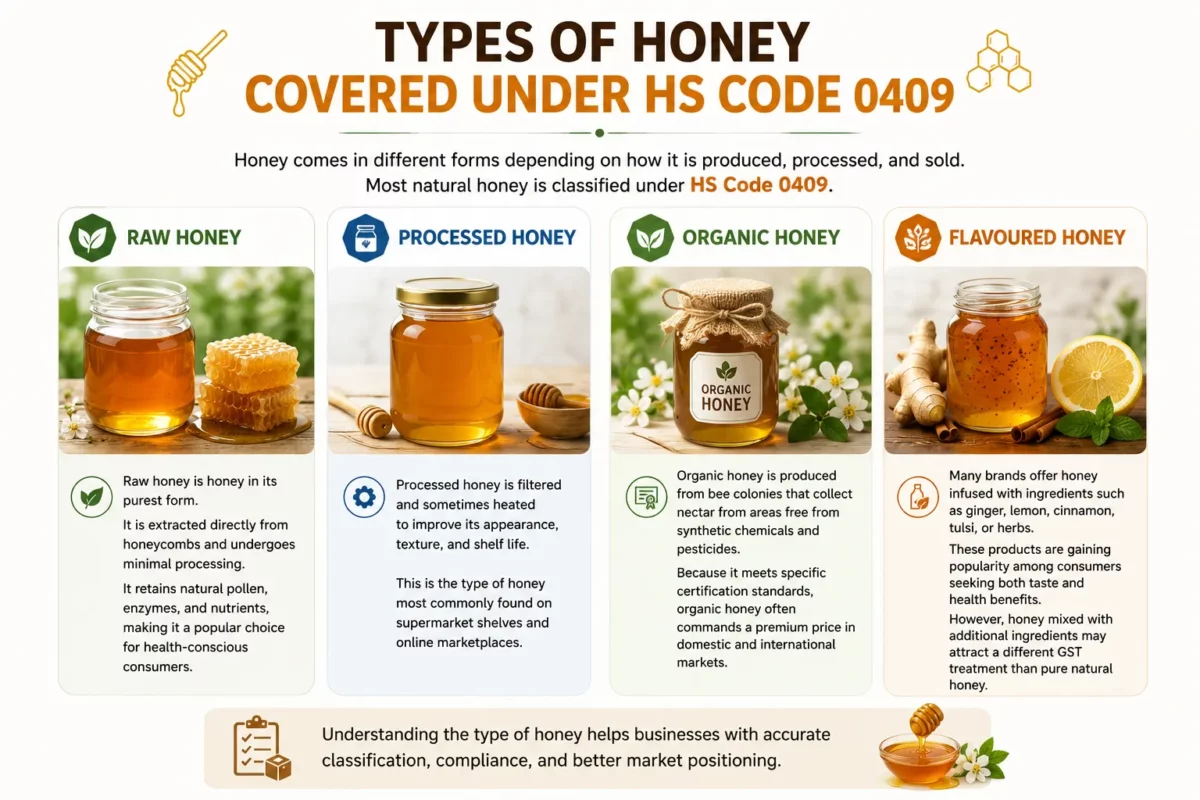
Honey comes in different forms depending on how it is produced, processed, and sold. Although most natural honey is classified under HS Code 0409, understanding the different varieties can help businesses classify and market their products more effectively.
Raw Honey
Raw honey is honey in its purest form. It is extracted directly from honeycombs and undergoes minimal processing. Since it retains natural pollen, enzymes, and nutrients, raw honey is highly popular among consumers looking for natural and healthy food products.
Processed Honey
Processed honey is filtered and sometimes heated to improve its appearance, texture, and shelf life. This is the type of honey most commonly found on supermarket shelves and online marketplaces.
Organic Honey
Organic honey is produced from bee colonies that collect nectar from areas free from synthetic chemicals and pesticides. Because it meets specific certification standards, organic honey often commands a premium price in domestic and international markets.
Flavoured Honey
Many brands now offer honey infused with ingredients such as ginger, lemon, cinnamon, tulsi, or herbs. These products are gaining popularity among consumers seeking both taste and health benefits. However, honey mixed with additional ingredients may attract a different GST treatment than pure natural honey.
What Affects The GST Rate On Honey?
The GST rate on honey is not always determined by the product alone. Several factors can influence how honey is taxed.
Branding And Packaging
One of the most important factors is whether the honey is sold under a registered brand name. Packaged and branded honey generally attracts GST, while certain unbranded varieties may qualify for exemption under GST rules.
Product Composition
Pure honey is treated differently from products that contain added flavours, preservatives, or sweeteners. Once extra ingredients are added, the product may fall into a different category for taxation purposes.
Intended Use
Honey sold for direct consumption may be taxed differently from honey-based products marketed as health supplements, medicinal preparations, or specialised food products.
Because GST regulations can change, businesses should always verify the latest tax notifications before determining the applicable rate.
Why Is The Correct HS Code Important For Honey?
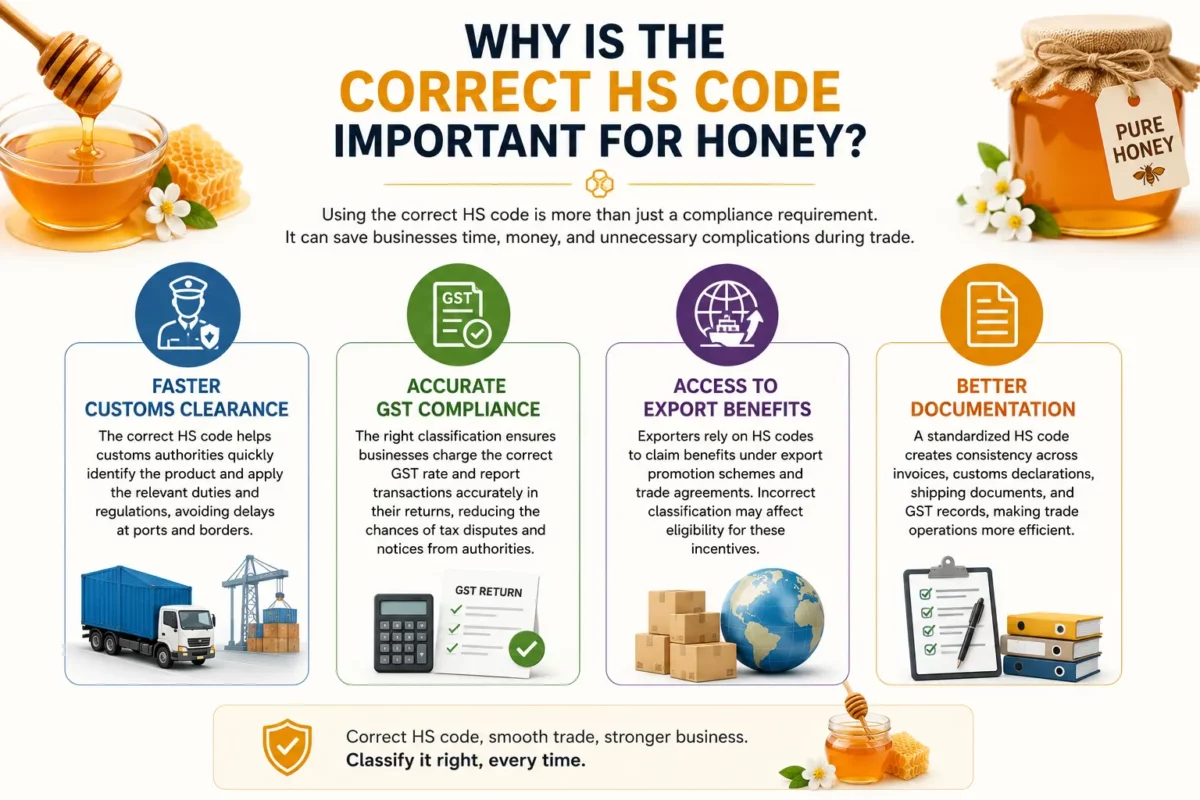
Using the correct HS code is more than just a compliance requirement. It can save businesses time, money, and unnecessary complications during trade.
Faster Customs Clearance
When the correct HS code is mentioned in shipping documents, customs authorities can quickly identify the product and apply the relevant duties and regulations. This helps avoid delays at ports and borders.
Accurate GST Compliance
The right classification ensures that businesses charge the correct GST rate and report transactions accurately in their returns. This reduces the chances of tax disputes and notices from authorities.
Access To Export Benefits
Exporters often rely on HS codes to claim benefits available under export promotion schemes and trade agreements. Incorrect classification may affect eligibility for these incentives.
Better Documentation
A standardized HS code creates consistency across invoices, customs declarations, shipping documents, and GST records, making trade operations more efficient.
Common Uses Of Honey Across Industries
While honey is widely consumed as a natural sweetener, its use extends far beyond household kitchens.
Food And Beverage Industry
Honey is commonly used in bakery products, cereals, confectionery items, beverages, sauces, and health foods. Many manufacturers use honey as a natural alternative to refined sugar.
Pharmaceutical Industry
Due to its natural antibacterial and soothing properties, honey is often used in syrups, cough remedies, and various health formulations.
Cosmetics And Personal Care
Honey is a popular ingredient in skincare and personal care products. It is frequently found in face masks, moisturizers, soaps, shampoos, and lip care products because of its moisturizing properties.
Health And Wellness Products
The growing demand for natural and organic nutrition has increased the use of honey in energy supplements, herbal products, and wellness formulations.
Documents Required For Import And Export Of Honey
Businesses involved in importing or exporting honey must maintain proper documentation to ensure smooth customs clearance and regulatory compliance.
Import Documents
- Commercial Invoice
- Packing List
- Bill of Entry
- Bill of Lading or Airway Bill
- Import Export Code (IEC)
- Certificate of Origin
- Food Safety Certifications, where required
Export Documents
- Commercial Invoice
- Packing List
- Shipping Bill
- Export Order or Purchase Contract
- Certificate of Origin
- Food Safety or Quality Certifications, depending on the destination country
Keeping these documents ready helps avoid delays and ensures hassle-free movement of goods across borders.
India’s Growing Honey Export Market
India has emerged as one of the world’s leading producers and exporters of natural honey. The country’s diverse floral sources and favourable climate contribute to the production of high-quality honey that is in demand across global markets.
Indian honey is exported to countries across North America, Europe, the Middle East, and Asia. Rising consumer preference for natural sweeteners, organic foods, and wellness products has further increased international demand.
For exporters, accurate HS code classification is essential not only for customs compliance but also for accessing export incentives and ensuring smooth trade transactions. As global demand continues to grow, honey remains an important agricultural export product for India.
HS Code Classification For Honey
The classification for honey is relatively simple compared to other foods:
- 040900 – Natural honey, whether or not packaged for retail sale
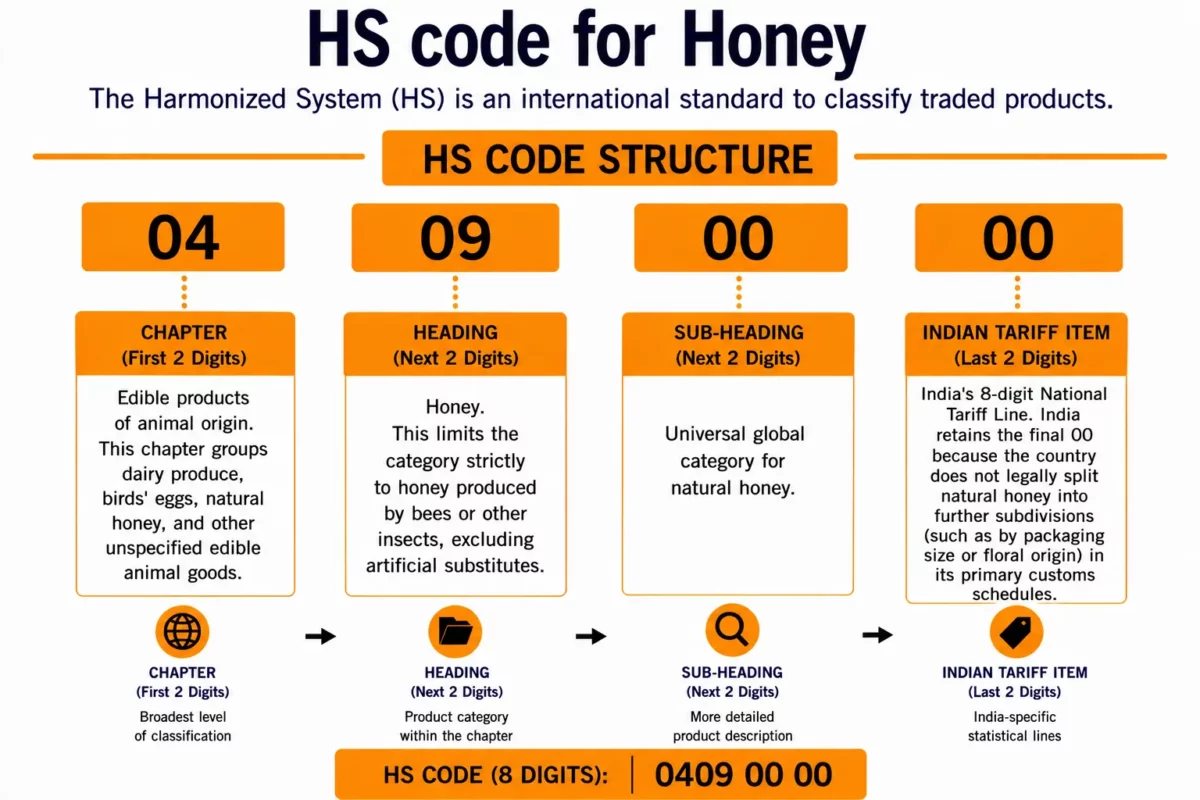
Some countries use additional digits for finer distinctions (packaging, organic certification), but 0409 is the global standard heading.
GST Rates For Honey In India
GST treatment for honey in India depends on whether it’s raw/unbranded or branded/processed:
- Natural Raw Honey (unbranded) – Exempt from GST
- Branded/Packaged Natural Honey – 5% GST
- Honey With Additives/Flavors (e.g., ginger, lemon) – 12% GST
HS Codes And GST Rates For Honey Products
Here’s a detailed table covering the Honey products, HS codes, and GST rates:
🪟 GST on Glass Products (2026)
🪟 Cast / Rolled Glass
📦 HS Code: 700300
📄 Category: Sheets, wired or not
💰 Current GST: 12%
🕰️ Earlier GST: 12%
🧊 Drawn / Blown Glass
📦 HS Code: 700400
📄 Category: Unworked sheets
💰 Current GST: 12%
🕰️ Earlier GST: 12%
🪞 Float Glass
📦 HS Code: 700521
📄 Category: Clear float glass
💰 Current GST: 12%
🕰️ Earlier GST: 12%
🛡️ Tempered / Safety Glass
📦 HS Code: 700721
📄 Category: Toughened, laminated
💰 Current GST: 12%
🕰️ Earlier GST: 12%
🍾 Glass Bottles And Jars
📦 HS Code: 701090
📄 Category: Containers for packing
💰 Current GST: 18%
🕰️ Earlier GST: 18%
🍽️ Household Glassware
📦 HS Code: 701310
📄 Category: Table / kitchen use
💰 Current GST: 18%
🕰️ Earlier GST: 18%
🧪 Laboratory Glassware
📦 HS Code: 701710
📄 Category: Lab, hygienic, pharma use
💰 Current GST: 18%
🕰️ Earlier GST: 18%
🎨 Decorative / Luxury Glass
📦 HS Code: 701890
📄 Category: Fancy or artistic glass items
💰 Current GST: 28%
🕰️ Earlier GST: 28%
📌 Note: GST rates for most utility and industrial glass types remain at 12–18%, while decorative luxury glass draws the highest slab of 28%.
Final Thoughts
Glass products are classified under Chapter 70 of HS codes, with subcategories ranging from construction glass to luxury decorative glassware. In India, GST varies from 12% on essential glass sheets and safety glass to 28% on decorative luxury glassware.
For businesses, accurate HS code classification is essential to avoid compliance issues, apply the correct GST rate, and ensure smooth international trade.
FAQs
The HS code for natural honey is 040900.
Raw and unbranded natural honey is generally exempt from GST in India.
Branded or packaged honey typically attracts 5% GST.
Honey with additives or flavors usually attracts 12% GST.
Yes, 0409 is the harmonized 6-digit code used globally; national extensions (8/10 digits) vary.