
Understanding HS Code For Glass
Glass is widely used across industries from construction and automotive to packaging and household products. For international trade and taxation, glass and glassware are classified under the Harmonized System (HS) codes, which provide a uniform system of classification.
Glass falls under Chapter 70 – Glass And Glassware. This chapter covers float glass, safety glass, tempered glass, laboratory glassware, tableware, and even glass beads. Each category has its own HS code for accurate trade reporting and taxation.
Importance Of HS Code For Glass
For manufacturers, exporters, and importers, correct HS code classification is critical:
- Customs Compliance: Ensures smooth clearance without penalties.
- Accurate GST Application: Helps apply the right GST rate.
- Trade Benefits: Necessary for claiming duty exemptions under FTAs.
- Global Recognition: HS codes are harmonized globally up to the 6-digit level, easing cross-border trade.
Factors Affecting Motor HS Code Classification
The classification of electric motors under the HSN system depends on several technical specifications. Businesses should carefully evaluate these factors before selecting the appropriate HS code.
Motor Type
Electric motors are broadly categorized as AC motors, DC motors, and multi-phase motors. Each category may fall under a different subheading within HS Code 8501.
Power Output
The output capacity of a motor is one of the primary factors used for classification. Motors with lower power ratings are classified separately from industrial motors with higher output capacities.
Industrial Application
Motors designed for specific industrial applications may require detailed examination to determine the correct classification. Product specifications and technical documentation play an important role in this process.
Product Configuration
A motor sold as an individual unit may have a different classification compared to a motor supplied as part of a complete machine or equipment assembly.
Applications of Electric Motors Across Industries
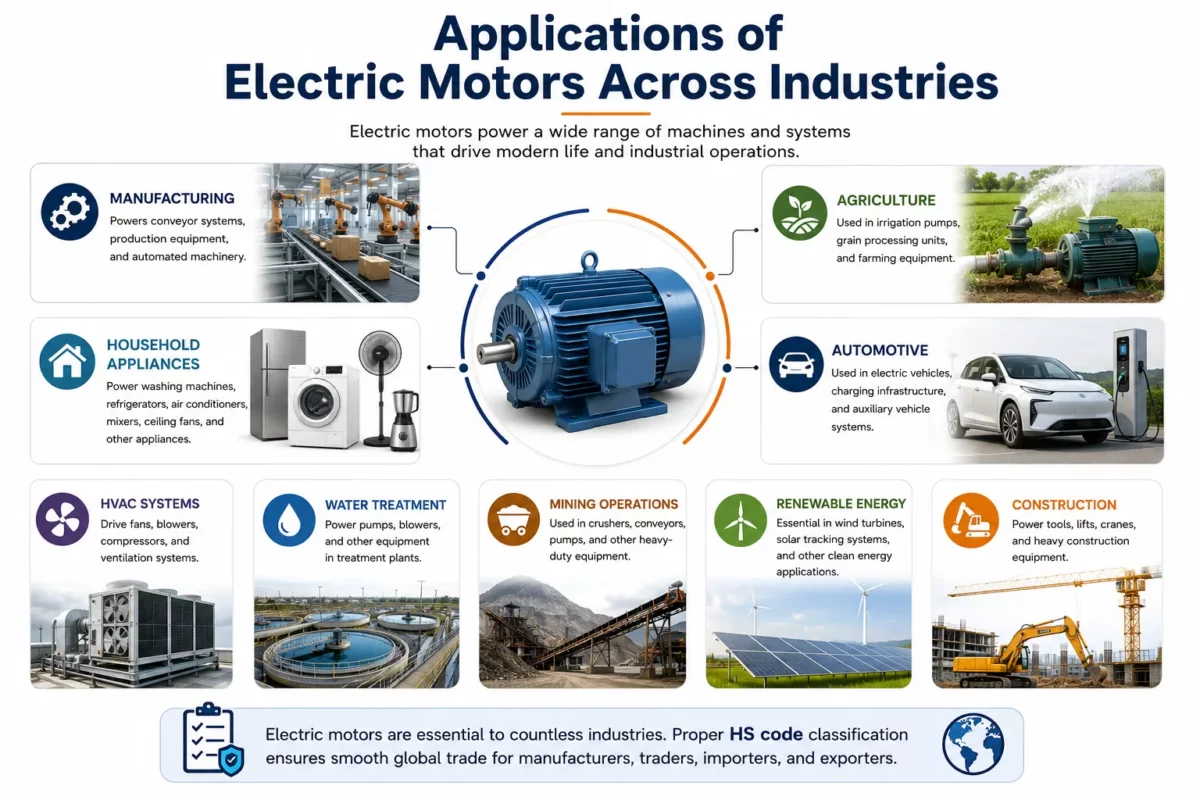
Electric motors are used in a wide range of sectors due to their efficiency, reliability, and versatility. They form an essential component of numerous machines and systems used in daily life and industrial operations.
In the manufacturing sector, electric motors power conveyor systems, production equipment, and automated machinery. The agricultural industry uses motors in irrigation pumps, grain processing units, and farming equipment.
Household appliances such as washing machines, refrigerators, air conditioners, mixers, and ceiling fans also rely on electric motors for operation. In the automotive sector, electric motors are increasingly used in electric vehicles, charging infrastructure, and auxiliary vehicle systems.
Additionally, motors are widely utilized in HVAC systems, water treatment plants, mining operations, renewable energy projects, and construction equipment. Their widespread use makes proper HS code classification important for manufacturers, traders, importers, and exporters.
Benefits of Using the Correct HS Code for Motors
Accurate HS code classification offers several advantages to businesses involved in the sale, import, export, or manufacture of electric motors.
Smooth Customs Clearance
Correct classification helps customs authorities identify products quickly and apply the appropriate duties and regulations, reducing delays during clearance.
Accurate GST Compliance
Using the correct HS code ensures proper GST invoicing and return filing, helping businesses avoid tax mismatches and compliance issues.
Better Trade Documentation
HS codes create consistency across invoices, shipping documents, and customs declarations, improving overall trade efficiency.
Eligibility for Government Benefits
Exporters may use HS codes to claim benefits under export promotion schemes and other government incentives available for specific product categories.
Reduced Risk of Penalties
Incorrect classification can result in notices, reassessments, and penalties. Proper classification minimizes such risks and supports regulatory compliance.
Documents Required for Import and Export of Motors
Businesses trading electric motors internationally must maintain proper documentation to ensure smooth customs processing.
Import Documents
- Commercial Invoice
- Packing List
- Bill of Entry
- Bill of Lading or Airway Bill
- Import Export Code (IEC)
- Certificate of Origin
Export Documents
- Commercial Invoice
- Packing List
- Shipping Bill
- Export Purchase Order
- Product Specifications
- Certificate of Origin (where applicable)
Accurate documentation helps customs authorities verify product classification, determine applicable duties, and facilitate faster clearance of shipments.
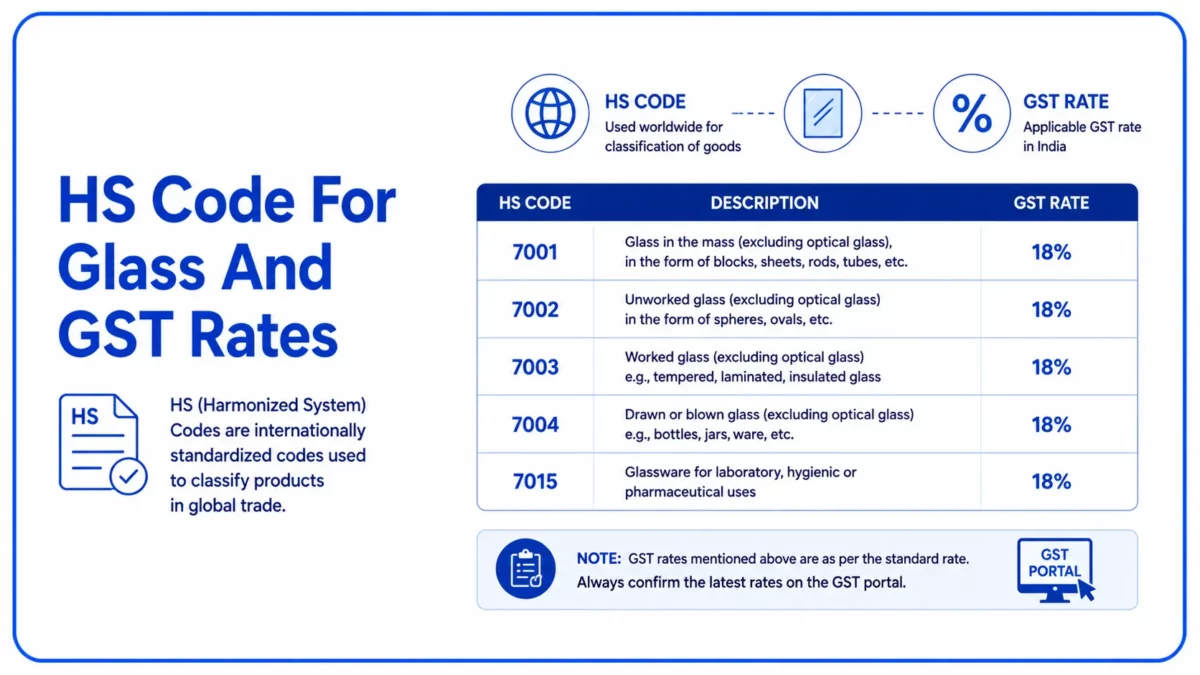
HS Code Classification For Glass Products
Glass products are categorized under different HS headings within Chapter 70:
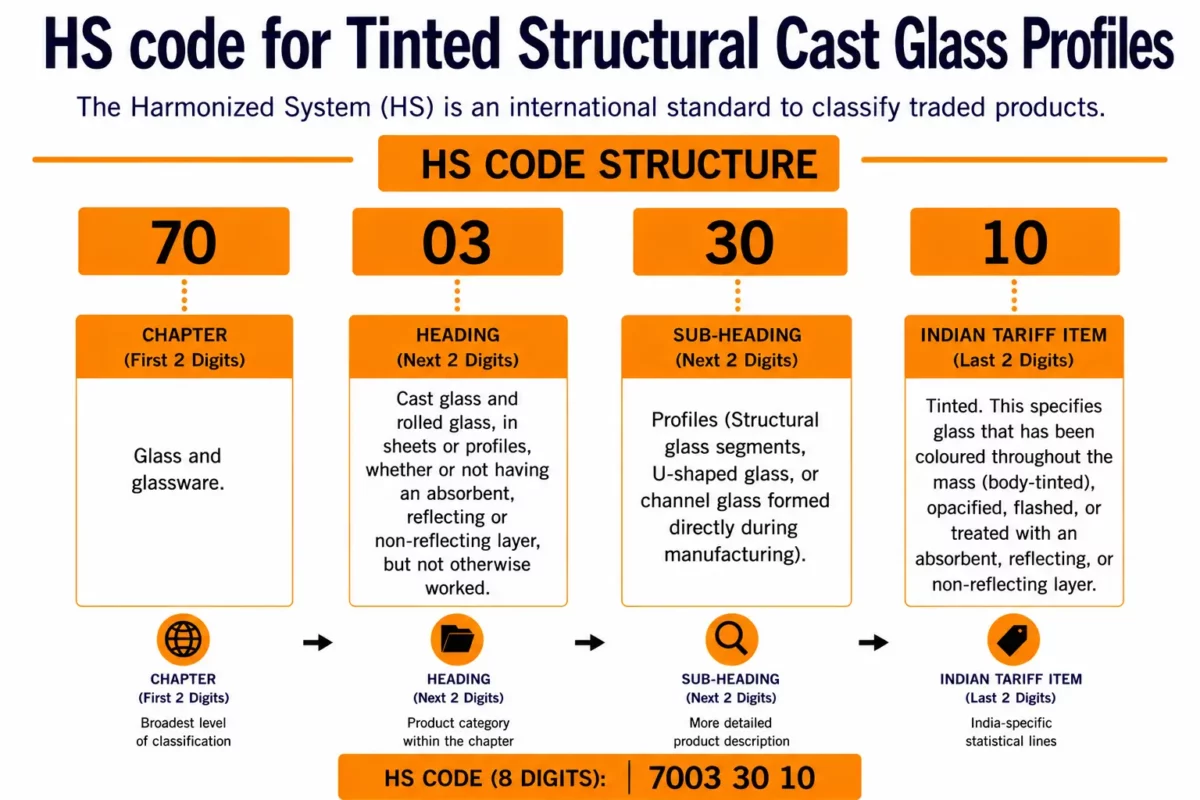
- 7003 – Cast glass and rolled glass
- 7004 – Drawn glass and blown glass
- 7005 – Float glass and surface ground or polished glass
- 7006 – Glass of heading 7003–7005, bent, edge-worked, engraved
- 7007 – Safety glass, toughened or laminated
- 7010 – Glass bottles, jars, containers
- 7013 – Glassware for table, kitchen, and household use
- 7017 – Laboratory, hygienic, and pharmaceutical glassware
GST Rates For Glass In India
In India, GST rates for glass and glassware vary based on product type:
- 12% GST – Applied on float glass, sheet glass, and safety glass.
- 18% GST – Applied on glass containers, laboratory glassware, and table/kitchen glassware.
- 28% GST – Applied on decorative and luxury glass items.
This structure ensures essential glass products for construction remain affordable while luxury and decorative items are taxed higher.
HS Codes And GST Rates For Glass
Here’s a detailed table covering the most common glass products, HS codes, and GST rates:
🪟 Glass Products GST Rate (2026)
🪟 Cast/Rolled Glass
📘 HS Code: 700300
📂 Category: Sheets, wired or not
💸 Current GST: 12%
🕰️ Earlier GST: 12%
🧊 Drawn/Blown Glass
📘 HS Code: 700400
📂 Category: Unworked sheets
💸 Current GST: 12%
🕰️ Earlier GST: 12%
🪞 Float Glass
📘 HS Code: 700521
📂 Category: Clear float glass
💸 Current GST: 12%
🕰️ Earlier GST: 12%
🛡️ Tempered/Safety Glass
📘 HS Code: 700721
📂 Category: Toughened, laminated
💸 Current GST: 12%
🕰️ Earlier GST: 12%
🍾 Glass Bottles And Jars
📘 HS Code: 701090
📂 Category: Containers for packing
💸 Current GST: 18%
🕰️ Earlier GST: 18%
🍽️ Household Glassware
📘 HS Code: 701310
📂 Category: Table/Kitchen use
💸 Current GST: 18%
🕰️ Earlier GST: 18%
🧪 Laboratory Glassware
📘 HS Code: 701710
📂 Category: Lab, hygienic, pharma use
💸 Current GST: 18%
🕰️ Earlier GST: 18%
🎨 Decorative/Luxury Glass
📘 HS Code: 701890
📂 Category: Fancy or artistic glass items
💸 Current GST: 28%
🕰️ Earlier GST: 28%
📌 Note: Functional glass items attract 12%–18% GST, while decorative glass commands a higher rate of 28%.
Final Thoughts
Glass products are classified under Chapter 70 of HS codes, with subcategories ranging from construction glass to luxury decorative glassware. In India, GST varies from 12% on essential glass sheets and safety glass to 28% on decorative luxury glassware.
For businesses, accurate HS code classification is essential to avoid compliance issues, apply the correct GST rate, and ensure smooth international trade.
FAQs
Glass and glassware are classified under Chapter 70.
Float glass is classified under 7005 (e.g., 700521 for clear float glass).
Glass containers like bottles and jars attract 18% GST.
Yes, luxury or decorative glass items fall under 28% GST.
Yes, HS codes are harmonized at the 6-digit level globally, but countries may add extra digits for detailed classification.