
Understanding HS Code for Motor
Electric motors are essential components used across machinery, appliances, industrial automation, pumps, fans, and electric vehicles. They are classified under specific HS codes based on type, power output, and application for the purpose of trade, taxation, and compliance.
Electric motors fall under Chapter 85 – Electrical Machinery And Equipment. The key heading is:
HS Code 8501 – Electric motors and generators (excluding generating sets).
Types Of Electric Motors Covered Under HS Code 8501
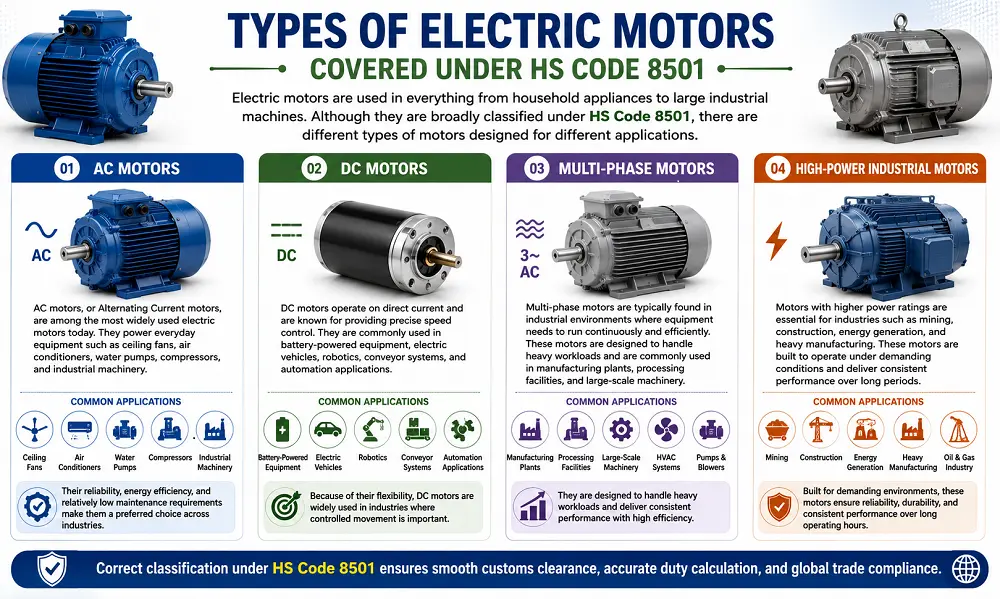
Electric motors are used in everything from household appliances to large industrial machines. Although they are broadly classified under HS Code 8501, there are different types of motors designed for different applications.
AC Motors
AC motors, or Alternating Current motors, are among the most widely used electric motors today. They power everyday equipment such as ceiling fans, air conditioners, water pumps, compressors, and industrial machinery. Their reliability, energy efficiency, and relatively low maintenance requirements make them a preferred choice across industries.
DC Motors
DC motors operate on direct current and are known for providing precise speed control. They are commonly used in battery-powered equipment, electric vehicles, robotics, conveyor systems, and automation applications. Because of their flexibility, DC motors are widely used in industries where controlled movement is important.
Multi-Phase Motors
Multi-phase motors are typically found in industrial environments where equipment needs to run continuously and efficiently. These motors are designed to handle heavy workloads and are commonly used in manufacturing plants, processing facilities, and large-scale machinery.
High-Power Industrial Motors
Motors with higher power ratings are essential for industries such as mining, construction, energy generation, and heavy manufacturing. These motors are built to operate under demanding conditions and deliver consistent performance over long periods.
Why Choosing The Right HS Code Matters
For businesses involved in manufacturing, importing, exporting, or trading electric motors, selecting the correct HS code is more than just a paperwork requirement. It plays an important role in taxation, customs clearance, and regulatory compliance.
Helps Avoid Delays At Customs
When a shipment reaches a port or border checkpoint, customs authorities use the HS code to identify the product and determine the applicable duties and regulations. An incorrect classification can result in additional inspections, requests for clarification, or shipment delays.
Ensures Correct GST Compliance
Using the right HS code helps businesses apply the correct GST rate and maintain accurate records. This not only simplifies tax filing but also reduces the chances of errors during audits or assessments.
Makes International Trade Easier
Since HS codes are recognized globally, they provide a common language for traders and customs authorities around the world. This standardization helps ensure smoother transactions across international markets.
Reduces Compliance Risks
Incorrect classification can sometimes lead to underpayment or overpayment of taxes and duties. By using the appropriate HS code, businesses can avoid unnecessary penalties and compliance issues.
Where Are Electric Motors Used?
Electric motors are an essential part of modern life. In fact, many of the machines and devices we use daily rely on motors to function.
Manufacturing And Industrial Operations
Factories and production facilities use electric motors to power conveyor belts, pumps, compressors, machine tools, and automated production lines. Without motors, modern manufacturing processes would be far less efficient.
Household Appliances
Many common household products contain electric motors. Washing machines, refrigerators, vacuum cleaners, mixers, water pumps, and ceiling fans all depend on motors to perform their functions.
Agriculture
In the agricultural sector, electric motors help power irrigation systems, grain processing equipment, dairy machinery, and various farm tools. Their reliability makes them an important component of modern farming operations.
Electric Vehicles
The growing popularity of electric vehicles has significantly increased the demand for electric motors. These motors convert electrical energy from batteries into mechanical motion, allowing EVs to operate efficiently without conventional fuel.
Infrastructure And HVAC Systems
Electric motors are also widely used in elevators, water treatment plants, ventilation systems, air-conditioning units, and commercial buildings. Their ability to provide consistent and efficient performance makes them indispensable in infrastructure projects.
Documents Required For Import And Export Of Motors
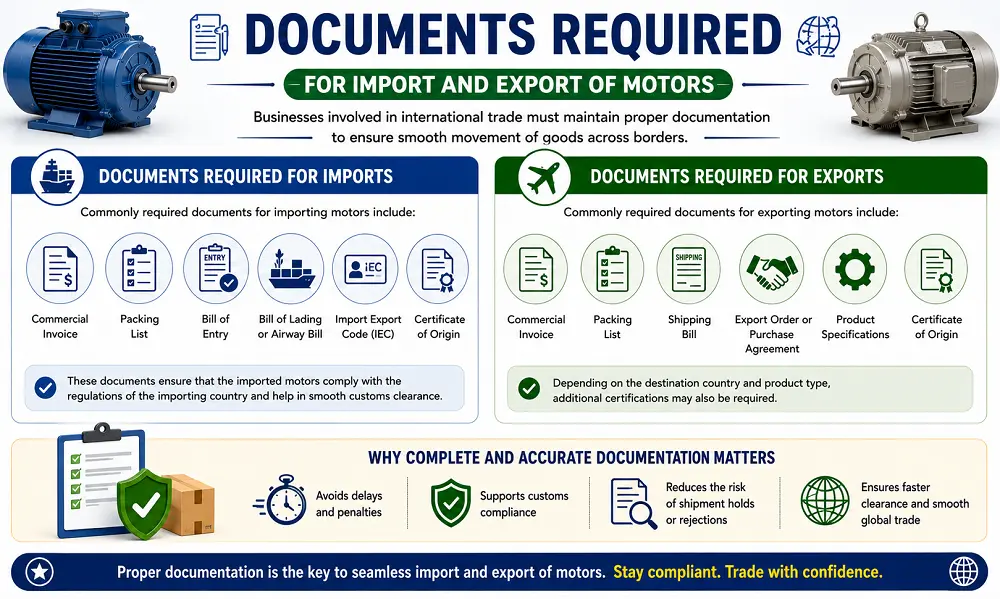
Businesses involved in international trade must maintain proper documentation to ensure smooth movement of goods across borders.
For imports, commonly required documents include a commercial invoice, packing list, bill of entry, bill of lading or airway bill, Import Export Code (IEC), and certificate of origin.
For exports, businesses generally need a commercial invoice, packing list, shipping bill, export order or purchase agreement, product specifications, and a certificate of origin. Depending on the destination country and product type, additional certifications may also be required.
Having complete and accurate documentation helps avoid delays, supports customs compliance, and ensures faster clearance of shipments.
Rising Demand For Electric Motors
The demand for electric motors has grown steadily over the past decade, driven by industrial expansion, automation, and the increasing adoption of electric vehicles. Businesses are also investing in energy-efficient motor technologies to reduce operating costs and meet sustainability goals.
Government initiatives promoting renewable energy, smart manufacturing, and electric mobility have further accelerated market growth. As industries continue to modernize and automate their operations, electric motors will remain one of the most important components powering economic and technological development.
For businesses dealing in electric motors, understanding the correct HS code and GST rate is essential not only for compliance but also for ensuring smooth trade operations and accurate tax reporting.
Importance Of HS Code For Motor
Accurate HS code classification for motors is important for:
- Customs & Import Duties: Determines correct tariff and IGST on imports.
- Domestic GST Filing: Ensures the applicable GST rate is charged correctly.
- Export Benefits: Helps in claiming MEIS, RoDTEP or EPCG benefits.
- Compliance: Avoids classification errors, delays, or penalties.
HS Code Classification For Motor
Motors are classified under HS Code 8501, with subheadings based on power rating and type:
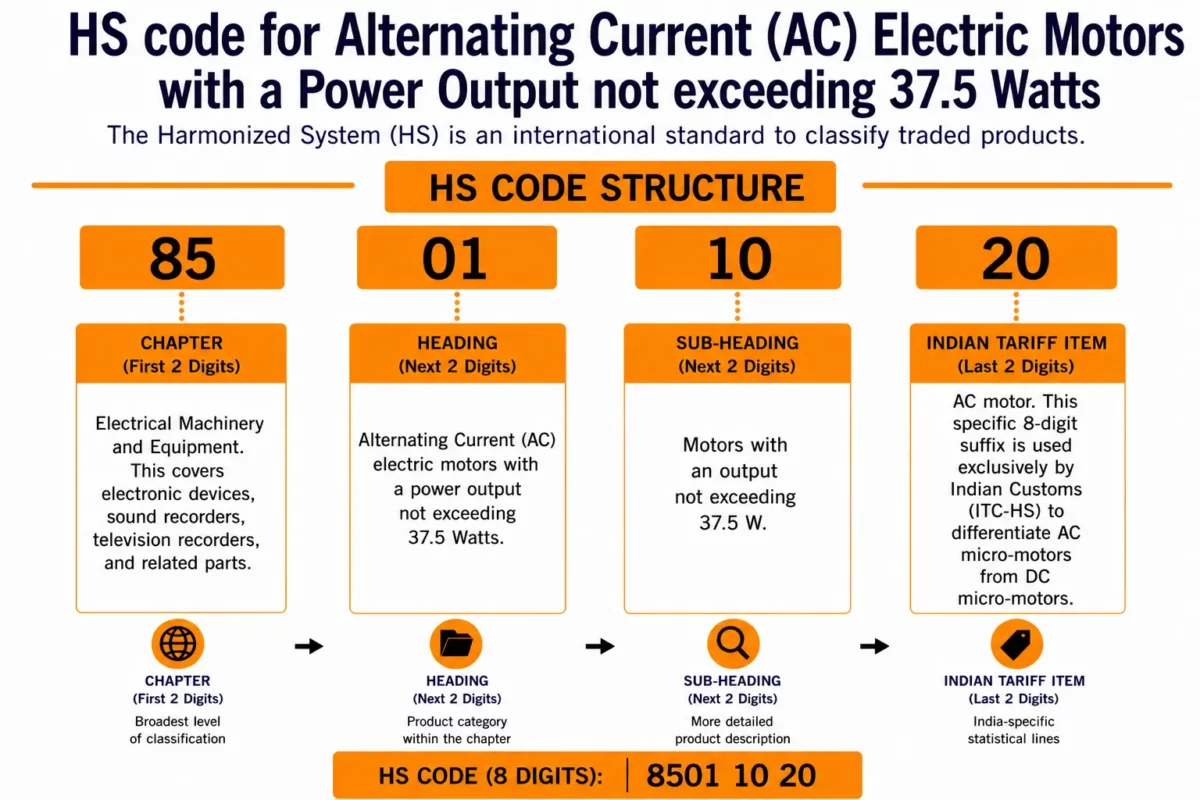
- 850110 – Motors of output ≤37.5 W (e.g., small appliances)
- 850131 – DC motors, output ≤750 W
- 850132 – DC motors, output >750 W but ≤75 kW
- 850133 – DC motors, output >75 kW
- 850140 – AC motors, multi-phase
- 850151 – AC motors, of output ≤750 W
- 850152 – AC motors, output >750 W but ≤75 kW
- 850153 – AC motors, output >75 kW
GST Rates For Motors In India
GST rates on electric motors in India typically fall under:
- Electric motors (HS 8501): 18% GST
- Electric motors for EVs or renewable energy: 5% GST (if covered by notification)
- Motor parts and accessories: 18% GST
Always check latest CBIC notifications for concessional rates under specific use-cases.
HS Codes And GST Rates For Motors
Here’s a table listing common electric motor types, HS codes, and applicable GST rates:
⚙️ GST on Electric Motors (2026)
⚙️ Small Electric Motor (≤37.5W)
🔢 HS Code: 850110
📄 Category: Miniature motors used in appliances
💰 GST: 18%
🔋 DC Motor (≤750W)
🔢 HS Code: 850131
📄 Category: Low-powered DC motors
💰 GST: 18%
🔋 DC Motor (>750W ≤75kW)
🔢 HS Code: 850132
📄 Category: Industrial DC motors
💰 GST: 18%
💪 High Power DC Motor (>75kW)
🔢 HS Code: 850133
📄 Category: Heavy-duty motors for machines
💰 GST: 18%
🔌 AC Motor (Multi-Phase)
🔢 HS Code: 850140
📄 Category: General purpose AC motors
💰 GST: 18%
🔄 AC Motor (≤750W)
🔢 HS Code: 850151
📄 Category: Low capacity AC motors
💰 GST: 18%
🔄 AC Motor (>750W ≤75kW)
🔢 HS Code: 850152
📄 Category: Mid-range AC motors
💰 GST: 18%
⚡ AC Motor (>75kW)
🔢 HS Code: 850153
📄 Category: High-capacity industrial AC motors
💰 GST: 18%
📌 Note: All categories of motors listed above are subject to 18% GST uniformly.
Final Thoughts
Electric motors fall under HS Code 8501, with classification based on type and power output. In India, most electric motors attract 18% GST, though concessional GST of 5% may apply to motors used in EVs or renewable energy equipment. Proper classification ensures compliance, correct invoicing, and smoother logistics in both import and domestic trade.
FAQs
The base HS code is 8501, with sub-codes based on motor type and capacity.
Most motors are taxed at 18% GST, unless notified otherwise (e.g., for EVs).
Yes, AC and DC motors have separate subheadings under HS 8501.
Yes, electric motors used in EVs may attract 5% GST, subject to CBIC notification.
Small motors (≤37.5W) used in appliances fall under HS 850110.