
Direct Export vs Amazon Global Selling is about choosing the right international selling model for Indian exporters. Amazon provides faster access to global customers along with marketplace support, making it easier for businesses to start selling internationally. In comparison, direct export offers greater control over pricing, branding, buyers, and profit margins. The ideal approach depends on factors such as the seller’s product category, business objectives, logistics capabilities, and overall stage of growth.
When sellers start thinking about international business, the first real question is rarely about branding or packaging. It is usually this: should I go straight to buyers myself, or should I use a marketplace and let the platform do part of the heavy lifting? That is where Direct Export vs Amazon Global Selling becomes a practical decision, not a theoretical one. And honestly, the answer depends on what kind of seller you are, how much control you want, and how much operational pain you are willing to carry.
Some businesses want full ownership of the customer journey. Others would rather trade a bit of control for speed, reach, and fewer moving parts. Both paths can work. Both can fail too, if the execution is weak. So the better question is not which model sounds better in a meeting. It is the model that fits your margins, your product, and your patience.
Amazon Global Selling India vs Direct Export: What Really Changes
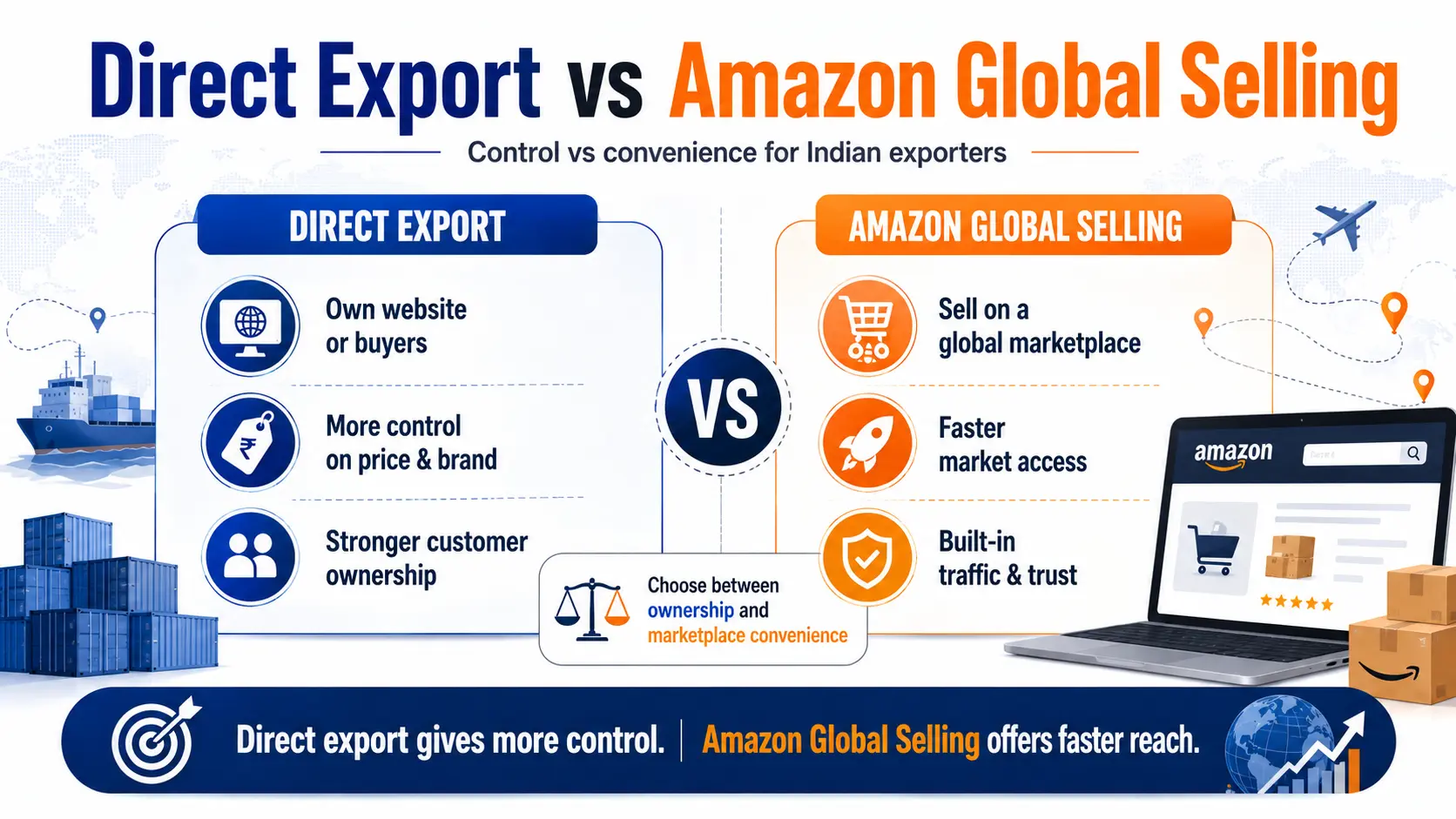
At a basic level, Direct Export vs Amazon Global Selling comes down to channel ownership. In direct export, you sell through your own website, distributors, importers, or overseas buyers. In Amazon Global Selling, you use Amazon’s cross-border setup to list and sell to international customers on a marketplace that already has traffic, trust, and infrastructure.
That difference sounds small until you live inside it.
Direct export means you have the power to set the price, the customer relationship and sometimes the brand presentation. Amazon has an audience, but it’s a system with rules, fees, and performance expectations. This is why Amazon Global Selling India vs direct export is not just a logistics comparison. It is a strategic choice about how much of your business you want to own versus outsource.
There is also a psychological difference, strangely enough. Direct export often feels slower at first, because you need to build everything yourself. Amazon feels faster because the stage is already built. But a built stage is not the same as a built business.
Cross-Border Ecommerce vs Traditional Export: The Real Trade-Off
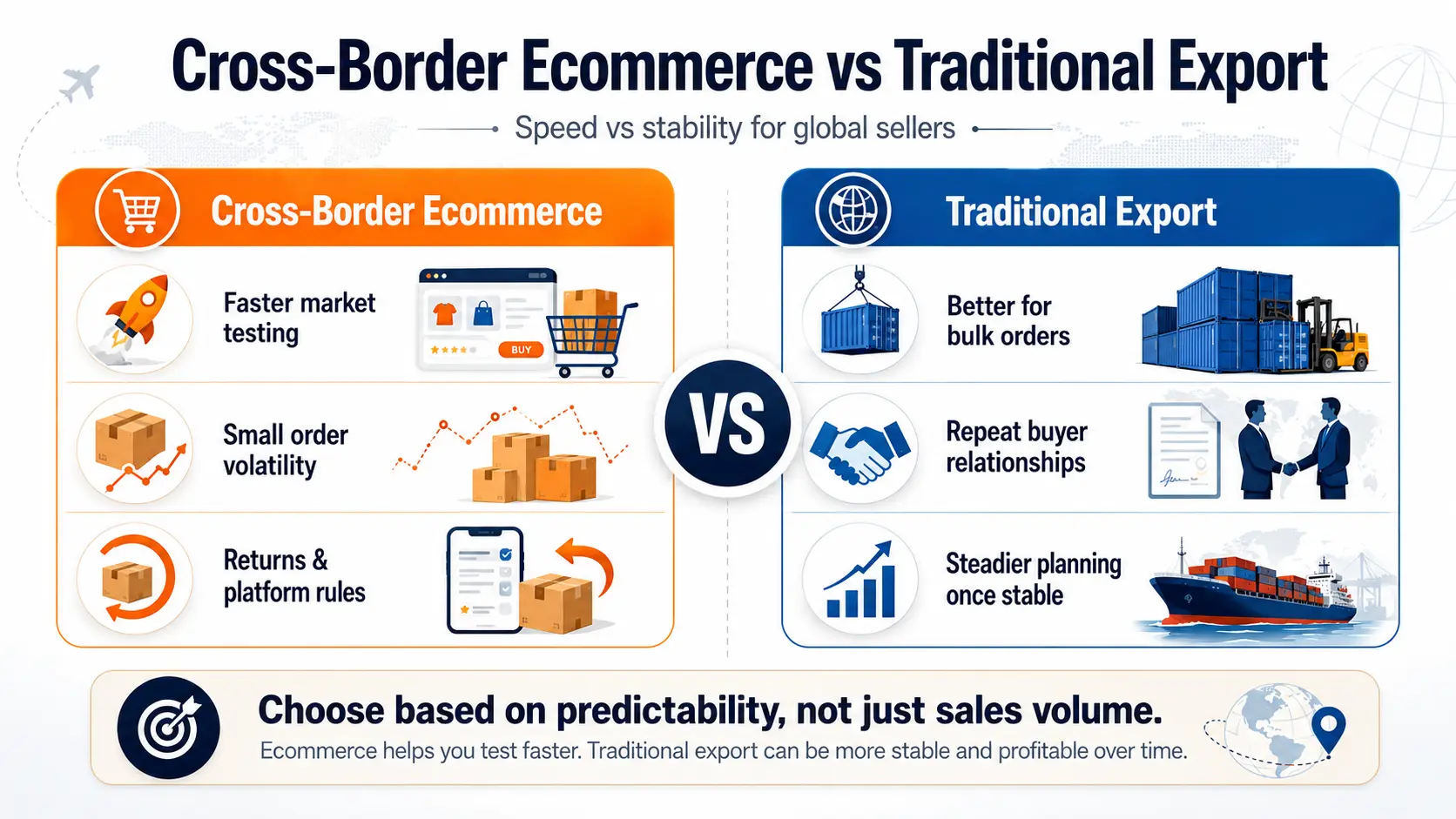
A lot of sellers compare cross-border ecommerce vs traditional export and assume the marketplace route is automatically modern and the older route is automatically clunky. That is too simple. Traditional export may look old-fashioned, but for bulk orders, repeat buyers, and stable relationships, it can still be cleaner and more profitable.
Here is the part many first-time exporters miss. Cross-border ecommerce can help you test markets faster, but it can also expose you to small order volatility, return issues, and platform rules. Traditional export may take longer to set up, yet once it stabilizes, it can offer steadier planning. That is why Direct Export vs Amazon Global Selling should be judged not only by sales volume, but also by predictability.
Comparison Table: Control, Cost, and Operations
🌍 Direct Export vs Amazon Global Selling
Compare control, scalability, pricing, and logistics before choosing your export model
This is where the debate becomes concrete. Sellers often ask about export margins Amazon vs direct, and that is the right question. A model that creates revenue but destroys margin is not really a win. A model that preserves margin but cannot reach buyers is also limited. Business, inconveniently, insists on both.
Control vs Convenience Export Model: Where The Money Actually Goes
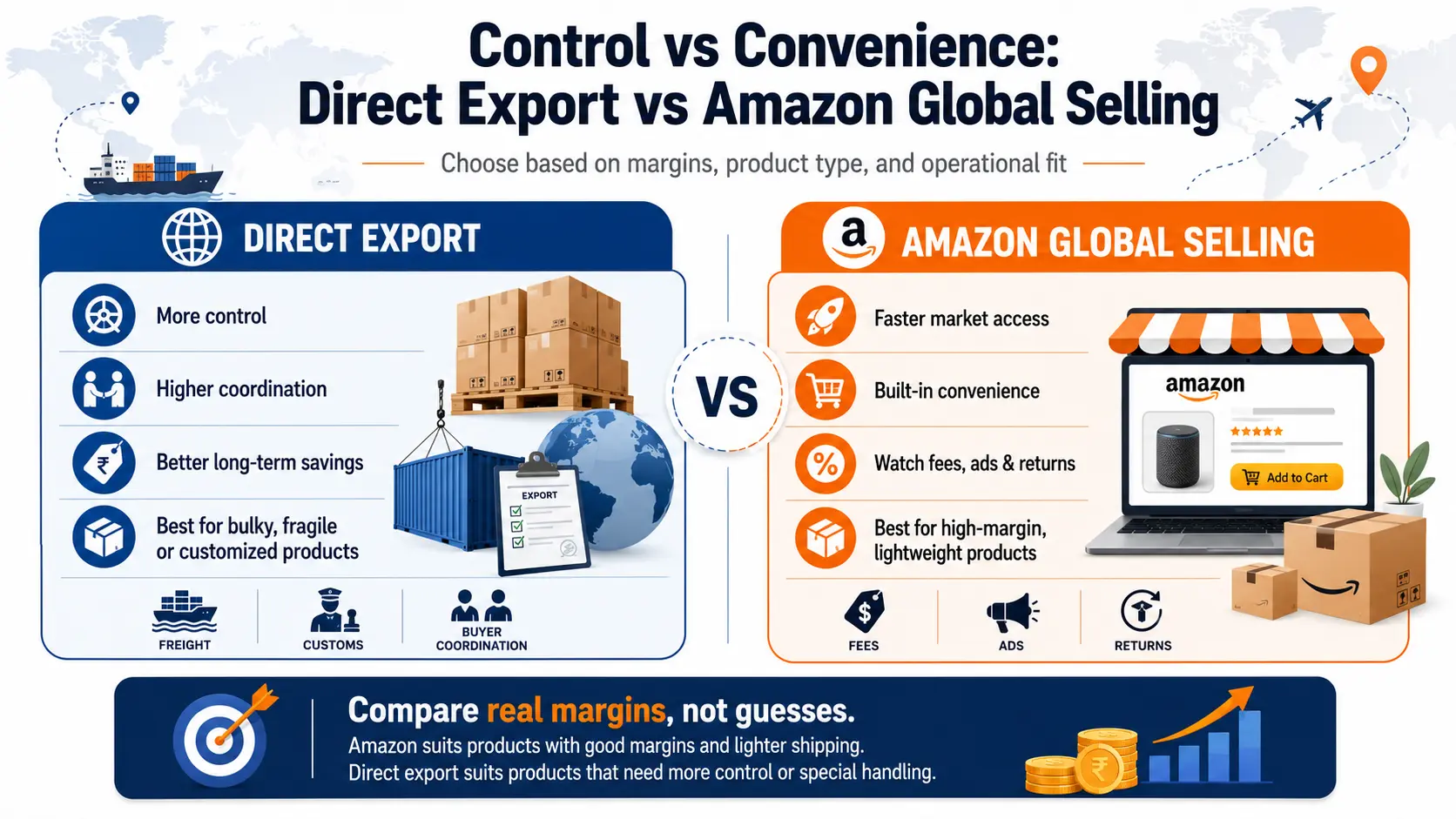
The phrase control vs convenience export model sounds abstract, but it is really about daily decisions. Would you prefer to control the way your product is packaged, priced and shipped, or would you prefer a system that helps you move faster, perhaps at the expense of a portion of the economics?
On Amazon, the convenience is obvious. You may get access to international demand without building every process alone. But you need to watch fees, ad spend, return handling, and storage costs. The phrase Amazon export fees India matters here because many sellers underestimate the small charges that add up over time. A marketplace can look inexpensive at the top line and become expensive in practice.
Direct export is usually more work at the start.
More coordination with freight partners, customs agents, overseas buyers, or a fulfillment setup may be necessary. However, if the system is operating properly, the savings can be substantial. That is why the question of export margins Amazon vs direct should be examined with real numbers, not guesses.
A simple rule helps here. Amazon could be a good choice if your product has a good margin, a reasonable shipping weight, and a high likelihood of appeal to customers. Direct export may be more appropriate for a bulky, fragile, highly customized product, or if the product is sold in small quantities.
Logistics Comparison: Amazon vs Direct Shipping
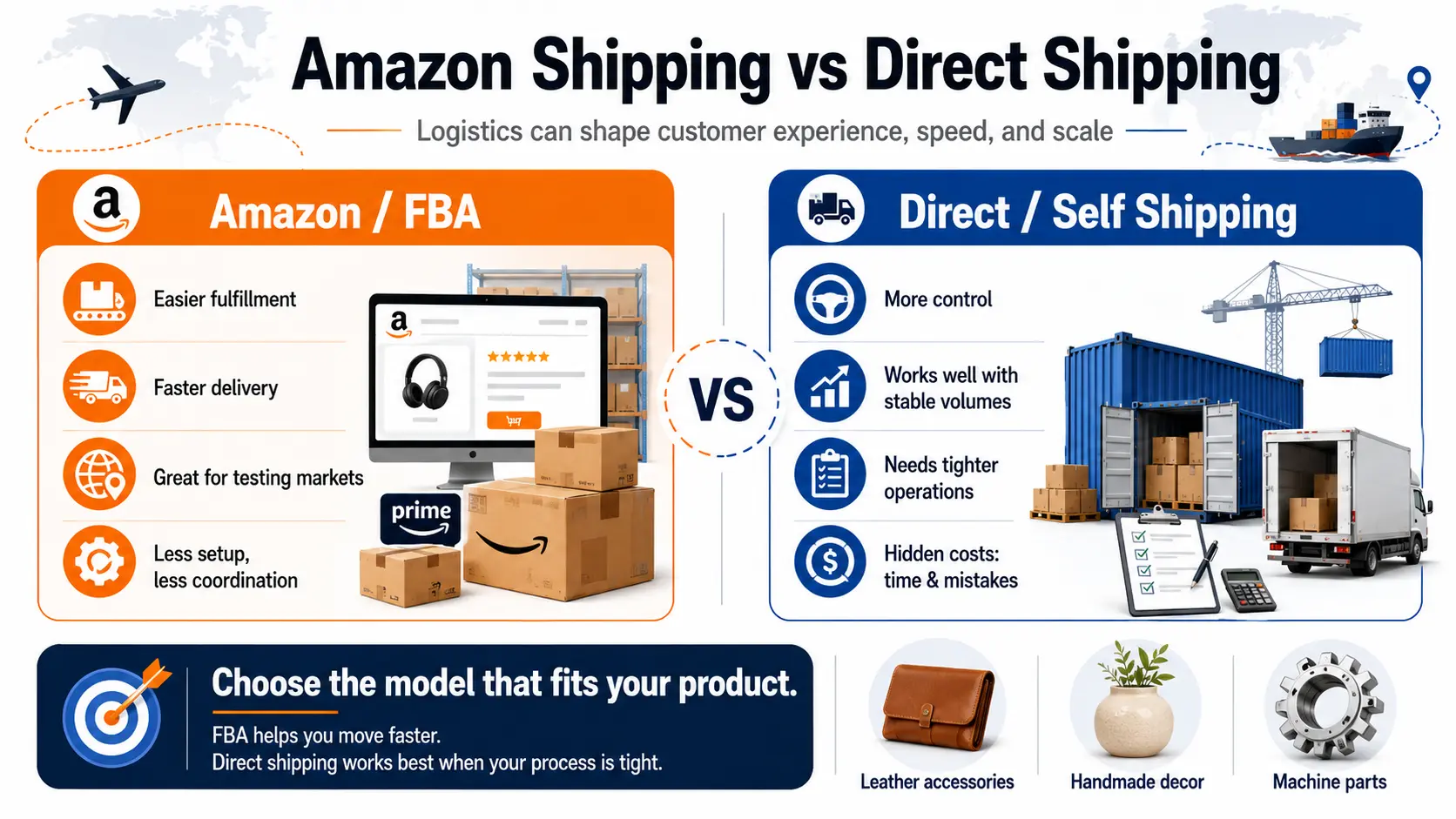
The logistics comparison Amazon vs direct shipping often decides the winner more than people expect. A good product with bad shipping will still disappoint the customer. A decent product with smooth logistics sometimes wins by default.
Amazon can simplify fulfillment, especially when you are testing a market and do not want to build overseas operations from scratch. That is the appeal of FBA (Fulfillment by Amazon) international vs self shipping. FBA lets you offload part of the load to Amazon, which can certainly make life easier and make your delivery faster. Self-shipping is more self-directed and requires more coordination and operations to be successful.
Direct shipping can work beautifully when your volumes are stable and your process is tight. But if every shipment becomes a small custom project, the business can get tired fast. At scale, the hidden cost is not just money. It is time, attention, and mistakes.
This is also where international selling platforms in India matter. Not every seller should choose the same route, because not every product has the same operational shape. A leather accessory brand, a handmade decor label, and a machine parts exporter will each face a different reality. The best channel is the one that fits the product, not the other way around.
D2C Export vs Marketplace Export: Which One Suits Your Brand?
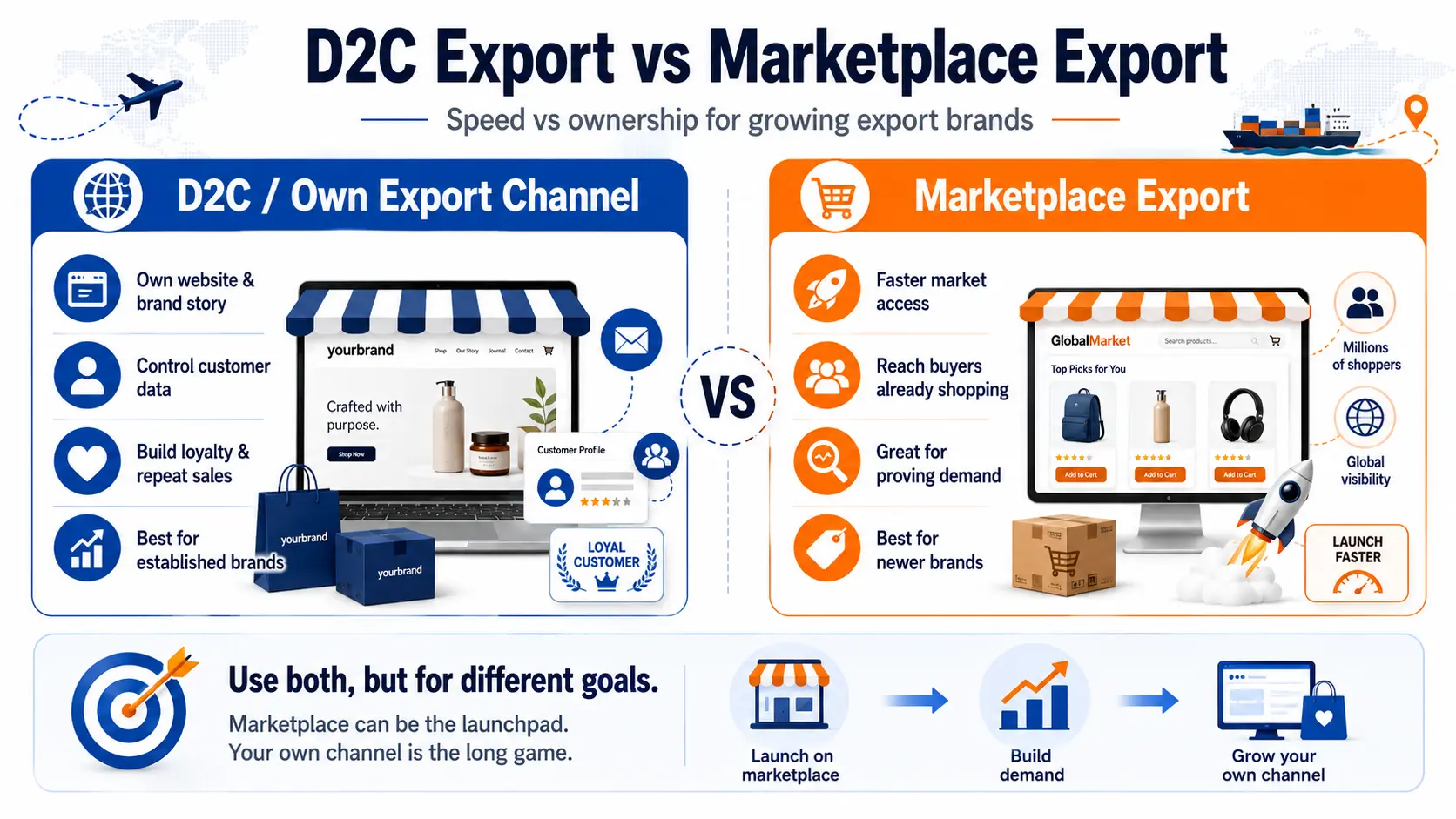
The D2C (Direct to Consumer) export vs marketplace export debate is really about brand maturity. D2C export gives you a direct line to the buyer. You own the website, the story, the email list, and the repeat purchase strategy. Marketplace export gives you faster access to buyers already browsing and buying. That can be a powerful shortcut.
For newer brands, marketplace export can be a lower-friction way to prove demand.
D2C export might make more sense for more established brands as it will foster greater loyalty and data control. It’s not an either-or situation, however. Some companies sign up with Amazon to access a market, then switch high-dollar repeat customers over to their own channel at a later date. That is not always easy, but it can be smart.
Here, the phrase global marketplace vs own export channel becomes useful. A global marketplace is often a launchpad. Your own channel is often the long game. One gives speed. The other gives depth. Perhaps the most honest answer is that good exporters eventually learn to use both, but not in the same way.
And yes, Direct Export vs Amazon Global Selling sits right at the center of that decision. One model is not universally better. It is better only when matched to the right product, the right market, and the right internal capability.
Practical Decision Guide
If you are still undecided, look at these questions.
1. Can your product tolerate marketplace fees and still leave a healthy margin?
2. Do you have the patience to build direct buyer relationships overseas?
3. Is your product more likely to be discovered through search and impulse buying, or through trust and negotiation?
4. Can you handle logistics without becoming distracted from product quality?
If the answer leans toward speed, visibility, and simpler entry, Amazon may be the better first step. If the answer leans toward margin control, branding, and deeper buyer ownership, direct export may be stronger. The better path is not always the flashiest one. Sometimes it is just the one that will still make sense six months later.
One more thing. Many sellers think they need to choose forever. They do not. A business can begin with Amazon, learn the market, and later build a direct export engine. Or it can start with direct export and use Amazon to widen its reach. The route is flexible, but the numbers need to stay honest.
Final Thoughts
In the end, Direct Export vs Amazon Global Selling is not a contest with one universal winner.
A compromise between control, cost, speed and comfort of use. Amazon provides convenience and market access. Direct export offers ownership and long-term flexibility in many instances.
The decision is yours, depending on whether you want to test, scale or create a stand-alone brand. That makes a difference more than they say. When one sees it clearly, the choice becomes a little noiseless and a little useful.
Frequently Asked Questions (FAQ’s)
It can be, especially for sellers who want faster market entry and less setup complexity. But beginners should still calculate fees, shipping, and return costs carefully.
Direct export often has stronger margin control, but not always. It depends on shipping costs, order size, buyer terms, and how efficiently you manage operations.
Yes. Many brands do. They use marketplace export for discovery and direct export for repeat buyers or larger orders.
Not always. FBA (Fulfillment by Amazon) international vs self shipping depends on your product size, turnover rate, and storage needs. FBA may be easier, but it is not automatically cheaper.
Start with the channel that matches your product and your capacity. If you need quick validation, Amazon can help. If you already have strong buyer relationships and healthier margins, direct export may be the better path.