
With AEPC membership, exporters get the RCMC certificate, access to government schemes like RoDTEP and RoSCTL (which can save 4–8% per shipment), and opportunities to connect with international buyers through trade fairs and meets.
Think about this for a second. When someone walks into a shop in Paris, New York, or Dubai and picks up a shirt, there is a very good chance that shirt was made in India. That is how big our garment export business really is.
India is one of the top three garment exporters in the world. The industry gives jobs to over 45 million people. From Tirupur to Surat, from Delhi to Kolkata, millions of hands stitch, pack, and ship clothes to every corner of the globe.
But here is the problem. Most garment exporters especially small ones face the same headaches over and over again. How do I find real buyers abroad? What papers do I need to export? Which government schemes can save me money? How do I enter a new country’s market?
If any of these sound familiar, you need to know about AEPC. It is the one body set up by the Government of India specifically to solve all of these problems for garment exporters like you.
What is AEPC?
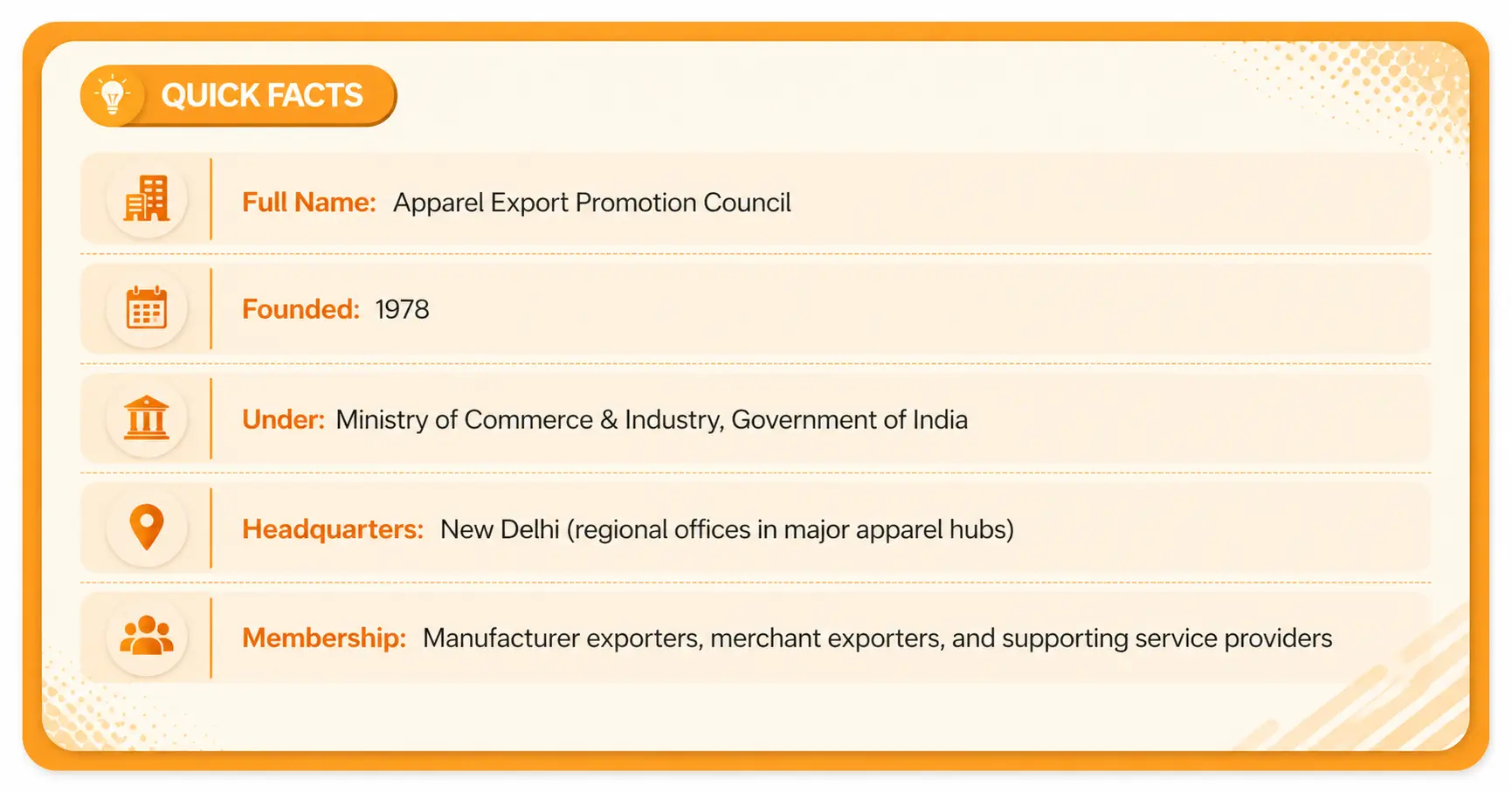
AEPC stands for Apparel Export Promotion Council. Do not let the long name confuse you. Simply put, AEPC is a government body that helps Indian garment exporters grow and sell their clothes to the world.
It was set up by the Ministry of Commerce and Industry back in 1978. Today it has over 16,000 member exporters across India. Big factories. Small tailoring units. Buying houses. All of them use AEPC.
Who should join AEPC?
Anyone who makes garments and wants to sell them abroad. Anyone who buys finished clothes and exports them. Anyone just starting out who wants to enter the export business. Small and medium garment units looking for more buyers. If your business has anything to do with readymade garments and international trade AEPC is for you.
Why Should You Care About AEPC?
Some exporters think: I can export on my own, why do I need AEPC? Fair question. Here is the honest answer.
Buyers trust AEPC members more. When a buyer in Germany or the US sees that you are registered with AEPC, they instantly know you are a serious, legitimate exporter. It works like a trust badge. It makes them more comfortable placing an order with you.
Most government money requires AEPC membership. The government offers schemes that can save you thousands of rupees per shipment. But to claim that money, you need the RCMC certificate, which only AEPC gives. Without it, you are simply leaving free money on the table.
Your problems become industry problems. When a new rule hurts your business, you alone cannot go to the Finance Ministry and complain. But AEPC can and does. They represent all 16,000+ members. When they speak, the government listens.
📊 India Textile Exports by Major Segment
| Segment | FY 2024–25 (₹ crore) | FY 2025–26 (₹ crore) | Growth |
|---|---|---|---|
| Total textiles exports including handicrafts | 3,09,859.3 | 3,16,334.9 | +2.1% |
| Ready-Made Garments (RMG) | 1,35,427.6 | 1,39,349.6 | +2.9% |
| Cotton yarn, fabrics, made-ups | 1,02,002.8 | 1,02,399.7 | +0.4% |
| Man-made yarn & fabrics | 41,196.0 | 42,687.8 | +3.6% |
| Handicrafts (excl. carpets) | 14,945.5 | 15,855.1 | +6.1% |
🌍 Market Growth & Policy Developments
| Category | Details | Impact |
|---|---|---|
| Export destinations | Growth in 120+ destinations (Apr 2025–Feb 2026) | Global expansion |
| High-growth markets | UAE, UK, Germany, Spain, Japan, Egypt, Nigeria, Senegal, Sudan | Up to 205% growth |
| Export schemes | RoSCTL & RoDTEP extended | Incentives continue |
| India–EFTA TEPA | Effective Oct 2025 | Better access |
| India–UK CETA | Signed July 2025 | Lower tariffs |
| India–EU FTA | Jan 2026 | Export boost |
7 Ways AEPC Helps You Export More
1. RCMC
The most important thing AEPC gives you is the RCMC short for Registration Cum Membership Certificate. Think of it as your official export ID card.
Without RCMC, you cannot claim most government export benefits. Banks may not give you export credit. And many serious buyers will not deal with you. It is that important.
What RCMC unlocks for you: access to government money-back schemes, eligibility for trade fairs and buyer meets, export credit from banks at better rates, credibility with international buyers, and entry into AEPC’s verified exporter directory. RCMC is valid for 5 years and is renewed online.
2. Government Schemes
The Indian government offers several schemes to help garment exporters. Most people do not even know these exist. AEPC makes sure you find out and actually claim what you deserve.
RoDTEP in simple words: When you make a garment, you pay taxes on raw materials, electricity, transport and more. RoDTEP gives some of that money back to you after export. Less tax cost means better profit margin.
RoSCTL in simple words: This is specifically for garment exporters. It refunds state-level taxes like electricity duty and mandi tax that GST does not cover. AEPC guides you through how to file and claim these. Between RoDTEP and RoSCTL together, a garment exporter can save roughly 4 to 8 percent on every shipment.
🚀 AEPC Benefits for Exporters
Quick snapshot of how AEPC helps garment exporters grow globally
3. Buyer-Seller Meets
Finding a genuine international buyer is the hardest part of exporting. Cold emails barely work. Random trade portals are full of time-wasters. But AEPC’s buyer-seller meets are different.
These are events organised in India and abroad where real buyers from the US, EU, UK, Japan, and the Middle East come specifically to find Indian garment suppliers. You get a proper scheduled meeting slot. You show your samples. You talk business. No middlemen, no cold calls. The value of one genuine buyer found at such an event can be worth years of emailing strangers.
4. International Trade Fairs
Trade fairs are massive events where thousands of buyers, brands, and retailers from around the world come together. If you are not there, your competitors are. AEPC not only attends these fairs but organises Indian pavilions so you can participate at much lower cost than going alone.
Key fairs where AEPC takes Indian exporters: Texworld Paris, Magic Las Vegas, India International Garment Fair, Apparel Sourcing Paris, and Source It to Hong Kong. Going as part of an AEPC group is far cheaper than booking alone, and you carry the added credibility of being part of an official Indian government-backed delegation.
5. Market Information
Not every market wants the same product. A buyer in Japan wants very different things than a buyer in Brazil. AEPC provides market intelligence reports, basically research that tells you what is selling, where, and for how much. Which countries are importing the most garments. What types of clothes are in demand. What price points buyers expect. Which trade agreements India has that give you a duty advantage. Knowing this before you spend money targeting a market is the smartest thing any exporter can do.
6. Documentation Help
Export paperwork is where many new exporters make expensive mistakes. One wrong code on a shipping bill. A mismatch between your invoice and packing list. A missing certificate. Any of these can delay your shipment for days or get it rejected at the port.
AEPC runs training workshops and provides step-by-step guides for all the key documents. These sessions are mostly free for members. The documents every exporter needs to know: IEC Code, RCMC Certificate, Shipping Bill, Commercial Invoice, Packing List, Certificate of Origin, Bill of Lading, and GST LUT. AEPC helps you understand what each one is and how to prepare it correctly.
7. Policy Advocacy
Sometimes a new government rule hurts the industry. Maybe a duty hike makes your raw materials expensive. Maybe a new compliance requirement adds cost. As a single exporter, you cannot do much about it. But AEPC can.
They sit on government committees. They submit recommendations before the Union Budget. They are in the room when trade policy decisions are made. As an AEPC member, your interests are represented at the highest level.
How to Join AEPC: 5 Simple Steps
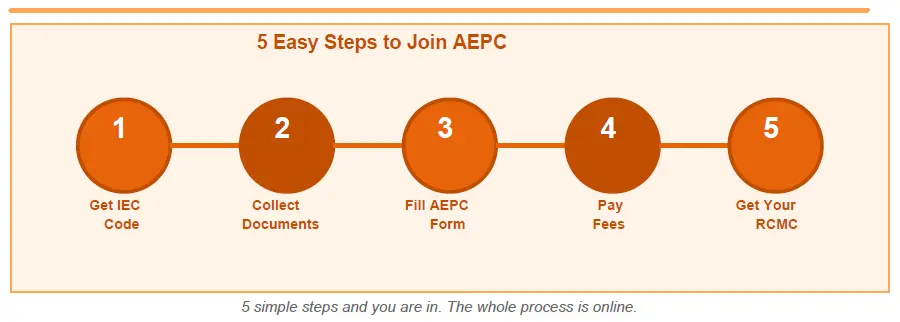
Step 1 — Get your IEC Code. Go to dgft.gov.in and apply for your Importer Exporter Code. It is free and takes 1 to 2 days.
Step 2 — Collect your documents. You will need your PAN card, GST certificate, bank certificate, proof of business registration, and ID proof of the owners.
Step 3 — Fill the AEPC online form. Visit aepc.in, go to the membership section, and fill in your details carefully.
Step 4 — Pay the annual fee. AEPC charges a small yearly fee. The amount depends on whether you are a manufacturer, merchant exporter, or buying house. Pay it online.
Step 5 — Wait for your RCMC. AEPC verifies your application in 7 to 15 working days. Your RCMC is sent digitally. Save it you will need it everywhere.
Common Problems AEPC Helps You Solve
AEPC Benefits
| What AEPC Gives You | In Simple Words | Result for Your Business |
|---|---|---|
| RCMC Certificate | Official proof you are a registered exporter | Builds buyer trust |
| RoDTEP & RoSCTL | Government refunds hidden taxes | Save 4–8% per shipment |
| Buyer-Seller Meets | Direct meetings with global buyers | Win export orders |
| Trade Fairs | Participate in global exhibitions | Increase visibility |
| Market Reports | Insights on demand & trends | Better decisions |
| Documentation Help | Guidance for export paperwork | Avoid costly errors |
| Policy Voice | AEPC represents exporters to govt | Better industry policies |
Cannot find genuine buyers abroad? AEPC’s buyer-seller meets and trade fairs connect you to verified importers directly.
Confused about export paperwork? AEPC’s free training workshops and documentation guides walk you through everything.
Not sure which government schemes apply to you? AEPC tells you exactly what you qualify for and helps you file the claims.
Want to enter a new country but don’t know how? Country-specific market reports from AEPC show you what sells, where, and at what price.
Export costs eating into your margins? RoDTEP and RoSCTL claims through AEPC can save you 4 to 8 percent per shipment.
AEPC vs Other Export Councils
India has several Export Promotion Councils. AEPC is specifically for readymade garments. TEXPROCIL handles cotton yarn and fabric. SRTEPC covers synthetic fibre and yarn. HEPC is for handloom fabrics.
If you make or export readymade clothes shirts, trousers, kurtas, dresses, jackets AEPC is your council. Simple as that.
Final Thoughts
AEPC is not just another government registration. It is your partner in the export business. It helps you find buyers. It saves you money through government schemes. It trains you on paperwork. It represents you to the government. And it puts you on the world stage through trade fairs.
The Indian garment export industry is growing. Right now, global brands are actively looking to source more from India. That is a huge opportunity. But to grab it, you need to be ready. And being ready starts with AEPC membership.
Whether you are a big manufacturer or a first-time exporter, the doors AEPC opens are real. The money it saves you is real. The buyers it connects you to are real.
The best time to register with AEPC was before your first export. The second best time is right now. Go to aepc.in and get started today.
Frequently Asked Questions (FAQ’s)
AEPC (Apparel Export Promotion Council) is a government body that helps garment exporters grow globally. It gives you credibility, access to buyers, and eligibility for government benefits.
You can export without it, but you will miss out on major government schemes and buyer trust. Most serious exporters get AEPC for long-term growth.
RCMC (Registration Cum Membership Certificate) is your official export membership proof from AEPC. It is required to claim benefits, access trade fairs, and build buyer trust.
AEPC organizes buyer-seller meets and global trade fairs with verified buyers. You get direct access without relying on cold emails or middlemen.
Through schemes like RoDTEP and RoSCTL, exporters can save around 4–8% per shipment. AEPC guides you on how to claim these benefits correctly.