
AI Overview
Amazon Vine offers early product reviews, but for Indian exporters, the cost goes far beyond the enrollment fee. Exporters must still cover product manufacturing, international logistics, FBA (Fulfilment by Amazon) charges, referral commissions, and storage fees on unsold inventory. Even then, there is no assurance of receiving reviews during the 90-day program window, and the fees paid are non-refundable. Vine is only viable for exporters with strong margins who see it as a strategic branding investment—not a quick growth hack.
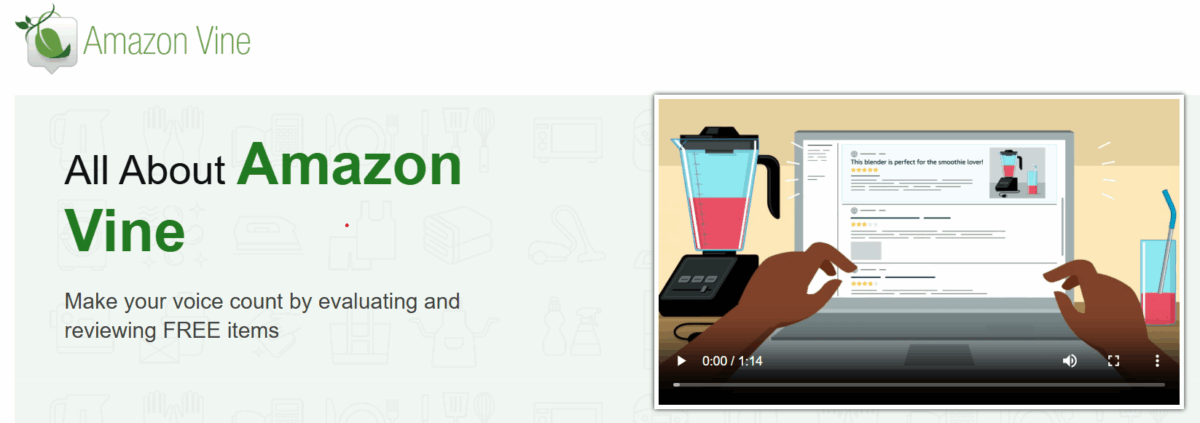
Enrol your product,
Give away a few units,
and get high-quality reviews from trusted reviewers.
Amazon Vine India is often pitched as a shortcut to credibility.
For Indian exporters using Amazon Global Selling India, this sounds especially tempting when launching a new ASIN in the US, UK, or EU markets.
But behind the promise of “early reviews” lies a web of costs that Amazon does not clearly spell out. Many exporters only realise the true Amazon Product Listing hidden costs after their margins take a serious hit.
This guide breaks down the real Amazon Vine cost for e-commerce sellers, explains how the program actually works for exporters shipping from India, and helps you decide whether Amazon Vine is worth it.
What is Amazon Vine, and how does it work for Indian exporters?
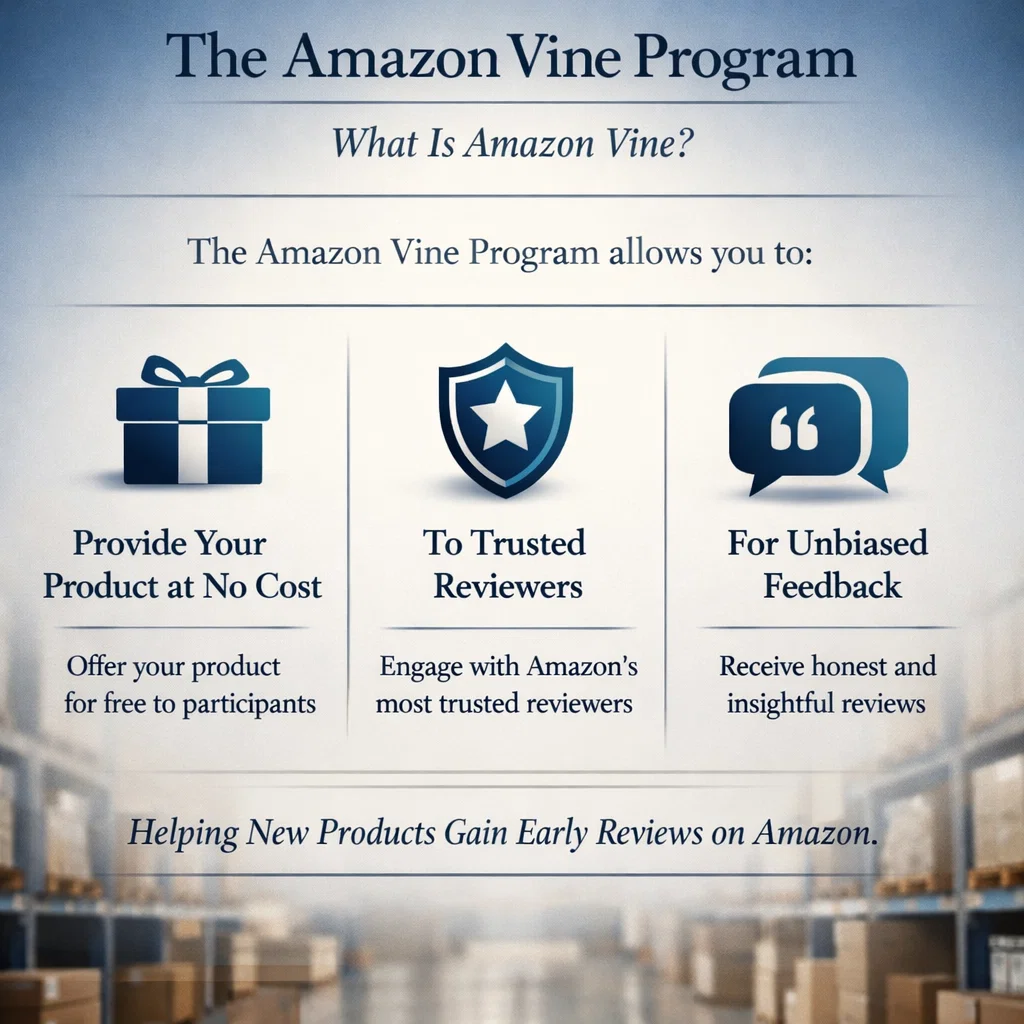
Amazon Vine is an invite-only program that allows Indian sellers to provide free products to Amazon-approved Vine Voices in exchange for honest reviews. These reviews carry a “Vine Customer Review of Free Product” badge and usually appear early on product listings.
For Indian sellers, Amazon Seller Account is accessed through Amazon Global Selling India, meaning:
- Inventory is manufactured in India
- Products are exported to Amazon marketplaces like the US, UK, or EU
- Fulfilment is typically done via FBA (Fulfilment by Amazon)
While the concept seems simple, Amazon Vine for Indian exporters operates very differently in cost structure compared to domestic US sellers.
Amazon Vine Enrollment Fee: What You Pay Per ASIN
The first visible cost is the Amazon Vine enrollment fee.
Amazon charges a fixed fee per parent ASIN enrolled in the Vine program. This is often referred to as the Amazon Vine cost per ASIN (parent ASIN).
Key points exporters often miss:
- The fee is charged per parent ASIN, not per review
- Variations under the same parent ASIN are included
- The fee is non-refundable, even if no reviews are received
This alone makes Amazon Vine for ecommerce sellers cost-sensitive, especially for Indian exporters managing multiple SKUs.
Units Enrolled vs Units Claimed: The Cost Trap Sellers Miss
One of the most misunderstood aspects of Vine is units enrolled vs units claimed (fee based on enrolled units).
Here’s how it works:
- You choose how many units to enrol (up to Amazon’s allowed limit)
- Amazon charges the enrollment fee based on units enrolled
- Vine Voices may or may not claim all the units
If you enroll 30 units but only 12 are claimed:
- You still pay the same enrollment fee
- The remaining inventory stays unsold
- Storage and opportunity cost continue
For Indian exporters, this is especially risky because:
- Units are already exported
- Inventory recall is impractical
- Slow-moving Vine stock adds long-term FBA costs
The 90-Day Enrollment Period: What If Reviews Don’t Come?
Amazon Vine runs on a 90-day enrollment period.
Amazon’s policy states:
- Vine reviewers have up to 90 days to claim and review products
- There is no guarantee of a first review within 90 days
This means:
- Your listing might still show zero reviews after 90 days
- The enrollment fee is not refunded
- Exporters lose critical launch momentum
For Indian sellers launching new brands in competitive categories, the lack of a guaranteed first review within 90 days can derail marketing and advertising plans.
Free Product Sampling Cost: The Giveaway Nobody Budgets For
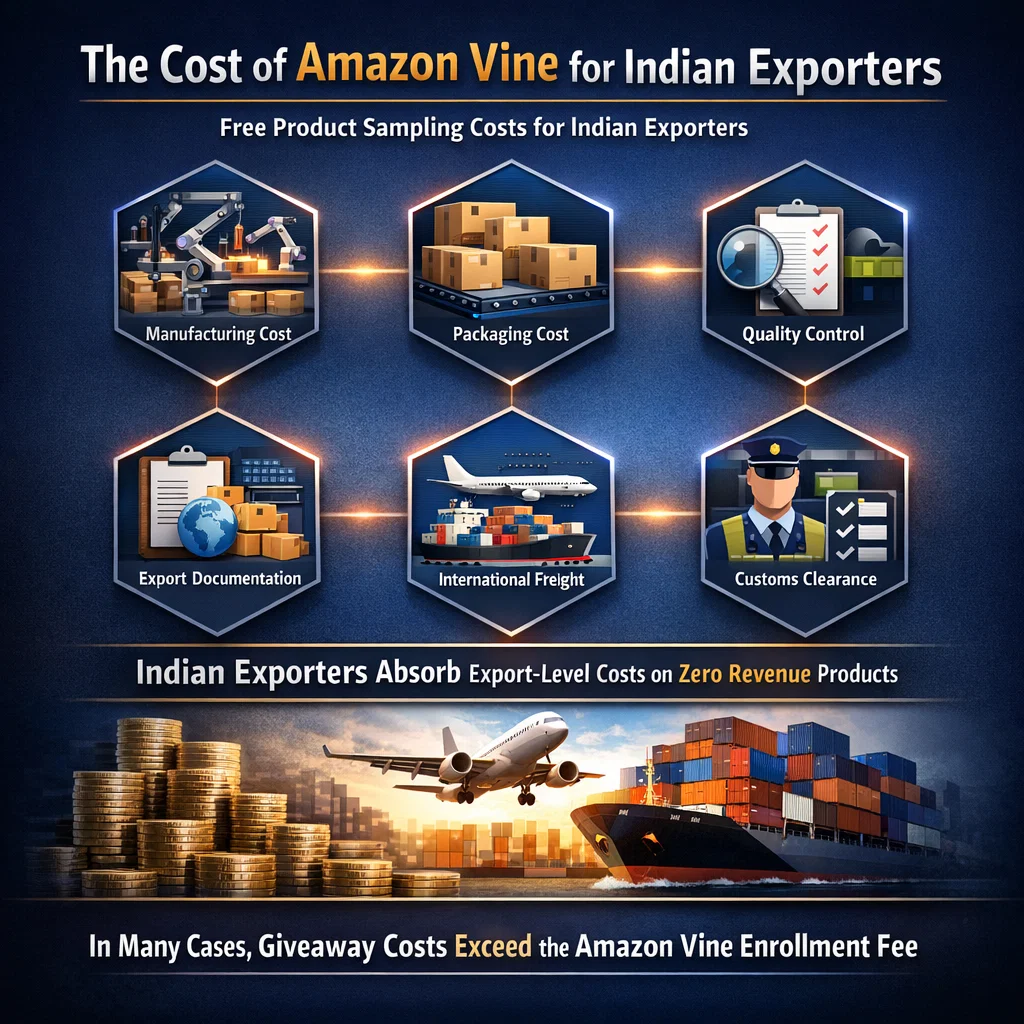
Amazon Vine requires sellers to provide products completely free of charge. This creates a major free product sampling cost/product giveaway cost, which includes:
- Manufacturing cost
- Packaging cost
- Quality control
- Export documentation
- International freight
- Customs clearance
Unlike domestic sellers, Indian exporters absorb export-level costs on products that generate zero revenue. In many cases, the product giveaway cost exceeds the Amazon Vine enrollment fee itself.
FBA Fees on Vine Units: Yes, You Still Pay Them
A common misconception is that Vine units are exempt from fulfilment charges. They are not.
Indian exporters still pay FBA (Fulfilment by Amazon) fees on Vine units, including:
- Pick and pack fees
- Weight handling fees
- Storage fees
Even worse:
- Unclaimed Vine units continue accruing monthly storage fees
- Long-term storage fees may apply
This means Vine costs don’t stop after enrollment. They quietly accumulate in the background.
Referral Fees on Vine Units: Another Silent Deduction
Another overlooked cost is referral fees on Vine units.
Yes, Amazon may still apply referral fees on Vine units, calculated on the product’s listed price, even though:
- The customer pays nothing
- The seller earns no revenue
For exporters, this further inflates the Amazon Vine hidden costs, turning “free reviews” into a multi-layer expense.
Amazon Vine Hidden Costs: Real Cost Per Review Breakdown
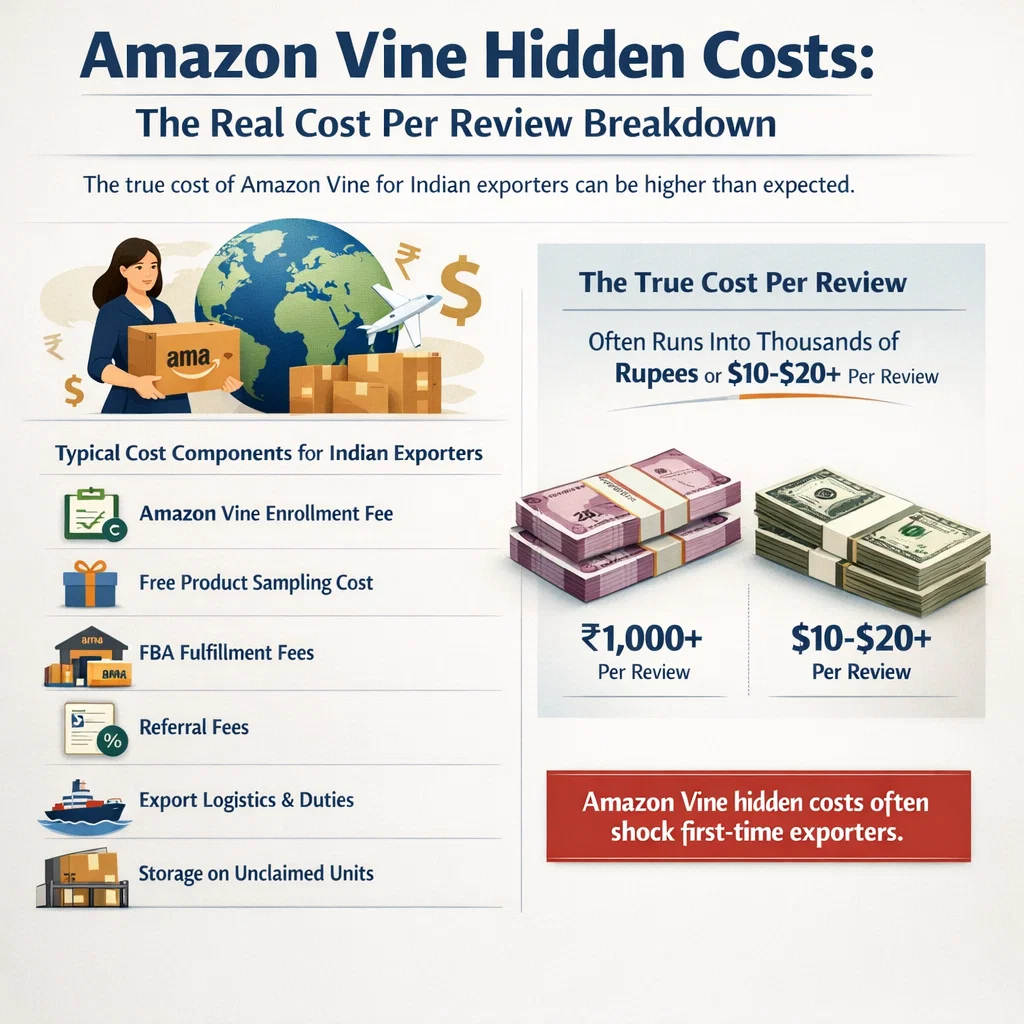
When you combine all components, the real Amazon Vine for ecommerce sellers cost looks very different from what most sellers expect. Typical cost components for Indian exporters:
- Amazon Vine enrollment fee
- Free product sampling cost
- FBA fulfilment fees
- Referral fees
- Export logistics and duties
- Storage on unclaimed units
In many cases, the true cost per review runs into thousands of rupees or even double-digit dollars per review. This is why Amazon Vine hidden costs often shock first-time exporters.
Amazon Vine via Amazon Global Selling India: Export-Specific Risks
While Amazon Vine can support product visibility, selling internationally through Amazon Global Selling India (exporting from India) comes with unique operational and compliance challenges for all Indian exporters.
- Higher landed cost per unit
- Currency fluctuations
- Longer replenishment cycles
- Limited ability to react if Vine underperforms
Unlike US sellers, Indian exporters cannot quickly adjust inventory or pricing mid-campaign.
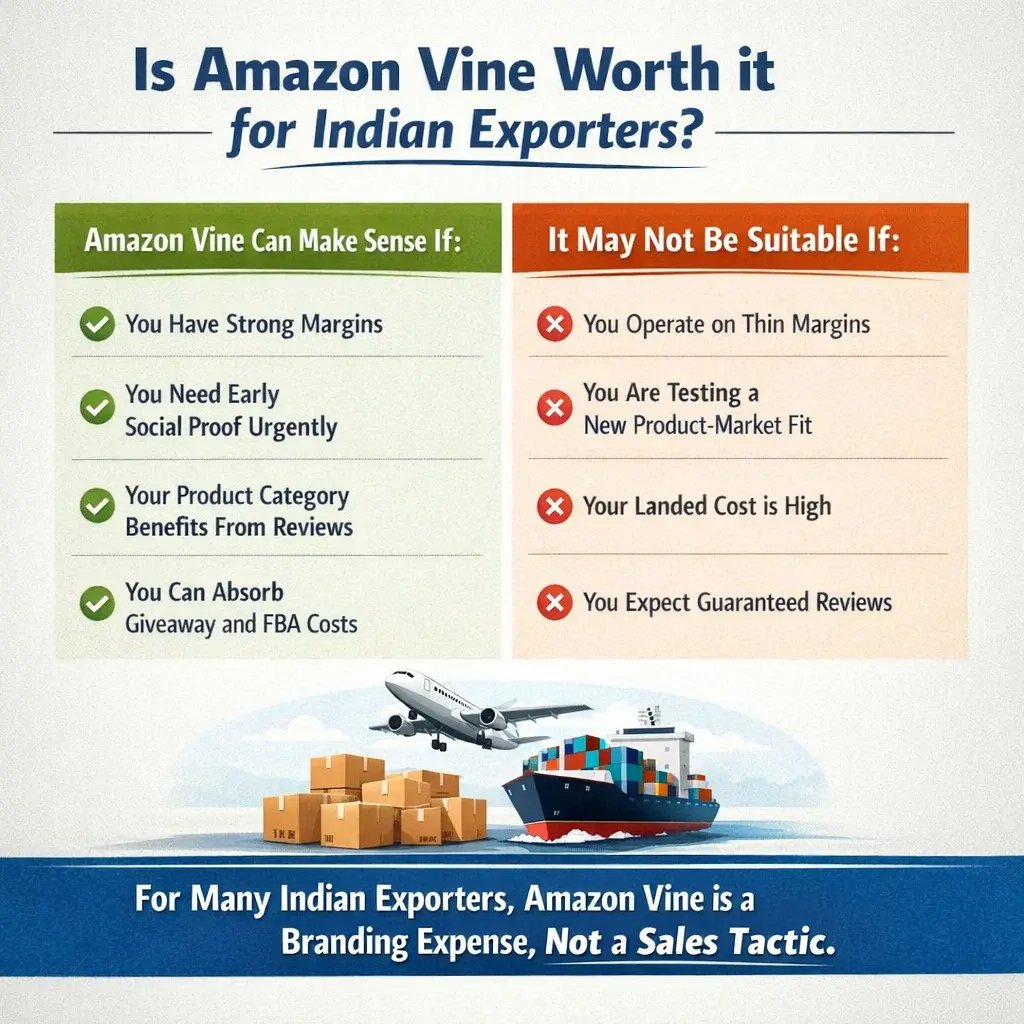
Is Amazon Vine Worth It for Indian Exporters?
Amazon Vine can make sense only if:
- You have strong margins
- You need early social proof urgently
- Your product category benefits from reviews
- You can absorb giveaway and FBA costs
It may not be suitable if:
- You operate on thin margins
- You are testing a new product-market fit
- Your landed cost is high
- You expect guaranteed reviews
For many Indian exporters, Amazon Vine is a branding expense, not a sales tactic.
How to Reduce Amazon Vine Costs as an Indian Exporter
Smart exporters reduce risk by:
- Enrolling fewer units
- Using Vine only on hero SKUs
- Calculating cost per review before enrolling
- Avoiding Vine for low-priced products
- Monitoring units claimed closely
Understanding units enrolled vs units claimed is critical to cost control.
Final Takeaways for Indian Exporters Considering Amazon Vine
Before enrolling, ask yourself:
- Can I afford the full Amazon Vine enrollment fee loss?
- Have I calculated free product sampling cost accurately?
- Am I prepared to pay FBA fees on Vine units?
- Do I understand referral fees on Vine units?
- Can I handle zero reviews after the 90-day enrollment period?.
Amazon Vine is not free. It is not cheap. And for Indian exporters, it is rarely forgiving.
Conclusion
Amazon Vine can help build early credibility, but only when you go in with realistic financial expectations and a clear objective.
For Indian exporters using Amazon Global Selling India, Vine is not just a review program. It is an export-level decision. Every free unit carries manufacturing cost, freight, duties, FBA fees, and working capital impact. If you do not account for all of this, the program can quietly erode your margins.
The biggest mistake sellers make is treating Vine like a growth hack. It is not a shortcut to sales. It is a paid visibility experiment.
Before enrolling, ask yourself:
- Am I using this to validate demand or accelerate an already validated product?
- Can my margins absorb the full cost if I receive fewer reviews than expected?
- Is this product strong enough to benefit from honest, unfiltered feedback?
Vine works best when:
- The product is high quality and differentiated
- Margins are healthy
- You need structured early social proof
- You are prepared to treat it as a branding expense
It works poorly when:
- Margins are thin
- Landed cost is high
- You expect guaranteed outcomes
- You are unsure about product-market fit
In the end, Amazon Vine is neither good nor bad. It is simply expensive. The exporters who win are not the ones who enroll first they are the ones who calculate first.
Understand the real numbers. Then decide.
Frequently Asked Questions
No. There is no guarantee. You might get several reviews, or you might get very few. The fee is not refunded if reviews don’t come in.
Yes. Even though the product is free to the reviewer, you still pay Fulfilment by Amazon (FBA) fees like pick and pack, shipping, and storage.
The full cost of the free product. It’s not just manufacturing. It includes export shipping, customs, duties, and FBA fees. That adds up quickly.
It makes sense if your margins are strong and you can afford to treat it as a marketing expense. If your margins are thin, it can hurt more than help.