

| ✨ AI Overview |
| Warehouse errors quietly damage margins, delay shipments, and hurt customer trust especially in export operations where precision is critical. The blog explains how simple, tech-enabled practices like barcode scanning, real-time inventory tracking, and optimized picking can reduce errors and improve accuracy significantly. By building structured systems and processes, businesses can prevent most mistakes, lower operational costs, and create a more reliable shipping experience for their customers. |
A customer places an order, waits eagerly, and receives the wrong item. Or nothing at all.
For exporters and logistics businesses, that moment isn’t just an inconvenience. It’s a reputational dent, a financial loss, and a client relationship you may never recover.
The hard truth: warehouse errors are far more common than most businesses admit. Picking mistakes, stock mismatches, mislabeled packages, and delayed shipments quietly eat into margins every single day. In international exports where timelines are tight, customs documentation is critical, and clients demand precision the cost of getting it wrong multiplies fast.
The good news? Most of these issues are entirely preventable.
Why Accuracy Matters More Than You Think
Inaccurate warehouse operations are expensive not just inconvenient. A single picking error doesn’t just mean reshipping. It triggers a cascade:
- Return logistics costs
- Customer service time
- Replacement inventory
- Expedited shipping fees
Industry research consistently shows that correcting a warehouse error costs 3–5× more than getting it right the first time.
For exporters, incorrect documentation or mislabeled goods can delay shipments at customs, breach delivery contracts, and damage relationships with overseas buyers.
Quick stat: Warehouses without structured accuracy programs report order accuracy rates of 96–97%. Sounds high? At 10,000 orders/month, that’s 300–400 incorrect shipments. Every single month.
Best Practice 1: Use Barcode Scanning at Every Stage
Manual data entry is the single biggest source of avoidable warehouse errors. Humans misread labels, miskey numbers, and make split-second mistakes especially under peak-period pressure. Barcode scanning removes that human variable almost entirely.
Manual Entry vs. Barcode Scanning
| Criteria | Manual Entry | Barcode Scanning (Scan-Verify) |
|---|---|---|
| Error Rate | Higher (human typing errors, misreads) | Very low (automated validation reduces mistakes) |
| Speed | Slow, depends on typing speed | Fast, near-instant scan & confirmation |
| Peak-Period Reliability | Prone to delays and increased errors under pressure | Highly reliable even during high-volume operations |
| Integration Capability | Limited, often requires manual syncing | Seamless integration with WMS, ERP, and inventory systems |
💡 Insight: Barcode scanning significantly improves accuracy, speed, and scalability in modern operations.
When scanners integrate with your Warehouse Management System (WMS), every pick, pack, and ship action is verified in real time. If a picker grabs the wrong SKU, the system flags it immediately before the error reaches the customer.
To get it right, build around three pillars:
- Standardised labelling: Every product, bin, shelf, and pallet must carry a clear, consistent barcode. Use the same label format across all inbound and outbound goods.
- Regular scanner maintenance: Schedule monthly checks and keep spare devices charged, especially during high-volume periods. A cracked lens or dying battery creates a false sense of security.
- Staff training: Train every team member on scan-verify workflows, what to do when a scan fails, and how to escalate discrepancies. Technology only works when people use it correctly.
3–5%
< 0.1% errors
Zero wrong shipments
Best Practice 2: Implement Real-Time Inventory Tracking
Ask any warehouse manager what keeps them up at night “stock discrepancies” will be near the top.
Real-time tracking means your inventory records update the moment any movement happens: a product is received, picked, damaged, or dispatched. This creates a live, accurate picture of what you have, where it is, and what’s committed to open orders.
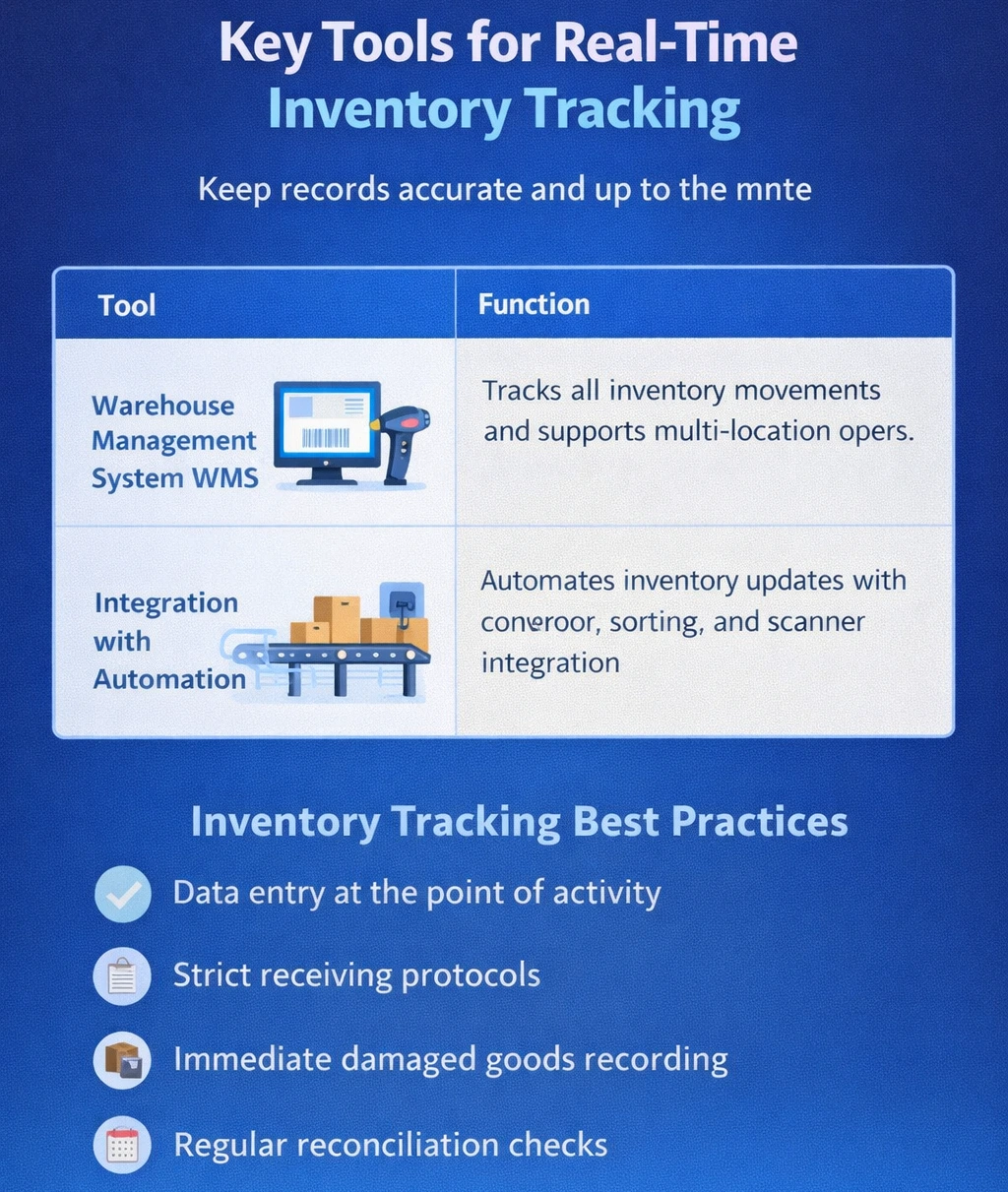
Key tools that make this possible:
- Warehouse Management System (WMS): Tracks every movement from receiving dock to dispatch. Look for platforms with multi-location and multi-currency support for export operations.
- Integration with automation systems: When your WMS connects directly to conveyor systems, sorters, and barcode scanners, inventory updates happen without human input. No delay. No data-entry errors.
Following solid inventory tracking best practices also means:
- Data entry happens at the point of activity, not hours later from memory
- Receiving protocols are strict and documented
- Damaged goods are recorded immediately
- Regular reconciliation is built into the routine
Why Real-Time Inventory Tracking Matters
Ask any warehouse manager what keeps them up at night — stock discrepancies will be near the top.
| Area | What It Means | Why It Matters |
|---|---|---|
| Real-Time Tracking | Inventory updates instantly when items are received, picked, damaged, or dispatched | Gives a live, accurate view of stock, location, and order commitments |
| Warehouse Management System (WMS) | Tracks every movement from receiving to dispatch | Ensures full visibility across locations (ideal for export operations) |
| Automation Integration | Connects WMS with scanners, conveyors, and sorters | Removes manual input → faster updates, zero data-entry errors |
| Point-of-Activity Entry | Data is recorded exactly when the activity happens | Prevents memory-based errors and delays |
| Receiving Discipline | Strict and documented receiving processes | Avoids incorrect stock entries from the start |
| Damage Recording | Damaged goods logged immediately | Prevents inflated inventory and order issues |
| Regular Reconciliation | Frequent stock checks built into routine | Keeps system data aligned with physical inventory |
💡 Bottom line: Real-time tracking + disciplined processes = fewer discrepancies and smoother operations.
Best Practice 3: Switch from Full Stock Counts to Cycle Counting
The old-school approach shutting down operations for a weekend annual count is disruptive, exhausting, and frankly not that accurate. People get tired, lose count, and skip bins.
Cycle counting is the smarter alternative. Count a portion of your inventory on a rolling basis a few product lines per day or week without ever halting operations. Over time, every SKU gets counted multiple times per year, and errors are caught before they cause real problems.
Two proven cycle counting methods:
- ABC analysis: Classify inventory into A (high-value/high-velocity), B (medium), and C (low) categories. Count A items weekly, B monthly, C quarterly. Focus effort where it matters most.
- Random sampling: Supplement ABC counts with periodic spot-checks across all categories. This keeps everyone honest and catches errors in unexpected places.
Smarter Inventory Counting: The Flow Approach
The old way? Shut down operations and count everything. The better way? Cycle counting — continuous, accurate, and disruption-free.
Two Proven Cycle Counting Methods
A → High value (count weekly)
B → Medium (monthly)
C → Low (quarterly)
Focus effort where it matters most.
Keeps teams alert and catches hidden errors in unexpected areas.
💡 Result: No shutdowns, less fatigue, and far more accurate inventory.
Best Practice 4: Optimise Your Picking Process
Picking is where most warehouse errors are born. It’s high-speed, repetitive, and performed under pressure a recipe for mistakes.
Common causes of picking errors include:
- Poorly designed pick paths that cover unnecessary ground
- Ambiguous bin labeling and similar-looking SKUs placed near each other
- Cognitive fatigue over long shifts
Picking Errors: Where Things Go Wrong (and How to Fix Them)
- Long, inefficient pick paths
- Confusing bin labels / similar SKUs
- Fatigue from repetitive work
- Zone Picking → less walking, more accuracy
- Batch Picking → fewer repeated trips
- Clear Bins → A3-2-4 style labeling
- SOPs at every station
- Scan-verify at packing
- Double-check high-value orders
💡 Fewer steps + clearer systems = fewer mistakes.
Structural fixes that reduce errors:
- Zone picking: Assign pickers to specific zones. They cover less ground, become expert in their area, and make fewer mistakes.
- Batch picking: Group multiple orders that share common items. Pick them simultaneously rather than walking to the same bin six separate times.
- Clear bin locations: Use logical, systematic bin numbering (e.g., Row A, Bay 3, Shelf 2, Bin 4 = A3-2-4) and print the full location on every pick list.
Process fixes that lock in accuracy:
- Standard Operating Procedures (SOPs): Document every step of the pick-pack-ship process and make SOPs visible at each workstation.
- Double-check systems: For high-value export orders, implement a two-person verification step before sealing packages. For standard orders, a scan-verify at the packing station achieves a similar result with minimal overhead.
Fix Picking Errors at the Source
💡 Accuracy isn’t about working harder — it’s about designing smarter systems.
Best Practice 5: Leverage Warehouse Automation & WMS Implementation
Human workers are incredible, but not designed for high-volume, repetitive tasks over long shifts without error. Warehouse automation handles precisely the tasks where human error is most likely and most costly.
- Orchestrates every workflow from receiving to dispatch
- Includes built-in verification checkpoints at each stage
- Scales seamlessly during peak periods
- Produces documented workflows that overseas buyers and compliance auditors expect
Key automation tools to consider:
- Automated sorting systems: Conveyor-based sorters read barcodes and route packages to the correct dispatch lane automatically. Can process thousands of items per hour with near-perfect accuracy.
- Pick-to-light systems: LED indicators on bin locations guide pickers directly to the right item. No paper pick lists. No misreads.
- Voice picking: Audio instructions through a headset keep pickers’ eyes and hands on the product. Both pick-to-light and voice picking can reduce error rates to below 0.1%.
From Manual Errors to Automated Accuracy
✅ Scalable Operations ✅ Compliance-Ready
Bonus: Additional Tips for Better Accuracy
Beyond the five core strategies, these habits compound your gains:
- Build an accuracy culture: When staff understand the downstream impact of errors on export clients, they take greater ownership. Reward precision, not just speed.
- Conduct quarterly process audits: Warehouses evolve with new products, clients, and volumes. Your processes must evolve with them.
- Track KPIs weekly: Monitor order accuracy rate, pick error rate, inventory accuracy %, and cycle count variance. Any deterioration is an early warning signal.
The Bottom Line
Getting warehouse accuracy right is not glamorous work. There are no viral moments in consistent, reliable order fulfilment. But for exporters who want to grow sustainably, it is the work that matters most.
- Barcode scanning: Eliminate manual entry errors at every stage of pick, pack, and ship.
- Real-time inventory tracking: Maintain live, accurate stock records and prevent discrepancies.
- Cycle counting: Keep stock reconciliation continuous and operational disruption minimal.
- Optimised picking: Use zone picking, batch picking, and clear bin organisation.
- Warehouse automation and WMS: Build a system designed for accuracy at scale.
Every one of these strategies delivers a dual payoff: lower operational costs and a better customer experience. When your export clients know they can count on you to get every order right, every time, you stop competing on price alone and start competing on trust. That is a far stronger position to build a business from.
The most successful exporters are not just good at sourcing and negotiating they are operationally excellent. Adopt a tech-enabled, process-driven approach to warehouse optimisation, and you will find that accuracy becomes your most powerful growth driver.
💡 Warehouse Tip: Reduce Errors Instantly |
|
Record every inventory movement at the moment it happens — not later. Delayed updates lead to stock mismatches, missed orders, and costly errors. Real-time entry keeps your inventory accurate and operations smooth. |
| Simple habit. Big impact. |
Frequently Asked Questions (FAQs)
The most effective warehouse management best practices for error reduction include implementing barcode scanning at every stage of the pick-pack-ship process, using a Warehouse Management System (WMS) for real-time visibility, adopting cycle counting for continuous stock reconciliation, and designing optimised pick paths that reduce opportunities for confusion. Together, these measures can push order accuracy rates above 99.5%.
Barcode scanning creates a real-time verification step at every point of product movement. When a picker scans an item before placing it in a box, the WMS immediately confirms whether it matches the order. If it does not, an alert is triggered before the error progresses. This scan-verify workflow dramatically improves both packing accuracy and shipping accuracy by catching mistakes at source, rather than after the package has left your facility.
Cycle counting is the practice of counting a portion of your inventory on a rolling basis typically using ABC analysis to prioritise high-value and high-velocity items. Unlike a full physical count that shuts down operations for hours or days, cycle counting happens continuously without disrupting daily workflow. It provides more frequent accuracy checks, catches discrepancies faster, and gives you a constantly up-to-date picture of your stock which is invaluable for exporters managing time-sensitive shipments.
If you’re regularly dealing with stock discrepancies, missed shipments, or order accuracy below 99%, your warehouse is ready. You don’t need an enterprise-scale operation to justify a WMS most mid-sized exporters see ROI within 12–18 months through reduced errors and lower labour costs per shipment. Start by auditing your three most error-prone processes and choose a system that solves those specifically.
Use phased, on-the-floor training rather than classroom sessions. Train a few confident staff members first and let them support the rest of the team during rollout. Run new systems in parallel with existing processes for the first week or two so staff build confidence gradually. Keep SOPs visible at every workstation, and revisit training quarterly not just at onboarding, since processes and error patterns evolve over time.