
India’s MSME sector has tremendous growth potential, contributing nearly one-third of the country’s GDP and driving around half of India’s exports, making Export from India for Small Businesses a key force in boosting foreign trade.
With the growing focus of the Indian government on boosting export capacity, now is the right time to take your business global.
Today, several opportunities exist for MSMEs to integrate themselves into global supply chains and lead the frontiers of Indian exports. However, understanding the regulatory framework for import-export businesses in India could prove to be a bit challenging without proper guidance.
Thinking of taking your small business to international markets but not sure how to do it? Worry not. Today, we will tell you all about how to export from India and expand your small business internationally, what are the necessary shipping documentations required for export, and a lot more.
Market Research, Targeting, and Identifying Export Ready Products
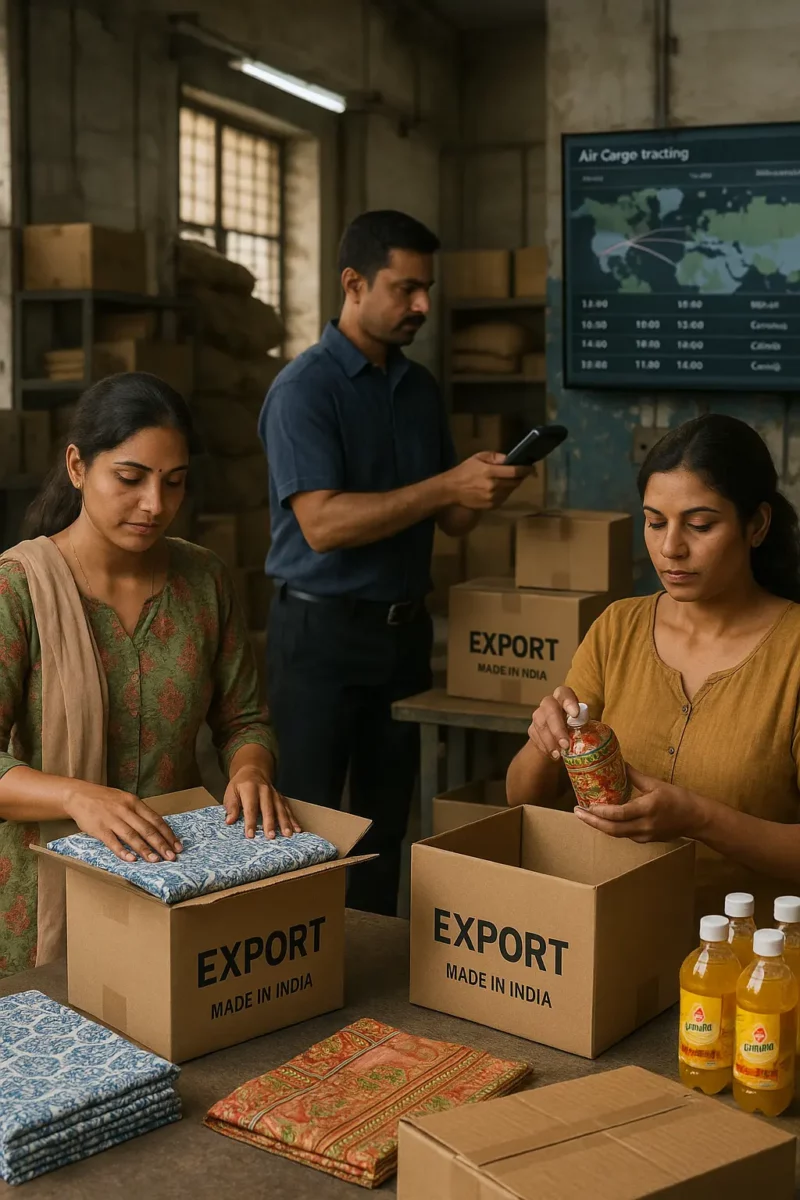
From Surat to Salem and Amritsar, businesses from all around India are selling locally made products to the world.
How can you do it? How can one export from India for small businesses?
The first step to starting your export journey is understanding the market. This can be done by conducting market research, analyzing demand, and knowing your target audience.
If you already have a well-established business in India then first identify the countries with potential customers for your existing products. Also, identify top export products that are growing in demand among international customers.
Why? Because it is not necessary that your herbal products would enjoy the same kind of demand in Saudi Arabia when compared to Europe. So do your research well before starting your export journey.
📦 Thinking of Exporting?
As a well-established domestic business, sending sample products to new markets can be a great way to start your export journey. This lets you:
- ✅ Get genuine feedback on your products
- ✅ Start small and test demand
- ✅ Minimize financial and logistic risks
Moreover, identify the opportunities that e-commerce exports offer. With the growing trend of online shopping, increasing your e-commerce presence can be a great way to cater to the demands of international customers.
SMEs like yours can make their unique mark on the international stage by leveraging competitive advantages like cultural uniqueness, cost efficiency, and quality craftsmanship. However, as an Indian exporter, it becomes extremely crucial for you to meet the expectations of foreign buyers and ensure compliance with international standards, such as quality checks and certifications.
Regulatory Framework and Compliance
The export from India for Small businesses involves several key steps: obtaining an Importer Exporter Code (IEC), selecting the right product and market, complying with export regulations, setting up logistics, securing payments, and handling documentation like invoices and shipping bills.
As a seller exporting from India, you are required to adhere to a regulatory framework and have all the necessary documents required to process the export to destination country. For instance, obtaining an Import Export Code (IEC), issued by the Directorate General of Foreign Trade (DGFT), is one of the key requirements in India. Other things like GST filings, shipping bills, and certificates of origin, play a critical role in facilitating smooth transactions.
Additionally, knowledge of export promotion schemes like RoDTEP and SEIS, along with proper documentation, can provide you with financial benefits. The Export Promotion Councils (EPCs) also encourage exporters and provide workshops to help with export finance.
Necessary Documents Required to Export from India for Small Businesses
Thinking of how to export from India (for small businesses) and which documents are essential to ensure compliance? Worry not! Here is the list of all the documents that you would require to start exports from India.
📦 Ready to Export? Here’s Your Power Checklist! 💼
Start your global shipping journey with confidence — tick off these essentials before you go! ✈️🌍
- ✅ Bill of Lading 📑 – Proof your cargo is good to go, accepted by the carrier.
- ✅ Commercial Invoice + Packing List 📋 – What’s in the box, what’s it worth — all in one!
- ✅ Shipping Bill (ICEGATE) 🚢 – Your customs green light — filed online before takeoff.
- ✅ Proforma Invoice 💰 – The official “please pay me” doc — sent before you ship.
- ✅ Purchase Order 🧾 – Your buyer’s “Yes, let’s do this!” in writing.
- ✅ Certificate of Origin 🌍 – Shows where your products were born — critical for trade deals.
- ✅ Bill of Exchange 🧾 – A polite but formal nudge: “Pay me this amount, please.”
- ✅ Letter of Credit 🏦 – Your safety net: payment is guaranteed, even if the buyer flakes.
- ✅ Inspection Certificate 🔍 – Optional but impressive — confirms your goods pass the vibe check.
- ✅ Phyto & Fumigation Certificates 🌱 – Going agri? These prove you’re pest-free and export-ready.
🚀 Export like a pro — checklist in hand, confidence on full blast.
Logistics and Supply Chain Management
A good shipping partner can make or break your export process. But how do you decide who’s right for your business?
SMEs must evaluate logistics supply chain providers based on their international shipping experience and value added services including customs clearance and insurance.
You want someone who knows the export process inside out and can handle different regulations smoothly.
Further, compare the rates of different service providers and choose the one that best suits your business needs. The value-added services offered by service providers can save you a lot of headaches. For instance, real-time tracking can prove to be a game changer.
A good shipping partner ensures timely delivery and offers real-time tracking. In this way, you can minimise risks, like lost shipments or delays. This ensures that your exported goods get to the customer without a hitch.
So, it is not just about cost. Choosing the right partner for international shipping is a lot more about reliability and service quality.
Be extra cautious while picking your logistics partner, as it goes a long way in ensuring successful export business.

Understanding Payment Methods and Risks Associated with Export Process
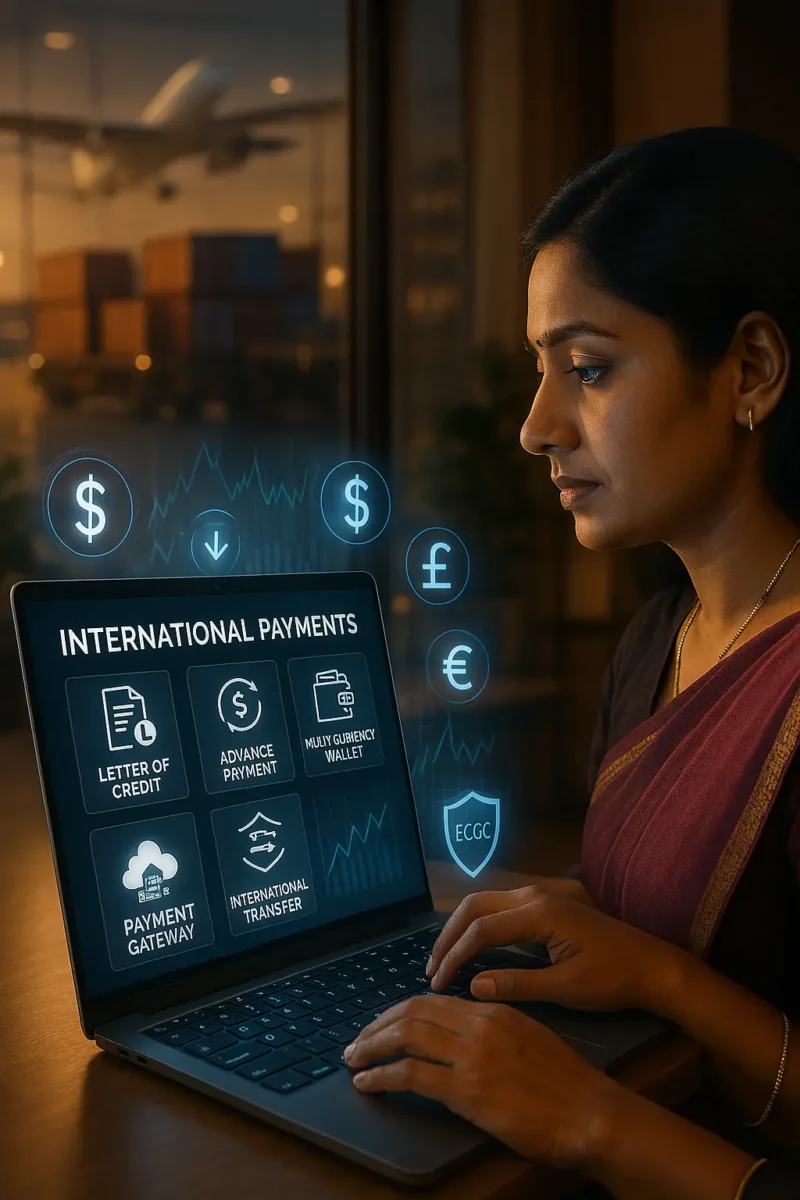
Choosing a suitable payment method helps lower financial and foreign exchange risks in exports. Options like Letters of Credit and Advance Payments, among others, offer varying levels of security when dealing in foreign currency transactions.
When exporting through eCommerce, the payment settlement methods can be classified as follows:
- Integrated payment services by eCommerce platforms (supporting multi-currency and foreign exchange transactions)
- Online payment gateway service providers that process payments in foreign currencies
- International money transfer services through agents, useful for foreign currency conversions and settlements
Protect yourself against non-payment and other uncertainties by leveraging export insurance coverage such as the one offered by ECGC (Export Credit Guarantee Corporation), especially for transactions involving foreign currency risk.
Manage foreign exchange risks through forward contracts or hedging instruments to stabilize revenue and protect against currency fluctuations.
Export factoring for SMEs in India
Exporting goods from India can be proved to be quite challenging, especially when you are dealing with importers you don’t really know or haven’t verified. It can feel like you’re entering into the unknown, and that’s where things can get tricky. But here’s a thought: what if you could pass on the risk of not getting paid to someone else? That’s exactly what export factoring firms are for. By selling your export trade receivables to them, you get paid quickly, freeing up cash to tackle your next export order. It’s like having a safety net, which keeps you away from the constant worry of payment uncertainties.
Support and Resources for SMEs
The big question? Why is it the perfect time to start exporting from India as a small and medium sized business.
The Indian government is offering extensive support to SMEs. Several government bodies have been established to offer export assistance for small businesses. They aim to ease their path to international success through initiatives like Export Promotion Councils (EPCs) and DGFT’s schemes.
Government Schemes and Benefits for SMEs in India
What are these schemes and what do they offer?
- Export Promotion Capital Goods (EPCG): Enables duty-free import of capital goods for export production.
- Merchandise Export from India Scheme (MEIS): Offers incentives to offset infrastructural inefficiencies.
- Market Access Initiative (MAI): Provides financial assistance for market research and trade promotion activities.
- Grants and subsidies under programs like Make in India
Private Support Services
Platforms such as Amazon Seller Central offers tools to simplify exporting.
- Need documentation assistance. Amazon’s Export Compliance Dashboard is all you would need.
- Say ‘Hi’ to Amazon FBA for hassle-free logistics management.
Financial Assistance
- Export Credit Guarantee Corporation (ECGC): Protects against export payment risks.
- Bank Loans: Avail pre-shipment and post-shipment financing to manage working capital.
No doubt, export is filled with challenges, including logistical delays, tariff barriers, and fluctuating markets. SMEs can address these by staying informed about trade regulations and leveraging the benefits offered by government policies.
Why Exporting is Vital for SMEs
While SMEs often prioritise local markets but diversifying into international markets provides many benefits. Some of these are as follows:
- Increased Revenue Streams: Access to a broader customer base.
- Improved Brand Visibility: Boost your credibility by increasing your international presence.
- Reduced Market Dependency: Diversifying markets mitigates risks from local economic fluctuations.
Conclusion
Starting your international trade journey can be both exciting and challenging. Remaining up-to-date with compliance and regulations can help you better leverage government benefits and private support systems.
With proper planning, you can successfully establish your global footprint and take your local business to new heights. Now that you know how to export goods from India, do not wait and start acting.
Ship smart and stay informed.
Happy Shipping!
FAQs
Begin by researching target markets, identifying the right export products, and understanding export regulations. Start by obtaining an IEC, followed by other necessary documents, and leverage the government benefits for SMEs.
Exporters can benefit from schemes like EPCG, MEIS, and services from ECGC for credit insurance and financing.
Products like textiles, spices, artificial jewellery, and herbal products are highly sought after in global markets.
Stay informed about trade regulations in target markets and utilise resources like the Export Compliance Dashboard (from Amazon) for assistance.