
AI Overview: Product Tagging in Ecommerce SEO
In ecommerce, visibility isn’t just about having great products, it’s about making sure the right people find them at the right moment. While most brands focus heavily on keywords, backlinks, and content, there’s a lesser-known lever that can quietly drive significant impact: product tagging.
When implemented strategically, product tagging transforms from a simple organizational tool into a powerful SEO multiplier. It enhances search engine understanding of your catalog, improves on-site navigation, and supports virtually every core SEO ranking factor — all without feeling “SEO-heavy”.
In short, smart tagging bridges the gap between discoverability and conversion, helping your ecommerce site rank better, perform faster, and serve shoppers smarter.
In ecommerce, visibility isn’t just about having great products it’s about making sure the right people can find them at the right moment. While most brands focus on keywords, backlinks, and content, one powerful SEO lever often flies under the radar: product tagging.
When implemented strategically, ecommerce product tagging becomes much more than an organizational tool. It directly influences ecommerce SEO, improves user experience, and helps search engines understand your catalog at a granular level. In fact, product tagging can quietly support almost every major SEO ranking factor without feeling “SEO-heavy” at all.
Let’s explore exactly how and why this works.
Understanding Product Tagging Beyond Basics
Many ecommerce teams think of product tags as simple labels: color, size, brand, or price. But modern product tagging is far more sophisticated.
Effective tagging captures:
- Functional attributes (material, fit, durability)
- Behavioral intent (occasion, use case, lifestyle)
- Search-driven descriptors (popular modifiers users type into Google)
- Contextual relationships between products
When combined, these tags act as connective tissue across your site, shaping how products are grouped, discovered, and indexed.
🚀 The SEO Foundation: Why Search Engines Love Tags
Tags help bots understand your products like humans do—only better.
Search engines don’t “see” products the way humans do. They rely on structured information to determine relevance. This is where ecommerce SEO and tagging intersect.
🔖 Tags Help You:
- Clarify topical relevance 📚
- Reinforce keyword context (without stuffing) 🧠
- Create scalable internal links 🔗
- Support semantic search understanding 🧩
🧠 In short: Tagging translates your product catalog into a language search engines understand fluently.
Driving Product Discoverability Improvements at Scale
One of the most immediate benefits of ecommerce product tagging is product discoverability improvements.
Without tagging, products are limited to:
- One primary category
- A single optimized product page
With tagging, the same product can appear across:
- Multiple filtered category views
- Themed landing pages
- Related product modules
- Tag-based collections
Each of these touchpoints creates additional discovery paths both for users and search engine crawlers. This dramatically expands the number of ways a product can be found organically.
Enhancing Metadata and Product Attributes for SEO Precision
Strong metadata and product attributes are essential for ranking but writing unique metadata manually for thousands of SKUs is unrealistic.
Product tags solve this by:
- Feeding dynamic metadata generation
- Standardizing attribute usage across the catalog
- Aligning titles and descriptions with real search modifiers
For example, tags like “vegan leather,” “slim fit,” or “summer wear” can be programmatically integrated into meta titles and descriptions, improving relevance without duplication.
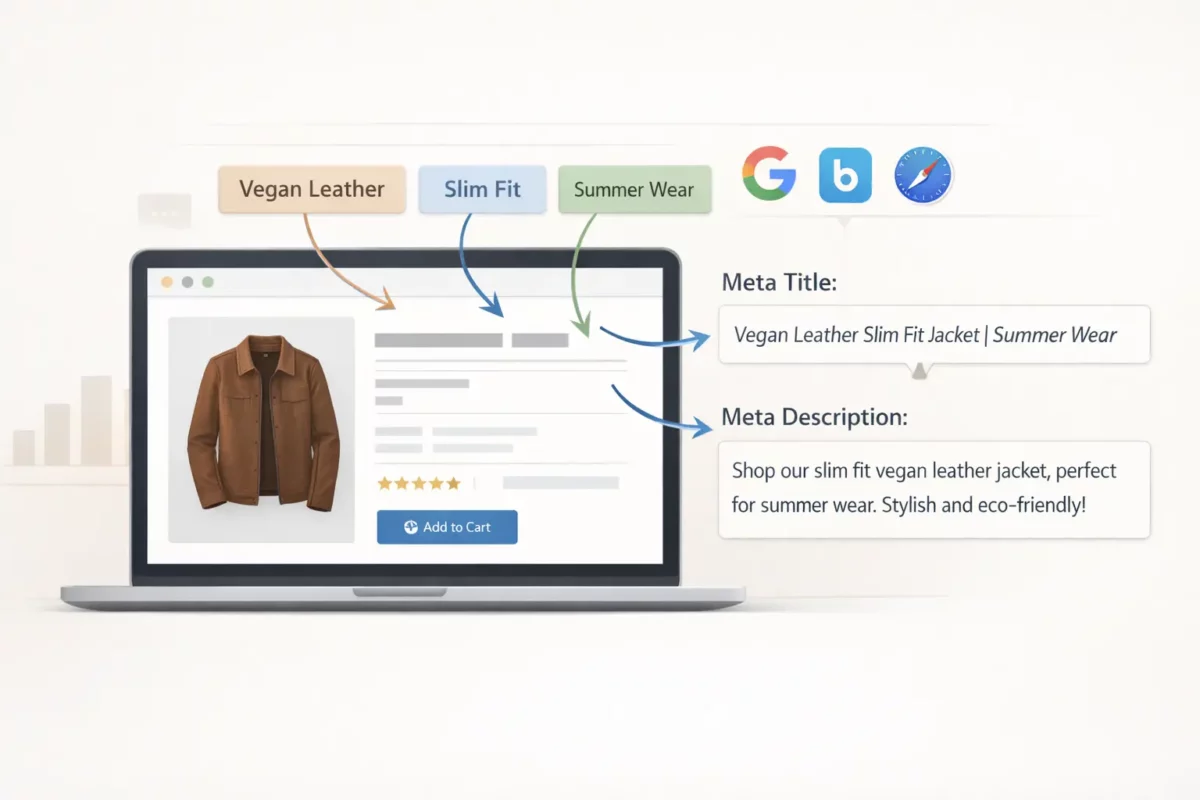
Search engines reward this clarity with better crawl efficiency and stronger keyword alignment.
Unlocking Internal Site Search Optimization
Internal search is often one of the highest-converting channels on an ecommerce site, but only if it works well.
Internal site search optimization relies heavily on accurate tagging because:
- Search queries map directly to tags
- Filters depend on tag logic
- Autocomplete suggestions draw from tag data
When users find what they want faster, they engage more deeply. This results in:
- Lower bounce rates
- Higher dwell time
- Increased conversion rates
All of these user engagement signals indirectly support SEO performance, reinforcing your site’s authority and relevance.
✨ Tag Structure = SEO Magic
Turn chaos into clarity—because smart tags = better rankings!
❌ When Tags Go Wrong:
- Duplicate content 🤯
- Keyword cannibalization 🥴
- Crawl budget waste 💸
✅ When Tags Are Strategic:
- Clear purpose 🎯
- Consistent naming 🧩
- Targets search intent 🔍
💡 SEO Tip: Clean taxonomy boosts crawlability, builds topical relevance, and future-proofs your rankings. Structure wins.
Scaling with Automated Product Tagging with AI
As catalogs grow, manual tagging becomes unsustainable. This is where automated product tagging with AI delivers enormous SEO value.
AI-powered systems can:
- Analyze product descriptions, specs, and images
- Identify missing or inconsistent tags
- Apply tags based on search behavior patterns
- Continuously refine tags as trends change
This automation dramatically improves tagging coverage and consistency, which in turn enhances product categorization accuracy across large inventories.
Improving Product Categorization Accuracy for Better Rankings
Accurate categorization is essential for both users and search engines.
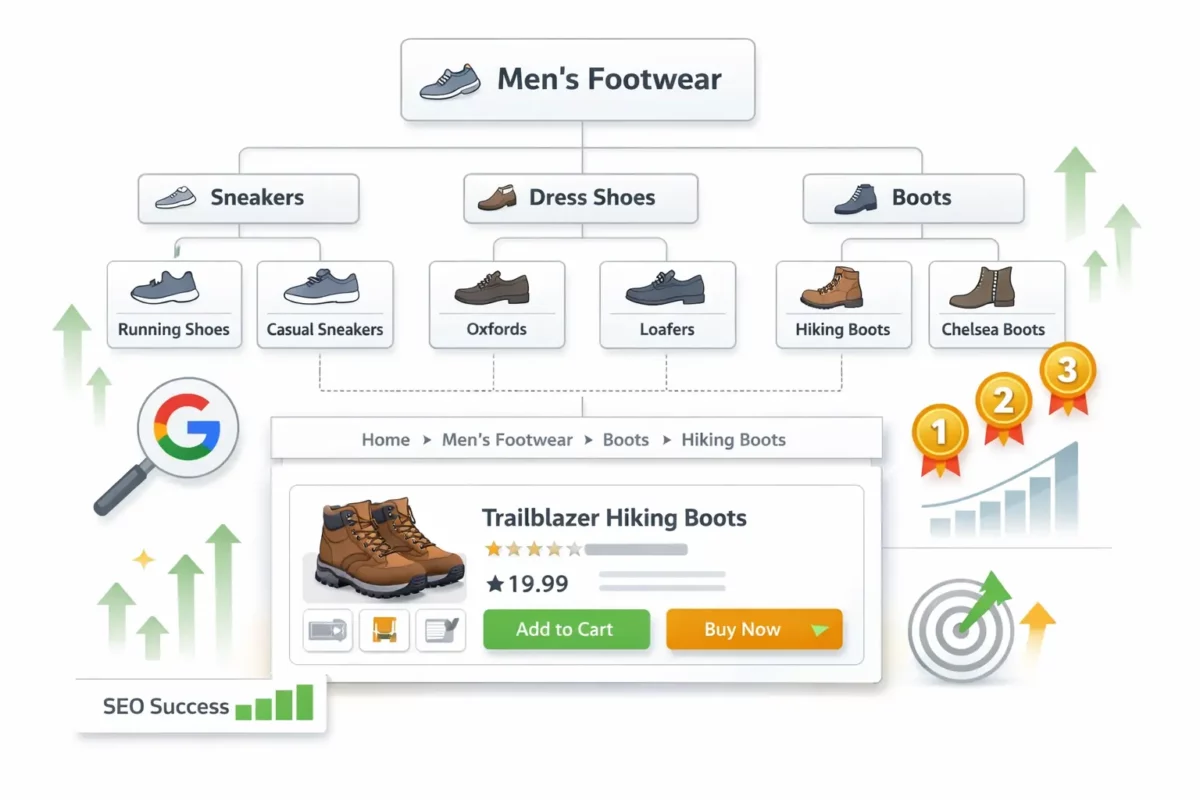
When product categorization accuracy is high:
- Category pages become more authoritative
- Breadcrumbs provide clearer context
- Product relationships make logical sense
Search engines use this contextual clarity to understand how products relate to broader themes, which strengthens topical authority and improves ranking potential across entire categories, not just individual products.
Reinforcing SEO Ranking Signals for Products
While tags may seem subtle, they influence several critical SEO ranking signals for products, including:
- Internal link distribution
- Keyword relevance
- Content depth
- Semantic relationships
Tags help products inherit authority from categories and collections, rather than standing alone. This interconnected structure signals quality, depth, and relevance factors search engines increasingly prioritize.
Winning with Long-Tail Search Through Tagging
Perhaps the most powerful advantage of product tagging is improving relevance for long-tail keywords.
Long-tail queries are:
- Highly specific
- Strongly intent driven
- Less competitive
- More conversion focused
Product tags naturally capture these nuanced descriptors without forcing them into copy that feels unnatural. Over time, your site begins ranking for hundreds or thousands of highly relevant long-tail searches that competitors miss.
This creates a compounding SEO effect: more qualified traffic, better engagement, and higher revenue per visitor.
Best Practices to Maximize Ecommerce Product Tagging SEO
To get the most from your tagging strategy:
- Base tags on real keyword and search data
- Avoid over-tagging or vague labels
- Audit and consolidate duplicate tags
- Ensure tags enhance, not replace, categories
- Align tagging with content, UX, and SEO teams
When product tagging is treated as a strategic SEO asset, rather than just a backend task, it becomes a long-term growth engine.
Final Thoughts
In today’s crowded digital marketplace, winning at ecommerce SEO requires more than surface-level optimization. Product tagging gives you a scalable, flexible, and search-friendly way to connect users with products while sending powerful relevance signals to search engines.
From product discoverability improvements and internal site search optimization to automated product tagging with AI and improving relevance for long-tail keywords, tagging quietly supports every layer of ecommerce success.
If SEO is about being understood, product tagging ensures your store speaks clearly at scale.
FAQs for How Product Tagging Improves Ecommerce SEO
Product tagging assigns descriptive labels to products based on attributes and use cases, helping improve organization, discoverability, and ecommerce SEO.
It helps search engines understand products better by strengthening metadata and product attributes, internal linking, and relevance signals.
Yes, proper tagging drives product discoverability improvements by allowing products to appear in filters, collections, and internal search results.
Categories define structure, while tags add flexibility. A strong tag structure and taxonomy ensures both work together without SEO issues.
Accurate tags improve internal site search optimization by matching user queries with relevant products faster.